This article is published in Aviation Daily part of Aviation Week Intelligence Network (AWIN), and is complimentary through Mar 06, 2026. For information on becoming an AWIN Member to access more content like this, click here.
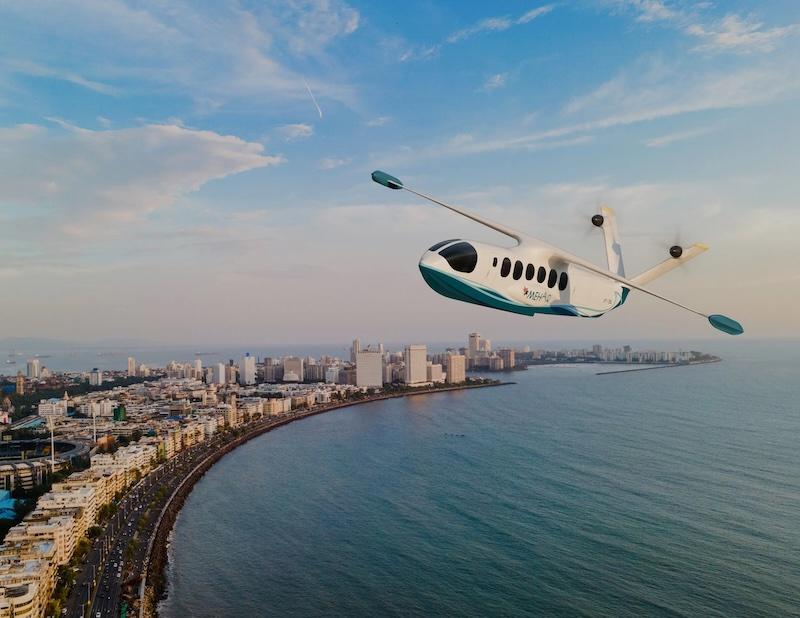
SINGAPORE—Virginia-based startup Tidal Flight has scooped orders and options for up to 10 of its nine to 12-passenger hybrid-electric Polaris amphibian aircraft from Indian seaplane operator Maritime Energy Heli Air Services (Mehair).
Under a memorandum of understanding signed at the Singapore Airshow, Mehair placed firm orders for five Polaris aircraft, plus five options. The Indian carrier, which operates a fleet of Cessna Caravan 208 floatplanes, aims to use the Polaris on regional coastal air services in support of a government-backed connectivity program under which Mehair has been awarded 92 seaplane routes.
So far, Tidal has flown two one-sixth-scale prototypes to prove out the hull design, says Tidal CEO Jude Augustine. “We're bringing modern monohull seaplane technology to the table for a type of design that’s not really been updated since the 1960s, so there's a lot of opportunity to improve the aerodynamic performance,” he adds.
Early development work has also included towing tank testing. “This, combined with flight testing, has given us the data to inform the hull design. So that's been a great milestone for us,” says Augustine, who adds that full-scale subsystems are now under construction, along with the first full-scale hybrid powertrain.
“We're taking delivery of engines and motors next month and driving some of that forward,” Augustine says. Development is taking place at the company’s Chesapeake Regional Airport facility in Hampton Roads, Virginia.
The aircraft’s hybrid-electric system is based on two aviation-certified, Jet-A-burning compression ignition diesel engines from Wisconsin-based DeltaHawk. “They're acting as generators in the aircraft, so they're not mechanically shafted to the propellers. We've also got a battery pack that is sized to provide full takeoff power. So, you can do harbor operations, takeoffs, landings, all fully electric with the engines off,” he adds.
Designed for missions between 100 mi. and 500 mi., the Polaris will have a maximum takeoff weight (MTOW) of 12,500 lb. and a cruise speed of 162 kt. at 7,000-ft. altitude. Measuring 59 ft. in length and with a 59-ft. wingspan, the Polaris will be capable of carrying a 3,100-lb. payload.
“We're also building the full-scale iron bird for our aircraft. We have the full iron bird structure erected, and we have some of the actuators, and those components are starting to be integrated,” he says.
First flight of the full-scale prototype is targeted for 2028, with certification in 2030. Although Augustine acknowledges this goal is “aggressive,” he adds: “We think we can be confident because we are just a simple fixed-wing seaplane, and the FAA has confidence certifying fixed-wing seaplanes. It's something that there's a strong Part 23 certification basis for.”
“The big area of novelty is, of course, the hybrid powertrain,” Augustine says. “That's why we're prioritizing the development of the hybrid powertrain so we can interface with the regulators and their engineers on the safety case as early as possible and reduce the risk on timeline.”