This article is published in Aviation Daily part of Aviation Week Intelligence Network (AWIN), and is complimentary through Mar 10, 2026. For information on becoming an AWIN Member to access more content like this, click here.

Airbus Pushes For More A220 Sales In Asia Pacific At Singapore

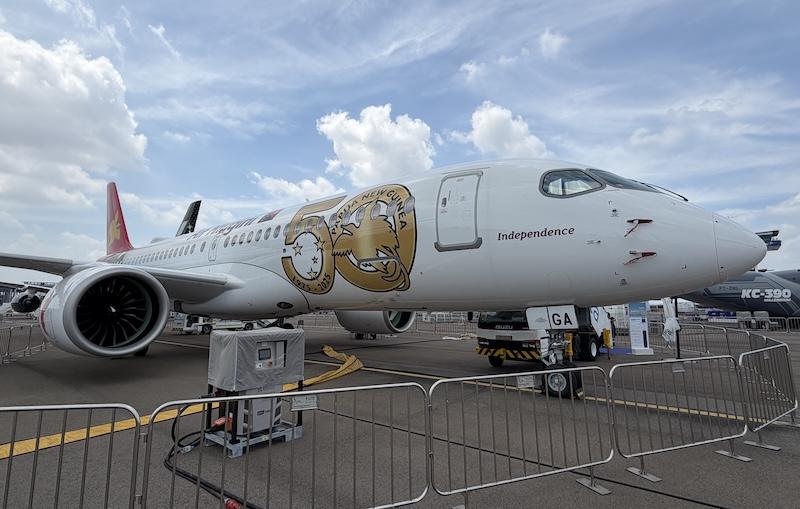
Air Niugini A220
Credit: Guy Norris/Aviation Week

SINGAPORE—Airbus is convinced it will be able to sell a lot more A220s in the Asia-Pacific region as airlines enter their next phase of route development. 

“We see a strong potential for the A220 in the region,” says Joost van der Heijden, an Airbus senior vice president, on the sidelines of the Singapore Airshow.

Airbus so far has delivered only 21 A220s to airlines in the Asia-Pacific region: 11 to Qantas Airways and 10 to Korean Air. There are currently orders in place for 19 more. The global backlog for the A220 is 467 aircraft, meaning the region is significantly underrepresented when measured against its share in the overall Airbus backlog of around one-third.

The company is understood to be finalizing an order for 100 A220s with AirAsia, though no announcement is expected at the Singapore Airshow, according to industry sources. That commitment has been in the works for a long time, and a deal has been expected at various instances but has not yet been concluded.

“The A220 has transformed route networks in the U.S. and Europe,” van der Heijden says. “It has made long, thin routes viable.” Van der Heijden argues that the aircraft “can do the same in Asia-Pacific.”

Airbus is observing that more secondary routes are being opened. But in Asia-Pacific, secondary does not mean short. In fact, van der Heijden stresses that the A220 has a competitive advantage over the Embraer E2 in this market because of its greater range capabilities.

However, Embraer has placed the E2 with several carriers in the region, notably Singapore Airlines affiliate Scoot, which is currently flying nine aircraft.

Van der Heijden believes that 550 additional routes are possible with the A220 that are too thin for larger narrowbodies.

Airbus has one Air Niugini A220-300 on display at the show.

Similarly, van der Heijden highlights the potential of the A321XLR, for which Airbus has identified 850 potential routes in Asia-Pacific. 

Unlike for the A220, the sales campaign is well on its way, with IndiGo having taken delivery of its first XLRs and Air India just having announced that it has converted 15 orders for the standard A321neo to the XLR version. Its range enables the aircraft to fly long-haul sectors that are too thin for widebodies, Airbus says. Van der Heijden pointed to routes such as Manila-Mumbai or Perth-Shanghai that are made possible by the type.

Overall, Airbus has 5,000 aircraft in service in Asia-Pacific; the order backlog for airlines in the region stands at 3,100. In relative terms, the A350-1000 has been particularly successful, as customers in the region control 52% of the global backlog of what is currently the largest A350 variant. Van der Heijden said the aircraft is benefitting from retirements of Boeing 777-300ERs, among other factors. 

Many airlines that commit to the A350-1000 are equipping it with a first-class cabin. To enable different cabin layouts, Airbus has decided to move one lavatory out of the passenger section and into the front center monument. That way, more space is freed up for additional features such as a small dressing room in the center suite that some airlines are installing.

Jens Flottau

Based in Frankfurt, Germany, Jens is executive editor and leads Aviation Week Network’s global team of journalists covering commercial aviation.