This article is published in Aviation Daily part of Aviation Week Intelligence Network (AWIN), and is complimentary through Mar 09, 2026. For information on becoming an AWIN Member to access more content like this, click here.

Embraer Looks For Further E2 Gains In Asia-Pacific Region

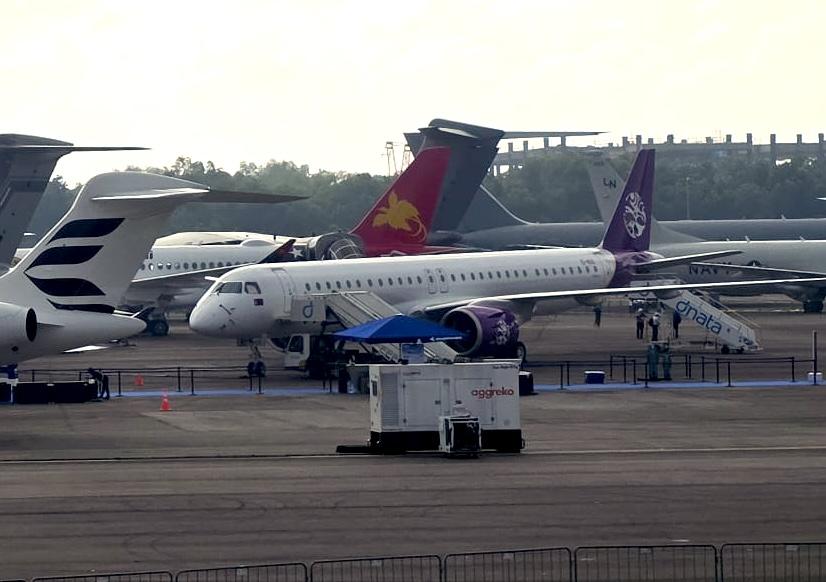
Hunnu Air E2

A Hunnu Air Embraer E195-E2 on the static at the 2026 Singapore Airshow.

Credit: Chen Chuanren/Aviation Week

SINGAPORE—Embraer believes that its success in securing high-profile customers for its E2 jets in a handful of key Asia-Pacific markets will help generate more demand in the region for the jet.

Scoot and Virgin Australia operate E2 jets, and All Nippon Airways has them on order, notes Raul Villaron, Embraer's senior VP of sales and marketing and head of region for Asia-Pacific, on the eve of Singapore Airshow

This gives the jets good visibility in Northeast Asia, Oceania and Southeast Asia, Villaron says. “We now have really strong [customer] brands in different parts of Asia-Pacific.”

Scoot took delivery of the last of its nine E2 deliveries in December. Embraer is hoping to win more orders from the Singapore Airlines subsidiary, Villaron says.

In Japan, ANA last year ordered 15 E190-E2s. This was significant as it was ANA’s first Embraer order.

The Japan Airlines group is an existing Embraer customer, and has stated it is considering placing a regional aircraft replacement order. Embraer is “very keen” to retain its presence in the JAL fleet and add the carrier as an E2 customer, Villaron says.

Japan has almost 50 Embraer aircraft in operation thanks to the JAL group and smaller carrier Fuji Dream.

There is also significant potential for more orders in the Australian market, Villaron says, as there are already five carriers there operating Embraer aircraft of various models. There is also a sizable number of older regional jets from other manufacturers that will eventually need replacement.

Villaron projects there could be a total of 200 Embraer aircraft operating in Australia by 2030.

The manufacturer is looking to grow in other parts of the Asia-Pacific region, too. Villaron notes Embraer's big push in the Indian market, having last month signed a partnership agreement with Adani Defense and Aerospace. “We see India as one of the largest and fastest-growing markets in the world, and we want a piece of that.”

There are an estimated 400 city pairs in India that are currently not served because they are “too long for turboprops and too thin for narrowbodies,” Villaron says.

E2s will play a large role in replacing the 800 turboprops in the Asia-Pacific region, he adds, arguing that the E2s are faster, have more capacity and greater range.

Another factor is that as more carriers upgauge their narrowbody fleets to larger variants, it opens a gap between turboprops and narrowbodies, Villaron says. Adding E2s to the mix gives them more network flexibility.

Adrian Schofield

Adrian is a senior air transport editor for Aviation Week, based in New Zealand. He covers commercial aviation in the Asia-Pacific region.