This article is published in Aviation Daily part of Aviation Week Intelligence Network (AWIN), and is complimentary through Feb 11, 2026. For information on becoming an AWIN Member to access more content like this, click here.

OEMs, Suppliers Must Adapt For Advanced Aircraft Types—Panel

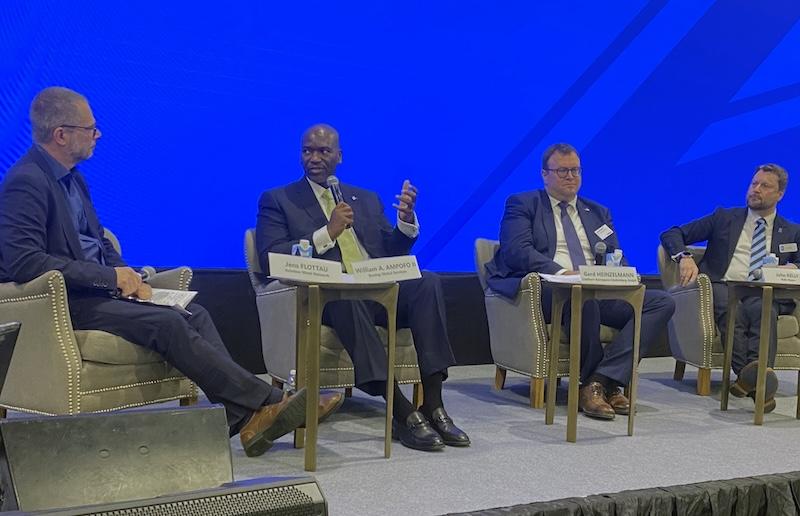
panelists at singapre airshow

Panelists on stage during the Singapore Airshow. From left: Jens Flottau, William Ampofo, Gerd Heinzelmann and John Kelly.

Credit: Adrian Schofield/Aviation Week

SINGAPORE—New approaches and technology will help aircraft manufacturers adjust to supply chain challenges that will emerge with more complex, next-generation aircraft types, according to a panel of industry experts at the Singapore Airshow.

New widebody and long-range aircraft types will pose questions for the industry because quantities of advanced materials and components needed are often not large enough to dual-source, said Gerd Heinzelmann, managing director for Liebherr-Aerospace Lindenberg.

“In principle, the challenges are similar to the current ones, but we are moving away from more simple technology that can be done by a wide supply chain into a very specific one,” Heinzelmann said.

In many cases, the new technologies are limited by the amount of sources that are approved or available now, Heinzelmann said.

New techniques and innovations in automation and robotics are examples of how technology can be harnessed to meet evolving products, said John Kelly, Rolls-Royce senior vice president of customers for Asia-Pacific. “Embedding that into our industrial footprint makes us more competitive and more resilient, not just to manage today’s supply chain, but to scale up for what the ... supply chain requirements are into the future.”

Heinzelmann said supplier relationships may need to look different in the future. As one example, a portion of airline advance payments to manufacturers could be allocated to suppliers, particularly for products with long lead times. In this way, “different levels of the supply chain can take different responsibility.”

This is an issue that has been discussed for many years, said William Ampofo, Boeing senior vice president for parts, distribution and supply chain for Boeing Global Services. One example of how Boeing is assisting some of its suppliers is that Boeing will invest in buying raw materials in advance, “so they’re not burdened with going to buy the raw material that is going into the product that we have to buy.”

“So that’s a capital infusion that is worth the investment for us, because it ensures that we have stable flow and supply,” Ampofo said.

Boeing focuses on “bringing our technical capability to bear to make sure that they’re ready [for] the requirements we have.” But he stressed that Boeing “is not above … helping from a financial capital and future perspective,” Ampofo said. The company has done more of this since the pandemic, because some of these second- and third-tier suppliers in particular “were under-capitalized and were struggling.”

Looking ahead, there is the possibility that OEMs may have to do more risk and revenue sharing, Ampofo said. He noted that the buying power of the OEMs is a lot stronger than the smaller suppliers, “So you could do some of the buying … on behalf of your suppliers,” particularly with raw materials.

Kelly said Rolls has also been getting more involved with its suppliers. “Our approach has always been: What can we do? What can we do to take responsibility? How can we be accountable for solving this and ... leaning into the supply chain to improve the resilience.”

Adrian Schofield

Adrian is a senior air transport editor for Aviation Week, based in New Zealand. He covers commercial aviation in the Asia-Pacific region.

Singapore Airshow 2026

For all the latest news live from Singapore Airshow, visit our Airshow News site section.