This article is published in Aviation Daily part of Aviation Week Intelligence Network (AWIN), and is complimentary through Mar 20, 2026. For information on becoming an AWIN Member to access more content like this, click here.
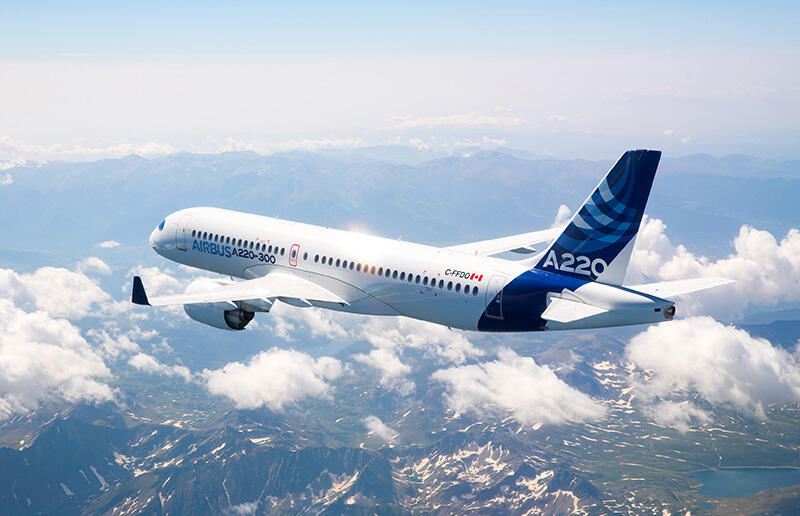
The A220-300 seats up to a maximum of 160 passengers whereas a -500 could accommodate 180 in a standard layout.
SAN DIEGO—The idea of a stretched version of the Airbus A220 is getting more public support from key customers.
“The A220-500 would be very interesting,” Air Canada’s CFO John Di Bert said at the International Society of Transport Aircraft Trading (ISTAT) Americas conference in San Diego. “It could be a good aircraft.”
“I think they should launch it and I think they will,” Azorra President Ron Baur added. “It looks like it is gaining momentum. Airbus wants to invest in the program, which is a good thing.”
Both Azorra and Air Canada are large A220 customers. Florida-headquartered lessor Azorra has been focusing on the A220 and the Embraer E2 in building up a latest-generation small narrowbody fleet. Air Canada has 42 A220s in service, according to Aviation Week’s Fleet Discovery database, and is awaiting delivery of 23 more.
Airbus has been considering the timing of launching a stretch, which was part of Bombardier’s original plans when the aircraft was still called the CSeries, for some time. Airbus Americas Chairman and CEO Robin Hayes said at the ISTAT event that the company is “spending a tremendous amount of time” on the A220-500 as well as the proposed stretch of the A350.
Earlier, key customers such as Air France, Delta Air Lines and Lufthansa have been pushing Airbus to launch the A220 stretch, which would likely feature around 180 seats in a single-class layout.
The range requirements are still subject to debate, however. Typically, in a simple stretch with no major modifications to fuel capacity or wings, an aircraft will lose some range. Airbus has been discussing internally whether the larger -500 should feature the same range as the -300 (around 3,400 nm, or 3,900 mi.) or whether less—and how much less—would be acceptable. Historically, U.S. airlines have been interested in having transcontinental narrowbody range, a capability that European carriers do not need and do not want to pay for.
“They would probably have to keep it simple,” Di Bert said. However, he also suggested that “a bit more range along with more seats would be helpful in our case.” Di Bert pointed out that the A220-300 fits the Canadian market particularly well because it can cover its large geography in spite of its relatively small size.
“I am a big believer in stretches. They have really good economics,” Baur said. “A stretched A220 would compromise range, but if the range is good enough it could be a really effective aircraft. It will never replace the A320 or the [Boeing] MAX 8; it will complement them.”
Baur is “in the camp of a simple stretch” even if that means shorter range. He does not think that U.S. airlines would need it for transcontinental operations, which would largely remain the territory of the A320neo or 737 MAX families.
Baur believes that the A220-500 would cannibalize some of the A320neo market, but that would also free up more capacity for Airbus to produce the A321neo for which there is the bulk of demand.
For a lessor such as Azorra that has been focusing on the smaller narrowbodies, the stretch would be an opportunity to expand its customer base to operators seeking larger aircraft.
“There would be demand from some airline customers,” said John Mowry, managing director at Alton Aviation Consultancy. “The risk is that it displaces demand for the A320neo,” he added. Therefore, he considers the step to launch “a big strategic decision.”