This article is published in Aviation Week & Space Technology and is free to read until Mar 21, 2026. If you want to read more articles from this publication, please click the link to subscribe.
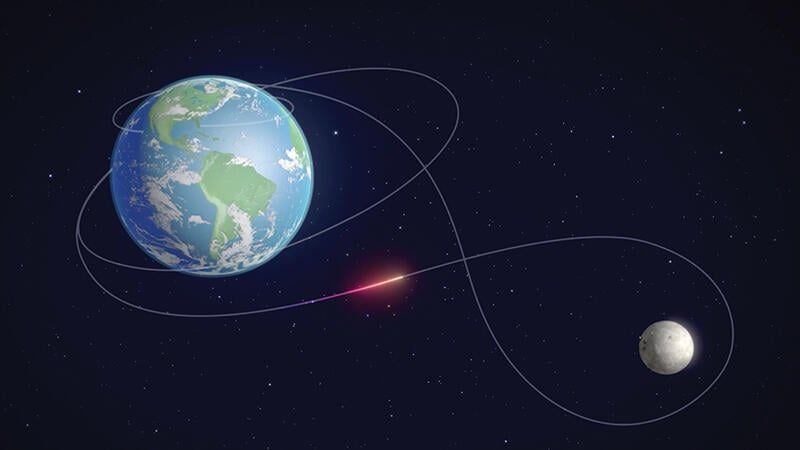
Following a checkout in high Earth orbit, the Orion spacecraft will fire its engines to put itself on a path toward the Moon. The burn sets up the free-return trajectory for Orion’s splashdown eight days later.
NASA used its first Space Launch System rocket to send an uncrewed Orion spacecraft on a 25-day test flight around the Moon in late 2022, kicking off its Artemis lunar exploration campaign.
On Artemis II, the agency will attempt to broaden Orion’s operational envelope by adding a flight crew, with assessments of the spacecraft’s environmental control, life support and astronaut interactive systems on tap. The mission is expected to pave the way for Artemis III in 2028 and the return of astronauts to the lunar surface.
Orion got its first taste of space during a two-orbit, 4.5-hr. flight test in December 2014, launching aboard the now-retired United Launch Alliance Delta IV Heavy. Eight years later, another Orion capsule launched aboard a Space Launch System (SLS) rocket and flew in a distant retrograde orbit around the Moon before making a Mach 32 reentry into Earth’s atmosphere to test the spacecraft’s heat shield and parachute landing system.
Work to understand unexpected heat shield wear on that mission, Artemis I, delayed the follow-on crewed Artemis II flight test, which is now targeted to launch this spring.
In addition to testing Orion’s life support systems, flight control software and data displays, the Artemis II crew will manually control Orion for a rendezvous proximity demonstration using the SLS’ discarded upper stage. The exercise is intended to test how the capsule will function when it departs from the SpaceX Human Landing System on Artemis III.
The SLS is to launch Orion into a low Earth orbit, then use its upper stage to boost the capsule into an elliptical, high Earth orbit for the proximity operations demo and checkout of the spacecraft’s systems while it is still relatively close to Earth. If Orion is in good health, its European Space Agency-provided service module will conduct a translunar injection (TLI) burn for a four-day journey to the Moon.
The TLI burn, targeted for 25 hr. 37 min. after launch, is planned to send the Artemis II crew more than 230,000 mi. from Earth and 6,400 mi. beyond the Moon’s far side in a figure-eight flight trajectory. The TLI burn also sets up the four-day journey back to Earth, which will rely largely on the gravitational forces of the Moon and Earth for propulsion.