This article is published in Aviation Week & Space Technology and is free to read until Mar 20, 2026. If you want to read more articles from this publication, please click the link to subscribe.
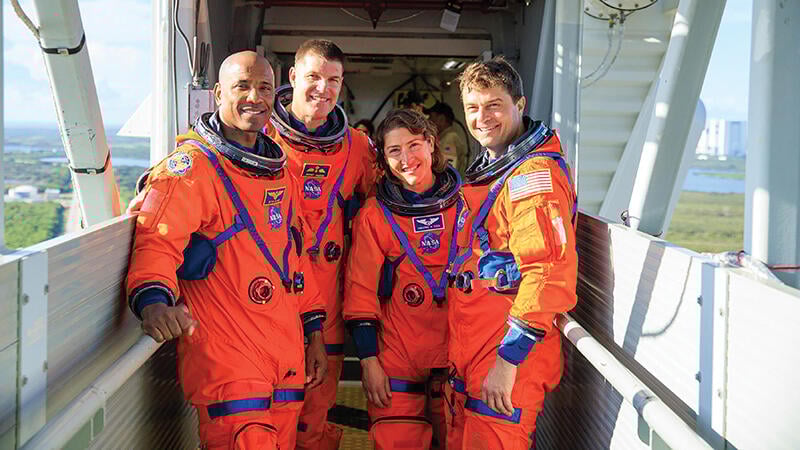
Artemis II astronauts (from left) Pilot Victor Glover, Mission Specialist Jeremy Hansen, Mission Specialist Christina Koch and Commander Reid Wiseman have been training since 2023 for NASA’s first crewed flight into deep space since 1972.
Fifty-eight years ago, Apollo 8 astronauts Frank Borman, Jim Lovell and William Anders became the first humans to leave the gravitational bonds of Earth orbit and circle around the Moon. Emerging from the far side, they shared what became an indelible image of Earth rising over the lunar horizon. The mission paved the way for a series of lunar landing sorties that established U.S. technological preeminence, created new branches of science and earned NASA global renown.
The U.S. civilian space agency is once again on the threshold of sending astronauts into deep space, this time under the Artemis program, which comprises international partners and a diverse four-member crew, including one with no previous spaceflight experience.
If plans hold, the mission, known as Artemis II, will take its place in history as the Apollo 8 of its era. Here is a look at the crew.
Gregory Reid Wiseman
Wiseman, 50, is a retired U.S. Navy captain, NASA’s former chief astronaut and the Artemis II commander. A native of Baltimore, Wiseman earned a bachelor of science in computer and systems engineering from Rensselaer Polytechnic Institute, a master of science in systems engineering from Johns Hopkins University and a certificate in space systems at the U.S. Naval Postgraduate School in Monterey, California.
As a member of the Reserve Officers’ Training Corps, upon graduation Wiseman was commissioned into the Navy and became a naval pilot. He served with Fighter Sqdn. 31 and deployed twice to the Middle East in support of Operations Southern Watch, Enduring Freedom and Iraqi Freedom.
Wiseman then was selected to attend the U.S. Naval Test Pilot School in Maryland. He graduated in 2004 and served as a test pilot and project officer with Air Test & Evaluation Sqdn. VX-23, working on flight-test programs involving the Lockheed Martin F-35 Lightning II and other aircraft. Later, as strike operations officer for Carrier Air Wing 17, Wiseman completed a deployment around South America. His final Navy assignment before joining the NASA astronaut corps was flying the Boeing F/A-18F Super Hornet with Strike Fighter Sqdn. 103.
Selected as a NASA astronaut in 2009, Wiseman completed two years of training and was assigned as a flight engineer for International Space Station (ISS) Expedition 40/41, which launched aboard a Russian Soyuz rocket in May 2014. During his 5.5 months aboard the ISS, he participated in more than 300 science experiments and conducted two spacewalks.
Upon his return, Wiseman served in leadership roles at NASA, including chief of the Astronaut Office in 2020-22. He returned to active status and was publicly named to head the Artemis II crew in April 2023.
“We feel like this is an Apollo legacy, but the four of us are standing on the shoulders of the International Space Station—the science, the research, the long-duration exposure that we have learned there,” Wiseman told reporters as the Space Launch System rocket and Orion spacecraft rolled out to Kennedy Space Center Launch Complex 39B on Jan. 17.
Victor J. Glover
Glover, 49, serves as the pilot for Artemis II. Like Wiseman, Glover was a naval aviator and test pilot prior to joining NASA. A native of Pomona, California, Glover attended California Polytechnic State University in San Luis Obispo, where he earned a bachelor of science in general engineering. He also holds master of science degrees in flight test engineering from the U.S. Air Force Test Pilot School, systems engineering from the Naval Postgraduate School and military operational art and science from Air University in Montgomery, Alabama.
Glover also completed a space systems certificate from the Naval Postgraduate School and a certificate in legislative studies from Georgetown University while serving as a Navy legislative fellow in the U.S. Senate.
As a Navy pilot, Glover trained and flew the Boeing F/A-18C Hornet and went on to serve with Strike Fighter Sqdn. VFA-34 in support of Operation Iraqi Freedom. Selected as a Navy exchange pilot to attend the Air Force Test Pilot School, Glover flew more than 30 aircraft types and was designated a test pilot in 2007. He then served with Air Test and Evaluation Sqdn. VX-31, evaluating weapon systems on the F/A-18 series and Boeing EA-18G Growler.
During his naval career, Glover logged more than 3,500 flight hours in more than 40 aircraft and completed over 400 carrier arrested landings and 24 combat missions.
Glover was selected to become an astronaut in 2013. His first space-flight was as the pilot for SpaceX Crew-1, the first operational mission of the SpaceX Crew Dragon spacecraft, which launched to the ISS in November 2020. He spent 168 days in orbit and completed four spacewalks.
“We’re still learning things from the Apollo era,” Glover said. “It’ll be nice to take the baton, run our best race and then hopefully pass that baton on to the Artemis 100 group.”
Christina Hammock Koch
Koch, 47, one of two mission specialists for Artemis II, was born in Grand Rapids, Michigan, and grew up in Jacksonville, North Carolina. She attended the North Carolina School of Science and Mathematics in Durham, graduating in 1997, and then earned bachelor of science degrees in electrical engineering and physics, followed by a master of science in electrical engineering and an honorary doctorate from North Carolina State University in Raleigh.
She began her career as an electrical engineer at NASA’s Goddard Space Flight Center, working on instrument development for astrophysics and cosmology missions. She participated in science expeditions, including a winter-over season at the Amundsen-Scott South Pole Station in Antarctica and field work in Greenland.
Koch also worked at the Johns Hopkins University Applied Physics Laboratory and later served with the National Oceanic and Atmospheric Administration as a field engineer in Alaska and as station chief of the American Samoa Observatory.
Koch was selected to join the NASA astronaut corps in 2013 and launched to the ISS for her first spaceflight in March 2019 aboard a Russian Soyuz spacecraft. She spent 328 days in orbit, the longest single spaceflight by a woman, and participated in six spacewalks.
“The Moon is like a witness plate for everything that’s actually happened to Earth but has since been erased by our weathering, tectonics and other geologic processes,” Koch said. “We can learn more about Solar System formation, how planets form maybe around other stars, and the likelihood of life out there starting with studying the Moon. That question is, in my opinion, one of the biggest philosophical questions of our time, and I think some of the first steps to answering it start with this mission.”
Jeremy Roger Hansen
Hansen, 50, is an Artemis II mission specialist and rookie astronaut with the Canadian Space Agency. He is expected to become the first non-American to venture into deep space.
Hansen was born in London, Ontario, and raised on a farm near Ailsa Craig, Ontario. He joined the Royal Canadian Air Cadets at age 12, earned his glider pilot wings at 16 and became a licensed private pilot at 17.
After high school, Hansen entered the Canadian Armed Forces and began post-secondary studies at Royal Military College Saint-Jean in Quebec, before completing a bachelor of science in space science and a master of science in physics from the Royal Military College of Canada in Kingston, Ontario.
After graduation, Hansen joined the Royal Canadian Air Force and completed Boeing CF-18 Hornet fighter pilot training in 2003. He served as a CF-18 fighter pilot with both the 441 and 409 Tactical Fighter Sqdns. and as a combat operations officer at 4 Wing Operations. Hansen achieved the rank of colonel before he was selected in 2009 by the Canadian Space Agency to join its fledging astronaut corps.
Hansen completed basic astronaut candidate training at NASA’s Johnson Space Center in 2011 and then began working in mission support roles, including capsule communicator. Hansen also participated in extreme environment simulations, including the European Space Agency Caves program in Sardinia in 2013 and seven days living underwater as part of a NASA mission in 2014.
“The Moon is something I’ve sort of taken for granted,” Hansen said. “I’ve looked at it my whole life, but then just glance away. I’ve been staring at it a lot more, and I think others are going to join us in staring at the Moon a lot more as there are humans flying around the far side. That’s just good for humanity.”