This article is published in Aviation Week & Space Technology and is free to read until Dec 26, 2026. If you want to read more articles from this publication, please click the link to subscribe.
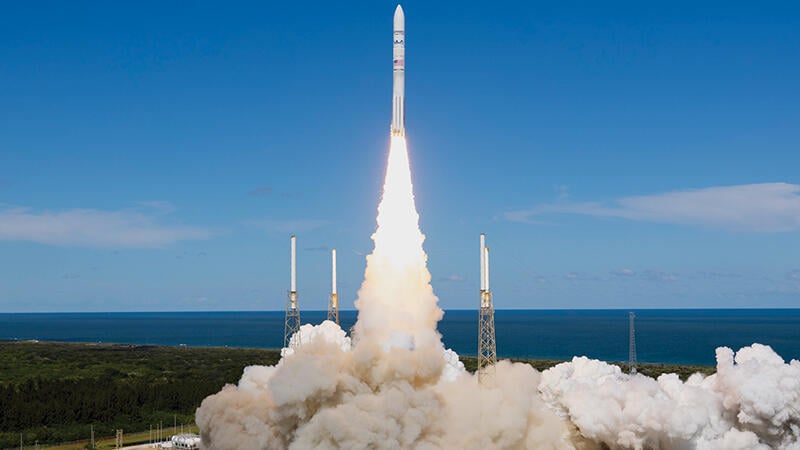
On the first of 38 missions for Amazon, a United Launch Alliance Vulcan rocket failed to deliver.
The launch of United Launch Alliance’s Vulcan rocket on a mission for Amazon was intended to mark the company’s triumphant return to flight after a nine-month hiatus to address booster nozzle issues.
Instead, 10 min. after liftoff on Nov. 15, United Launch Alliance (ULA) faced fallout from the first failed mission in its 20-year history—and more delays for the 70-plus flights on the Vulcan manifest, including high-priority National Security Space Launch (NSSL) payloads.
- Investigation focuses on fuel supply problem
- Six NSSL missions were previously shifted to SpaceX
- SRB nozzle probe remains open
Company leaders were feeling optimistic as the fifth Vulcan rocket lifted off at 12:40 p.m. EST from Cape Canaveral SFS for the Amazon Leo 1 mission. It was the first of 38 Vulcan launches under contract to deploy the lion’s share of Amazon’s 3,232-member satellite network in low Earth orbit (LEO).
ULA had processed and stacked the Vulcan rocket in a newly built second vertical assembly facility that was constructed to help increase the rocket’s launch rate to two flights per month. The pacing item for that was expected to be production of new nozzles for the Vulcan’s GEM 63XL solid rocket boosters (SRB), built by Northrop Grumman. Nozzle failures during the Vulcan’s second and fourth flights in October 2024 and February 2026 triggered two investigations and grounded the rocket for 10 months and nine months, respectively.
As the Vulcan rolled out to the launchpad for its return-to-flight mission, ULA had another 15 boosters in various stages of production, an agreement to take over manufacturing of the Vulcan’s payload fairings and composite structures and a sold-out manifest through the end of the decade. It also was on schedule to debut the Vulcan’s West Coast launch site at Vandenberg SFB in California in early 2027.
The rocket’s initial ascent appeared normal. Its twin methane-fueled BE-4 engines, manufactured by Blue Origin, and six improved, redesigned SRBs fired as expected to boost the 215-ft. vehicle off Space Launch Complex 41 and out over the Atlantic Ocean. Initial attempts to launch on Nov. 13-14 were scrubbed due to ground systems issues.
During two previous missions, the BE-4s compensated for SRB performance issues and successfully dispatched the Centaur V with enough velocity to reach its intended orbit. That was not the case on the failed Amazon Leo 1 flight.
Preliminary analysis indicates the BE-4s were operating as expected, but they underperformed due to a fuel supply issue, the cause of which is under investigation. The booster’s low thrust appears to be “the result of inadequate fuel supply from the vehicle to the BE-4 engines, not from the performance of the engines,” ULA said Nov. 18. The company added that, ultimately, “the second stage . . . was unable to recover from the performance loss, resulting in loss of mission.”
The rocket was flying with a Centaur V upper stage optimized for LEO that was 6 ft. shorter and filled with one-third less liquid propellant than the Vulcan’s higher-energy Centaur V, which successfully flew the previous four missions. The 40 Amazon Leo satellites in the Vulcan’s nose cone weighed more than 50,000 lb., the heaviest payload ever flown by ULA.
Taking BE-4 engine performance off the anomaly investigation is a relief for manufacturer Blue Origin, which not only builds BE-4s for the Vulcan but also flies them on its New Glenn rockets. The BE-4s that powered the Vulcan on the Amazon Leo 1 mission were the first to fly since Blue Origin implemented retrofits to the engines’ main oxidizer valves, following a static fire mishap in May that destroyed a New Glenn rocket and heavily damaged its sole launch site. The New Glenn pad has since been rebuilt, and Blue Origin expects to return the rocket to flight in January.
The mission’s failure is causing more stress on ULA, which already has seen six near-term NSSL missions moved to rival SpaceX amid the investigation into the SRB nozzle anomaly that occurred during the Vulcan’s fourth flight in February. That mission, USSF-87, included two satellites for the U.S. Space Force’s Geosynchronous Space Situational Awareness Program constellation.
A malfunction of one of the rocket’s four GEM 63XL SRBs occurred about 20 sec. after liftoff, kicking off a nine-month investigation involving ULA, Northrop Grumman and numerous government agencies. A similar incident with a booster nozzle occurred during the Vulcan’s second mission on Oct. 4, 2024. After USSF-87, the Space Force put a hold on Vulcan launches for NSSL missions until the SRB nozzle investigation, which remains ongoing, is complete.
Preliminary analysis from the failed Nov. 15 mission shows that the SRBs, which had been modified following the February launch anomaly, performed as expected. Additional nozzle design changes might be incorporated for future flights to improve the nozzle’s robustness further, ULA CEO Mark Peller told Aviation Week before the launch.
The Vulcan’s latest grounding strains the growing launch bottleneck that is already prompting satellite operators to become very creative in their search for rides to space (page 14). The Vulcan’s timeline to return to flight—whether in service to its NSSL missions or commercial customers—remains uncertain. ULA is one of three companies certified to fly the U.S. military’s most sensitive payloads under the NSSL Phase 3 Lane 2 program as well as the predecessor Phase 2 contract.
“While Sunday wasn’t exactly the outcome we had hoped for, we stand with our industry partners,” Space Access Portfolio Acquisition Executive Brig. Gen. Eric Zarybnisky said Nov. 17 at a Washington Times event in Arlington, Virginia. “It still is rocket science, and we look forward to continuing to work with ULA as we work through this anomaly investigation.”
The third grounding of the Vulcan could have consequences for ULA’s NSSL portfolio. The six NSSL missions or payloads the Space Force previously shifted from ULA’s Vulcan to SpaceX’s Falcon fleet are:
■ USSF-63, which includes a prototype cislunar surveillance satellite known as Oracle-M that was developed by the Air Force Research Laboratory. It is slated to launch no earlier than mid-2027 on a Falcon Heavy. The original USSF-63, a classified mission for the Space Force, is now USSF-112 and will launch on a Vulcan “at a later date,” a service spokesperson told Aviation Week on Nov. 6.
■ The second satellite of the Space Force’s flagship geostationary Earth orbit-based missile warning constellation, which was moved from USSF-50 on a Vulcan rocket to USSF-174 using a Falcon Heavy. USSF-50 is scheduled to launch a classified payload that originally was part of USSF-174. The spokesperson did not provide target launch dates.
■ Three GPS satellites—GPS III-7-9—all initially assigned to the Vulcan, which flew on SpaceX Falcon 9 rockets over the last 18 months.
■ A Space Development Agency (SDA) missile-tracking satellite mission originally awarded to ULA, which is due to fly by early 2027 on a Falcon 9. In exchange, ULA was assigned to loft two next-generation GPS satellites, in development by Lockheed Martin, along with the classified USSF-70 mission and a longer-term SDA mission, all initially awarded to SpaceX.
The Space Force has not said whether additional future missions could be swapped following the Nov. 15 failure. Returning the Vulcan to service for NSSL missions is a key focus for ULA, a joint venture of Lockheed Martin and Boeing.
“National security was at the heart of what we designed the vehicle for and what we remain committed to as one of the cornerstones of our business,” Peller said Nov. 17 during a panel discussion with Zarybnisky.
“Those requirements to meet that full range of missions . . . that’s a very high bar,” Peller said. The Vulcan “turned out to be a very flexible and capable vehicle, which has been very successful attracting civil business and commercial business,” he added.
ULA is the prime launch partner for Amazon, which is in the early phases of building a 3,232-member broadband satellite network in LEO. So far, about 13% of the operational constellation has been deployed over 16 launches. The Vulcan failure is Amazon’s only unsuccessful mission.
“There is risk with any launch, and that’s especially true for inaugural missions,” Amazon said in a statement after the Vulcan incident. “ULA has been a trusted partner for Amazon, and we believe they’ll learn from this mission and deliver on their long-term plans for Vulcan.”
Amazon declined to comment on the value of the satellites or whether they were insured. Despite the loss, Amazon remains poised to roll out initial broadband satellite service in the coming weeks.
Amazon has contracts for 37 more Vulcan launches to deploy more than half the constellation. The company also purchased 24 launches on Blue Origin New Glenn rockets, 24 flights on Arianespace’s Ariane 6 and 13 on SpaceX Falcon boosters. Amazon Leo missions on the New Glenn have not yet started. Operational Amazon satellites have flown four times on the Ariane 6, three times on Falcon 9s and eight on ULA Atlas V rockets, which are no longer in production.


Related Content