This article is published in Aviation Week & Space Technology and is free to read until Oct 16, 2026. If you want to read more articles from this publication, please click the link to subscribe.
Sierra Space’s Ghost Reentry Vehicle Is Taken Through Logistics Paces

Sierra Space conducted two drop tests of its Ghost reentry vehicle during U.S. Space Command's recent Apollo Nexus exercise.
A bottle of whiskey and a software-defined radio might make an unusual test load, but Sierra Space used the odd pair to help prove its Ghost reentry vehicle’s capabilities.
The space and defense company demonstrated that its Ghost reentry vehicle can safely return cargo to Earth from high-altitude balloons positioned at 35,000 ft. and 68,500 ft. above sea level, Erik Daehler, senior vice president of Sierra Space Defense, told Aviation Week July 28.
The drop tests—the vehicle’s first in nearly two years—were part of a recent exercise known as Apollo Nexus hosted by U.S. Space Command (Spacecom) in May at Dugway Proving Ground, Utah.
- The vehicle was air-dropped from 68,500 ft.
- The demo was part of U.S. Space Command’s new logistics exercises
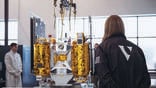
The opportunity to join Apollo Nexus came quickly, Daehler said. Sierra Space had less than four months to build a Ghost vehicle from scratch and to partner with parent Sierra Nevada Corp. to place a company-built software-defined radio and a bottle of whiskey aboard to test the Ghost’s ability to carry delicate electronics—and liquid cargo—back to Earth without damage.
“We were able to safely demonstrate that and prove that we could come through all of those environments and then be recoverable in a certain period of time by the team on the ground,” Daehler said, declining to disclose the whiskey brand.
“Getting something into theater to the warfighter when they need it is critical,” he added. “If you’re in a denied area where you couldn’t get a [Boeing] C-17 [Globemaster III] or a [Lockheed] C-130 [Hercules] to be able to do a drop into the theater, space is a perfect logistics node.”
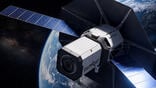
In April 2024, Sierra Space unveiled its Ghost vehicle after several years of stealth development. It pitched the Ghost as a safe, reliable way to deliver payloads from space to anywhere on Earth within 90 min. and to remain prepositioned in orbit for five years.
Six months later, the company won a firm fixed-price contract to study the Ghost’s potential to scale its payload capacity under the Air Force Research Laboratory’s (AFRL) Rocket Experimentation for Global Agile Logistics (REGAL) program, which is associated with the AFRL’s broader Rocket Cargo initiative.
That contract, along with another commitment to U.S. Transportation Command, allowed Sierra Space to begin work on operationalizing the Ghost for national security missions, Daehler said. “How do you bring it home?” he mused. “How do you deploy it into theater? When you deploy it into theater, how do you operationalize that?”
Since revealing the Ghost, the company has worked intensely to manage the spacecraft’s center of gravity and turbulent flow as it moves from the hypersonic and transonic portions of its descent from space into the atmosphere. This allows the vehicle’s momentum and trajectory to be altered to fit the customer’s needs, Daehler said. The company continues to explore variants of different sizes with a common architecture and design “that’ll allow us to deploy from any logistics node location,” he said.
Sierra Space plans to apply lessons learned from the first flight of its Dream Chaser spaceplane, which is expected to launch this year onboard a United Launch Alliance Vulcan vehicle.
The company announced on Sept. 2 that it had signed unnamed national security and commercial customers to fly payloads on the first orbital mission, known as Tenacity.
“We’re taking the learning experience from Dream Chaser as a logistics node and taking all of that and applying it into these smaller, portable, on-orbit, stageable kinds of capabilities,” Daehler said.
The Ghost’s new milestone comes as the U.S. military explores novel ways to move equipment around the globe faster using prepositioned spacecraft, rockets or orbital reentry vehicles. U.S. Space Command, which is responsible for warfighting operations starting 62 mi. above sea level, is using the Apollo exercises to stress-test its logistics chains in an increasingly contested environment.
The inaugural effort, known as Apollo Insight, was the first of four planned tabletop exercises. Held in March, it examined the potential threat of weapons of mass destruction in space. Two months later, the command hosted Apollo Nexus, featuring representatives of the U.S. military, industry and the other Five Eyes partners—Australia, Canada, New Zealand and the UK—to learn how to increase interoperability in a warfighting scenario.
Then in September, Spacecom launched the first “live-fly” exercise, called Apollo Maneuvers, with three key tasks: conducting coordinated, multi-orbit maneuvers, refining maneuver warfare concepts that could improve future operational planning and integrating participating nations from the command’s global alliance known as Multinational Force-Operation Olympic Defender, which includes the Five Eyes countries, along with France and Germany.
Gen. Stephen Whiting, Spacecom commander, first proposed the exercises during a Jan. 28 keynote speech at the Space Mobility Conference and Expo in Orlando, Florida. He said they were inspired by the Louisiana Maneuvers—a series of armored exercises held in 1941 that exposed deeper systemic, operational and logistical deficiencies and prompted the U.S. Army to update its vehicle technology ahead of World War II.
The Space Force is the newest military service and the only one without a dedicated logistics tail, Whiting noted in his speech. He said that as the space domain becomes more congested, “we cannot afford a static posture.”