This article is published in Aviation Week & Space Technology and is free to read until Jul 25, 2026. If you want to read more articles from this publication, please click the link to subscribe.
True Anomaly says its off-the-shelf spacecraft and software suite are well suited for new USSF missions.
The call came before sunrise over New Zealand’s Mahia Peninsula. Less than 17 hr. later, Rocket Lab launched a company-built satellite to space with its Electron rocket, marking a key milestone in a U.S. Space Force program designed to deploy spacecraft to orbit quickly in response to potential threats.
The Electron rocket lifted off on June 19 at 10:19 p.m. local time from one of two company pads in the Mahia Launch Complex. It took flight 16 hr. and 42 min. after the Space Force sent Rocket Lab the notice to launch on June 18, and the Pioneer spacecraft reached low Earth orbit approximately 9 min. later.
- Rocket Lab breaks the Space Force’s rapid call-up record
- True Anomaly platform is “purpose-built” for the service’s missions
The effort, part of the service’s Victus Haze mission, required Rocket Lab to launch to a previously unknown orbit within 24 hr. of call-up. The company was then tasked with completing on-orbit checkout and vehicle commissioning within 72 hr. of launch before it approached a second spacecraft—built by True Anomaly and launched last month—and then snapping a photo and sharing that image in near real time with the mission team on the ground. Rocket Lab took about 37 hr. to complete spacecraft commissioning, the company announced June 22.
“Now . . . we are on the hunt!” CEO Peter Beck posted on social media that day, sharing a brief video from one of the Pioneer spacecraft’s onboard cameras, set to the theme music from “Jaws.”
Victus Haze is the second mission in the Space Force’s Tactically Responsive Space (TacRS) program. In the 2023 Victus Nox effort, Firefly Aerospace launched a spacecraft built by Boeing subsidiary Millennium Space Systems within 27 hr. of the military’s go-for-launch call.
Under Victus Nox, the Space Force sought to prove it could work with industry partners to hasten the acquisition, development, delivery and launch of a commercially built spacecraft. For the latest mission, the service’s Space Safari office tasked the two companies with providing spacecraft, finding rides to space and operating the two satellites as they ran through “red team” and “blue team” space domain awareness and rendezvous and proximity operations (RPO) scenarios. The Rocket Lab spacecraft carries an advanced optical sensor built by the Lawrence Livermore National Laboratory; True Anomaly provided its own payload.
For many programs, success is defined by the end product, but for TacRS, it is marked by the process, Col. Bryon McClain, acting portfolio acquisition executive for space combat power, tells Aviation Week. Stress-testing the entire commercial pipeline, from spacecraft design to launch to on-orbit tasking, is the key deliverable for Victus Haze, along with working through any issues that arise.
“Adapting to those anomalies is just as good as everything going perfectly,” says McClain, whose portfolio includes the Space Safari office.
The Victus Haze mission demonstrated just that need for flexibility. True Anomaly’s spacecraft was originally slated to launch on a Firefly Alpha rocket. But Firefly suffered two mishaps in 2025 that grounded the Alpha for nearly one year. The rocket successfully launched again on March 11, but Space Force leaders have acknowledged its grounding delayed Victus Haze. To overcome the launcher setback, True Anomaly pivoted to place its Jackal-0004 satellite on the SpaceX Falcon 9 CAS500-2 rideshare on May 3.
Originally, Rocket Lab was slated to launch its spacecraft first, followed by True Anomaly. But the team used the situation to adapt, McClain says. Meanwhile, Firefly plans to support a future Victus mission with its forthcoming Alpha Block II rocket and a True Anomaly spacecraft, a Firefly spokesperson says.
In partnership with The Aerospace Corp., Space Safari matured a new digital, “plug-and-play” interface between spacecraft buses and mission payloads to add flexibility to Victus Haze. That open system architecture reduced integration timelines and costs and is being used across other payload contracts, Space Systems Command (SSC) says. The service also partnered with its innovation arm, SpaceWERX, to support the Rocket Lab contract and with the Defense Innovation Unit to procure a second True Anomaly space vehicle for a future mission.
The Victus Haze mission aimed to validate the processes of two relatively new space companies—Rocket Lab and True Anomaly. The former started purely as a launch provider but has since become an end-to-end spacecraft builder that designed and completed the maneuverable spacecraft within 18 months, says Brian Rogers, vice president of global launch services at Rocket Lab. The Pioneer spacecraft featured numerous company-supplied components, including solar power, propellant tanks, star trackers and flight software.
Rocket Lab’s Electron rocket and dual launch facilities in Mahia helped the Space Force stress-test its ability to deploy assets rapidly from diverse locations, offering a “responsive launch-plus spacecraft service wrapped up in one,” Rogers says.
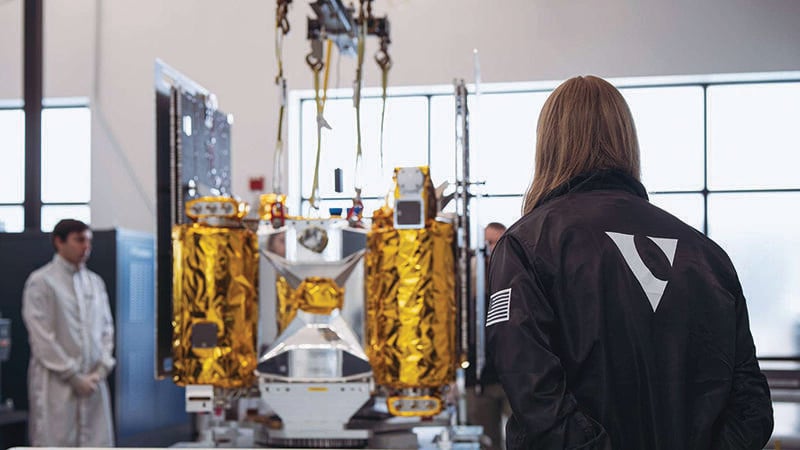
True Anomaly began building the Jackal spacecraft last September and shipped it in preparation for launch in May. The company declared the spacecraft fully commissioned on June 18, after completing numerous test objectives related to RPO and space domain awareness activities.
True Anomaly CEO Even Rogers says the Jackal spacecraft and Mosaic software suite are “purpose-built” for efforts like Victus Haze. After serving in the Space Force, he founded the company in 2022 to fill what he saw as a need for commercially built systems that could support the service’s increasingly dynamic mission set.
“For years, tactically responsive space had largely existed as a concept without the required tools to respond effectively,” Rogers says. “We’re excited to demonstrate what becomes possible when industry and warfighters work side by side to tackle operational problems end to end.”
For the Space Force, the Victus line of missions is as much an acquisition experiment as an operational test. Military planners are preparing for a more contested orbital environment, and the service wants to deploy new capabilities within days, not years. Service officials describe TacRS as a means to hasten the U.S. response to emerging threats, whether by launching new sensors, inspecting suspicious spacecraft or replenishing degraded constellations. The series is helping Space Safari expose bottlenecks from contracting and integration to launch and on-orbit tasking, McClain notes.
The Victus Haze mission is slated to run for approximately six months, during which the two spacecraft are to continue to demonstrate joint RPO and space domain awareness activities on orbit, the SSC says.
From there, Space Safari has three additional named Victus missions on its docket. Victus Surgo and Victus Salo are to launch two highly maneuverable spacecraft built by Impulse Space on a commercial rideshare; they are to remain pre-positioned on orbit to perform a space domain awareness mission. Those missions are scheduled to launch in the first half of 2027, the SSC says.
Victus Sol would be the service’s first operational mission at a date not yet announced. It is slated to support a combatant command’s tasking request or an exercise. In 2025, the SSC awarded Firefly a $22 million launch service contract to support the mission.
As TacRS matures, expect to hear less about it, McClain says. Ultimately, the Space Force sees the mission as similar to aircraft scrambling to intercept a suspicious vehicle in sovereign airspace, with little to no notice to the general public.
“We’re learning publicly, just to emphasize the capability that’s out there,” he says. “But like all of our continuous operational systems, once we start getting into an operational case, it’ll probably get a lot more quiet.”