This article is published in Aviation Week & Space Technology and is free to read until May 30, 2026. If you want to read more articles from this publication, please click the link to subscribe.
Major space companies, including BAE Systems, plan to demonstrate maneuverable spacecraft in response to a stronger demand signal from the U.S. Space Force.
After years of uneven demand signals, industry partners see a clearer push from the U.S. Space Force toward maneuverable platforms, which is driving new designs and increased confidence in on-orbit servicing markets.
Attendees of the Space Foundation’s annual Space Symposium, held in Colorado Springs on April 13-16, noted increased enthusiasm from service officials for more agile spacecraft, even as new fiscal 2027 budget documents reveal a dip in proposed funding for such capabilities.
- U.S. Space Command is developing a maneuver warfare strategy
- Pentagon is still hedging its bets, budget shows
Gen. Stephen Whiting has spent the past two years leading U.S. Space Command (Spacecom) and pressing for more maneuverable—and ultimately refuelable—spacecraft to enable what the service calls dynamic space operations. As he enters his final months in command, he is shaping a strategy that emphasizes on-orbit maneuver as adversaries demonstrate emerging refueling and logistics capabilities.
“When we look at scenarios involving a protracted conflict against a peer opponent, we need a new strategy that isn’t predictable or static,”Whiting said in a keynote address at the Space Symposium.
Over the past year, rhetoric from Whiting’s command, which sets requirements for on-orbit activity, has struck a different tone on in-space logistics and maneuver than the Space Force, which provides systems and personnel to support those activities. Whiting has urged near-term investment, while Space Force leaders have signaled a preference to let commercial technology mature before committing at scale.
- Related Content
Check 6 Podcast: At Space Symposium, NASA Is Cool Again
Momentum might now be shifting. The Space Force selected 14 vendors for its RG-XX program to field by 2030 next-generation geosynchronous reconnaissance satellites that are highly maneuverable and refuelable. The $1.84 billion indefinite-delivery, indefinite-quantity contract marks a potential inflection point for industry investment in mobility and servicing, RG-XX vendor representatives said.
For newer entrants, RG-XX offers a path to a major program of record. True Anomaly, a Denver-based space defense technology firm, is developing autonomous orbital vehicles and software for space domain awareness, battle management and ground command and control. “[The RG-XX program] directly aligns with the capabilities that we’ve been investing in,” Senior Vice President for Space Defense Steve Kitay said on the sidelines of the symposium.
Meanwhile, the Space Force continues to underfund in-space servicing and related capabilities—grouped as space access, mobility and logistics (SAML)—in its recent budget request. The service’s research and development request reaches $40.7 billion, roughly doubling over the previous year. But within that increase, SAML funding falls to $9.7 million, a 66% decrease from $29.2 million in 2026, according to budget documents. The request includes no dedicated SAML procurement funding.
Lt. Gen. Philip Garrant, head of Space Systems Command, told reporters at the symposium that SAML lines prioritize near-term demonstrations and novel propulsion. The service is integrating mobility and servicing into programs of record, such as RG-XX, “from the inception, not an add-on after the fact,” he said.
Several on-orbit refueling and servicing demonstrations are scheduled this year with industry partners, including Astroscale U.S., Northrop Grumman and Orbit Fab, to test those companies’ spacecraft designs and refueling interfaces.
For Northrop Grumman Space Systems President Rob Fleming, these activities are not just demonstrations: The company already operates two servicing vehicles for its customers, such as Intelsat. “We’ve actually proven that it’s something that can be done,” he told Aviation Week at the symposium. The company plans to debut its Mission Robotic Vehicle—a refuelable servicer with a 15-year lifespan—in 2026, while participating in Space Force demonstrations.
Fleming expects operational servicing platforms to “drive the imagination of end users” and accelerate the market. He said demand signals from the Pentagon are strengthening alongside commercial investment but noted that timing remains a challenge. “The question for us is metering out the timing of investment and how we balance it against our national security portfolio,” he said.
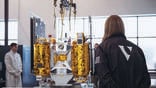
Established integrators are also moving toward more agile spacecraft. Boeing and its subsidiary Millennium Space Systems are developing a new satellite platform called Resolute, designed for high maneuverability with greater delta-V. BAE Systems introduced the Ascent, a refuelable space tug capable of carrying multiple rideshare payloads across Earth orbits and into cislunar space. The company targets a 2027 Pathfinder mission to demonstrate refueling and multi-orbit maneuver, Thai Sheridan, vice president and general manager for military space, told reporters at the symposium. BAE and Millennium were both onboarded to the RG-XX program.
The growing focus on on-orbit maneuver is encouraging to companies built around in-space servicing. As Pentagon officials increasingly describe space as a warfighting domain, “it’s quite clear that mobility, both in terms of movement and maneuver, is going to be required,” said Robert Carlisle, cofounder and CEO of Argo Space, which develops small spacecraft transfer vehicles.
Carlisle pointed to a recent Space Force solicitation for geosynchronous refueling as a positive step, particularly for such satellites as RG-XX. But he argued that the service must look beyond refueling to prepositioning, rearming and repairing assets on orbit.
A new Space Force policy paper suggests a measured approach. The Objective Force 2040 document, released April 15, describes responsive launch, on-orbit servicing and space logistics as “a new paradigm for satellite resilience and reconstitution” while emphasizing the need to continue assessing their operational utility.