This article is published in Aerospace Daily & Defense Report part of Aviation Week Intelligence Network (AWIN), and is complimentary through Dec 12, 2025. For information on becoming an AWIN Member to access more content like this, click here.
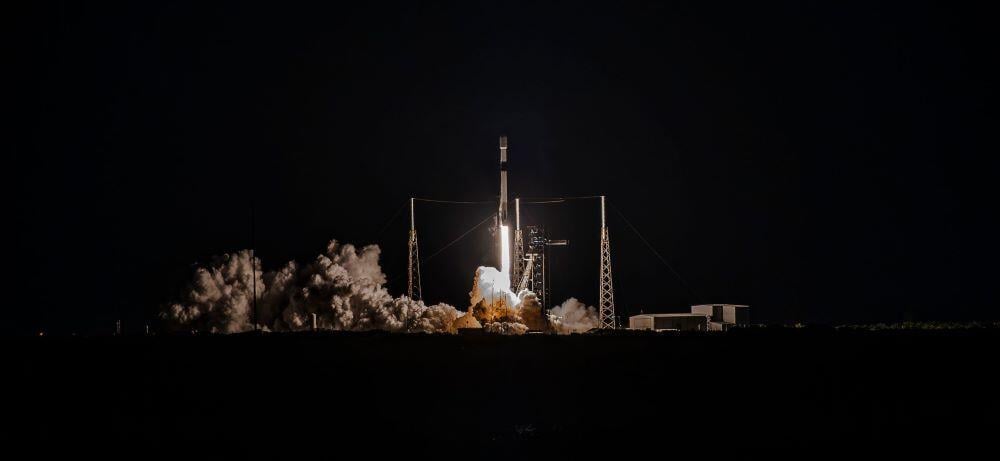
SpaceX launches Starlink 6-87 on Nov. 10 from Cape Canaveral SFB, Florida, marking the 94th launch from the U.S. Eastern Range this year.
With less than two months to go in 2025, the global launch market has already surpassed all previous annual records, with the U.S. and China continuing to lead the way.
The two busiest space nations each met key milestones since Nov. 10. The U.S. Space Force’s Space Launch Delta (SLD) 45 supported its 94th launch of 2025 that evening, when a SpaceX Falcon 9 launched at 10:21 p.m. EST from Space Launch Complex 40 at Cape Canaveral SFS, Florida, carrying 29 Starlink satellites to low Earth orbit (LEO). With that mission complete, the Eastern Range beat its 2024 record of 93 launches and has kept its ranking as the world’s busiest spaceport.
In the next few weeks, SLD 45 expects to complete 100 orbital launches in one year. Together with Space Launch Delta 30 at Vandenberg SFB, California, the U.S. has launched more than 150 times so far in 2025, according to data collected by astronomer Jonathan McDowell.
China is also accelerating its launch cadence and broke its own annual record last weekend when it surpassed 70 launches for 2025, up from 68 successful orbital launches in 2024. Beijing is not slowing down, despite the failure of Galactic Energy’s solid-fuel Ceres-1 rocket to reach orbit after launching on Nov. 9.
The two nations have contributed to a record-breaking year for global launch attempts. More than 260 orbital launch attempts have occurred to date this year, beating 2024’s number of 259, says Fletcher Franklin, deputy director of analytics at BryceTech.
“Based on our data, we anticipate an increase in global launches in 2026 due to an increased number of forecasted spacecraft, including large constellations continuing their deployment phases, existing providers increasing launch cadence, and new launch vehicles likely debuting,” he tells Aviation Week.
Looking further out toward 2030, Fletcher says data shows average annual launches tapering off, as super-heavy launch vehicles such as SpaceX’s Starship rocket bring increased capacity and large constellations enter a steady state.
The driver of the growing launch rates is tied to burgeoning LEO-based satellite constellations for commercial and government customers, with SpaceX outpacing its colleagues as it regularly deploys Starlink satellites.
Global satellite operators have announced or submitted 70,000 satellite plans for LEO with launches expected in 2025-2031, according to an analysis by Goldman-Sachs in May. China could provide about 53,000 of those launches, or about 75%, wrote Allen Chang, head of the company’s Greater China Technology Research team.