This article is published in Aerospace Daily & Defense Report part of Aviation Week Intelligence Network (AWIN), and is complimentary through Jul 12, 2026. For information on becoming an AWIN Member to access more content like this, click here.

The Exploration Company Plans Heavy-Lift Launcher

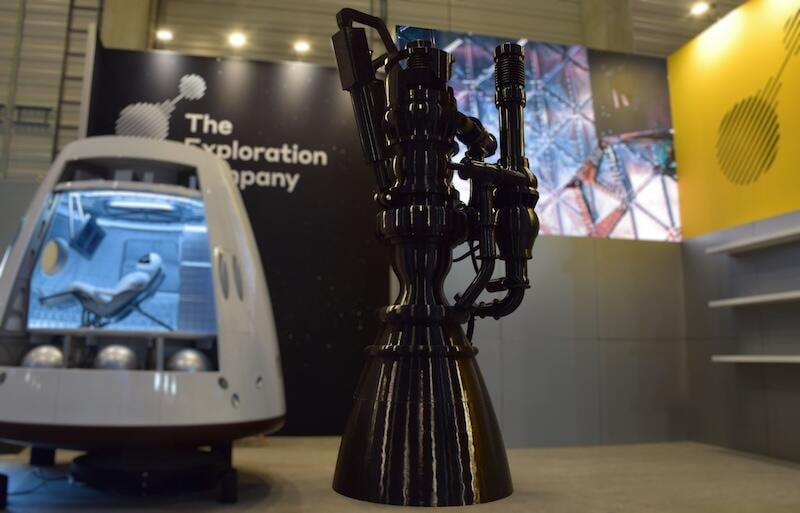
exploration co model
Credit: The Exploration Company

BERLIN—European space startup The Exploration Company has launched an ambitious push to develop a reusable heavy-lift launcher, looking to largely draw on private financing to realize its ambition.

The company aims to demonstrate a development version of the Storm engine, which is central to the rocket program, on a test stand toward the end of 2028. The actual launcher should be ready in 2033, CEO Hélène Huby said in an interview at the ILA Berlin air show.

The company used the gathering to unveil a subscale model of the full-flow, staged combustion cycle Storm, which will be fueled by liquid oxygen and bio-methane. The system has been in development for about two years, with key components tested at a subscale level.

The heavy-lift rocket, which would use nine Storm engines in the first stage, would deliver around 15-20 metric tons of payload to orbit. That would evolve over time, with plans for 40 metric tons of payload in a reusable configuration, or 60 tons when not looking to reuse the first stage.

Storm is being designed to deliver up to 180 metric tons of thrust at sea level. Work so far has centered on turbomachinery, the main combustion chamber hardware, regeneratively cooled nozzle extensions, as well as ox-rich and fuel-rich pre-burners, said Head of Propulsion Sebastien Reichstadt.

Huby said that to save time, the company is skipping the step of developing a smaller launcher. Developing the smaller rocket would waste about five to seven years. The Exploration Company had explored buying UK rocket startup Orbex, but the talks failed and the British business went bust.

The company has had financial backing through the European Space Agency (ESA) and its French counterpart CNES. German aerospace research agency DLR also has been working with the company.

Huby also said the company is wrapping up work under an existing ESA program to develop a cargo return capsule. By the end of the month, it aims to have achieved Technology Readiness Level 6, equivalent to a demonstrated prototype, for 95% of the subsystems, with the rest to be completed through the summer.

The Exploration Company is poised to bid on a follow-on stage, in competition with Thales Alenia Space. Under that program, companies need to co-fund about 40% of the program now called Aladdin. Huby said her company has secured the requisite private  backing for the next phase.

Robert Wall

Robert Wall is Executive Editor for Defense and Space. Based in London, he directs a team of military and space journalists across the U.S., Europe and Asia-Pacific.