This article is published in Aviation Week & Space Technology and is free to read until Apr 17, 2026. If you want to read more articles from this publication, please click the link to subscribe.

After Setbacks, Firefly’s Alpha Roars Back To Orbit

rocket launching

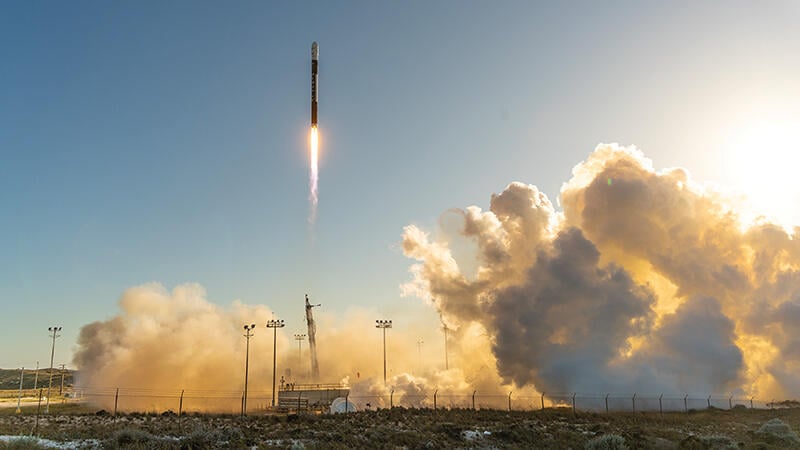
Firefly has upcoming missions scheduled for the U.S. Space Force, NASA and commercial customers.

Credit: Sean Parker/Firefly Aerospace

Firefly Aerospace has returned to flight after nearly one year, ready to resume its mission to bring additional launch capacity to hungry U.S. government and commercial space customers.

The Cedar Park, Texas-based provider’s Alpha launch vehicle took off March 11 from the company’s Space Launch Complex-2 at Vandenberg SFB in California at 5:50 p.m. PDT, following several attempts scrubbed due to high winds and atypical sensor readings. But with the weather and sensors finally cooperating, the small-lift rocket carried its cargo to orbit at last, its contrails standing out against a cloudless afternoon sky from a Los Angeles beach 157 mi. south of the launchpad.

  • The next Alpha flight will include Block II upgrades
  • The U.S. Space Force is using Firefly for “Victus” responsive launch mission

The mission, called “Stairway to Seven” for the Alpha’s seventh flight, marked the rocket’s first successful launch after being grounded after two mishaps in 2025. It was also the final use of its current configuration before Firefly incorporates a sizable upgrade known as Block II.

The Alpha carried a demonstrator payload for Lockheed Martin to orbit, Firefly disclosed for the first time following the launch. In its own statement, Lockheed Martin described the payload as “experimental items.”

The Alpha’s launch record has not been perfect. Its first launch, in September 2021, and its sixth launch, in April 2025, both failed. During Flight 4 in 2023, the rocket experienced a software algorithm error that prevented the second stage from deploying the payload to its planned orbit, although the customer—also Lockheed Martin—was able to complete its primary mission objectives.

Firefly then suffered two mishaps in 2025 that kept it from returning to flight. On April 29, during its sixth mission, the rocket experienced an anomaly during first-stage separation that led to the loss of the Lockheed Martin payload. Then on Sept. 29, Firefly lost a first-stage booster meant for Flight 7 during preflight testing at the company’s facility in Briggs, Texas.

With the Alpha’s return to service, Firefly aims to help lessen an enduring bottleneck in the launch market for U.S. government and commercial payloads. The company declined to comment on launch plans ahead of announcing its fourth-quarter 2025 financial results, scheduled for March 19.

Firefly is on contract with Lockheed Martin for 25 Alpha flights through 2029 under a June 2024 agreement. Meanwhile, the U.S. Space Force has tapped the Alpha rocket as a commercial provider for its rapid-launch series to deliver commercially derived space systems to orbit quickly. In 2023, Firefly launched a satellite built within one year by Boeing subsidiary Millennium Space Systems under the Victus Nox mission—liftoff occurred within 27 hr. of a call-up.

The service’s next mission in the series, known as Victus Haze, was due to launch by the fall of 2025, but the Space Force delayed it to allow Firefly time to assess lessons learned from the Sept. 29 anomaly, service leaders previously confirmed. Firefly is contracted to launch an additional mission in the series called Victus Sol.

The company also has four more Blue Ghost missions in the pipeline for NASA. The next mission is due to launch this year, CEO Jason Kim said during a November earnings call.

Meanwhile, the Alpha’s configuration is about to evolve. Firefly used Flight 7 to test and validate numerous subsystems ahead of the rocket’s Block II upgrade on the forthcoming Flight 8. The Block II upgrade includes an increase in the Alpha’s length to 104 ft. from about 97 ft., consolidated in-house batteries and avionics, increased strength of all carbon composite structures and an enhanced thermal protection system, the company said.

Firefly will use the Block II Alpha variant to support hypersonic testing, national security missions including for the Trump administration’s Golden Dome missile defense architecture and commercial satellite launches.

The company is also continuing work on a new medium-launch vehicle, called the Eclipse, in partnership with Northrop Grumman. Designed to replace the latter’s Antares rocket, the Eclipse is envisioned as partially reusable and capable of launching nearly 36,000 lb. into low Earth orbit.

Vivienne Machi

Vivienne Machi is the military space editor for Aviation Week based in Los Angeles.