This article is published in Aviation Week & Space Technology and is free to read until May 30, 2026. If you want to read more articles from this publication, please click the link to subscribe.
Post-recovery inspections revealed that the Artemis II Orion heat shield had suffered less ablation and damage than the heat shield used on Artemis I.
As preparations for NASA’s next Artemis mission accelerate, the agency and its mission partners aim to maximize lessons learned from Integrity, the Orion spacecraft that returned the Artemis II crew safely to Earth on April 10 after a fiery reentry at 24,664 mph and a lunar roundtrip of almost 695,000 mi.
There is plenty to learn. The entire Artemis II mission was designed to validate the Lockheed Martin-built Orion spacecraft’s systems, crew operations and mission procedures ahead of a planned campaign of sustained lunar exploration. Now, under Administrator Jared Isaacman’s plan to increase mission cadence, NASA is doubling down on efforts to make the most of Integrity’s experience before the 2027 launch of Artemis III.
- Lockheed completes modified Artemis III heat shield
- The company proposes an “evolved” commercial version
NASA’s immediate focus was on the condition of the Avcoat heat shield, an area of potential concern after the heat shield on the uncrewed Artemis I test mission in 2022 exhibited greater ablation levels than had been expected. However, initial reviews brought good news. “Inspections on the recovery ship found the char loss behavior observed on Artemis I was significantly reduced, both in terms of quantity and size,” the agency said in a statement on April 20.
The crew module was expected to return to NASA’s Kennedy Space Center (KSC) in April for additional examination of the heat shield during Orion deservicing in the Multi-Payload Processing Facility, the agency said. “Over the summer, the heat shield will be transported to NASA’s Marshall Space Flight Center in Huntsville, Alabama, for sample extraction and internal X-ray scans to provide further insight into the system and material behavior,” NASA added.
Lockheed Martin also provided early indications that the heat shield performed well. “We’ve had a preliminary look at the heat shield,” Kirk Shireman, vice president of the Lockheed Martin Lunar Exploration Campaign, tells Aviation Week. “We want to get a good look at that, so those are things we’ll definitely investigate.”
NASA’s revised reentry strategy that cut almost 7 min. from the time the shield would experience peak heating of 4,000-5,000F appears to have mitigated the problems that Artemis I had experienced. In the Artemis I reentry, the gases produced during pyrolysis of the Avcoat could not escape gradually and led to charring and hardening of the outer layer of the heat shield during the skip reentry. Gas buildup caused spallation and explosive pressure releases that detached portions of the shield.
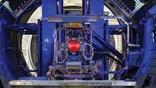
Lockheed has also finished manufacturing the heat shield for the Orion spacecraft earmarked for Artemis III. “We’re now wiring up all the instrumentation, and we’ll be setting up to mate the heat shield with the crew module here shortly,” Shireman says. “On Artemis III, we’ve made modifications to the formulation, and it’ll allow us to skip without having potato-chip-size pieces of the Avcoat come off.”
The space company plans to move into assembly of the heat shield for Artemis IV next week, Shireman says. The process involves bonding machined blocks of Avcoat to a carbon-fiber skin that is then bolted to a titanium frame. The Avcoat itself consists of an epoxy novolac resin, silica fibers and balloons or pockets of phenolic material to trap insulating air.
“We had a handful of problems” from a systems perspective, Shireman says. “I would say small. There were really three big problems that we all talked about. There was a helium leak on the service module, a water valve issue on the European service module (ESM) and then the urine vent line,” he adds, referring to problems encountered with the waste management system when the vent to the exterior of the spacecraft froze.
“The team currently is assessing the hardware and gathering data to support the postflight investigation of the urine vent line issue during the Artemis II mission,” NASA says. “Teams will work to identify root cause and initiate corrective action for Artemis III.”
“In general, the toilet performed exceptionally well,” Shireman says, noting that the focus is on the vent line. “We’re already looking at it. We’ve taken samples and inspected [them] with a borescope. There’s much more to do, but we’re already doing those things.
“Pretty much everything else was nominal,” Shireman continues. “In fact, I think a lot of what we learned is, ‘Wow, that performed better than we expected.’” The environmental control and life-support system (ECLSS) “performed flawlessly,” he says. “Carbon dioxide levels were extremely low throughout the mission. That was frankly the surprise to me. I was expecting higher levels of carbon dioxide. . . . The fans all worked, the humidity control, the scrubbing of contaminants—all those things worked really well.”
Investigations into the ESM are focused on valve issues in a pressure control assembly that regulated the flow of helium to repressurize propellant, as well as an isolation valve in the potable water system that failed in an open position.
Lockheed, meanwhile, is speeding up work to complete the next three Orion spacecraft for the restructured Artemis program, which now calls for tests of the crew capsule alongside one or both lunar landers in Earth orbit in 2027 and a return to the Moon’s surface with Artemis IV and V in 2028.
“If you take the dates that NASA wants to meet that increased cadence, it is a pretty significant acceleration from our current dates, so it is definitely going to be a challenge to go do it,” Shireman says. “That’s the bad news. The good news is, if you fly more often and you’re producing vehicles more often, you get better at it. If you do something and then you wait three years and do it again, you just aren’t as efficient.
“So this increased cadence is great, both from a vehicle production standpoint and operations,” Shireman adds. “It’s great, but it’s not without challenge. But we are looking forward to accelerating and meeting that challenge.”
Spacecraft for Artemis missions III, IV and V are in various stages of assembly and completion at the Neil Armstrong Operations and Checkout (O&C) building at KSC. “They’re all making great progress,” Shireman says. “In fact, while we were flying Artemis II, we were doing a thermal test on the crew module for Artemis III.” The thermal test was completed ahead of schedule on April 11-12.
Lockheed is also gearing up to conduct the acoustic test of the Airbus/European Space Agency-built ESM for Artemis III “imminently” and is completing wiring on the heat shield, which will be mated shortly to the crew module.
The crew module for Artemis IV was due to be moved from the O&C clean room, where welding work associated with the propulsion system and the ECLSS had been taking place. The ESM was delivered from Airbus’ facility in Bremen, Germany, in November and was then scheduled to be moved into the clean room for the same purpose, Shireman says. Work on the heat shield assembly for Artemis IV was also due to begin in the second half of April.
Lockheed is installing a secondary structure around the underlying primary structure of the Artemis V pressure vessel in Florida. Proof pressure testing is also underway to ensure the soundness of the structure, including that of the major friction stir welds between the seven large aluminum alloy elements that make up the primary vessel.
Following pressure testing, Lockheed plans to continue with crew module assembly, a process that it expects will take less time than for the initial Artemis vehicles. “We start installing equipment, wiring harnesses and tubes and valves for the propulsion system,” Shireman says. “We’re executing the same process we did on Artemis I, II, III and IV, so the good news is we’ve kind of worked out a lot of the bugs. That’s not to say we’ll do it overnight, but we know where we had problems, and we’ve made production modifications to improve those things,” he adds.
Looking ahead, Lockheed has revealed details about its plans for an “evolved” commercial Orion architecture designed to meet the agency’s revamped lunar exploration initiative. Sparked by funding threats to Artemis and the December 2025 executive order to accelerate U.S. space capabilities, the plan forms the core of Lockheed Martin’s response to NASA’s request for information (RFI) on the Enabling Commercial Lunar Transportation initiative; inputs were due April 23.
The revised architecture includes upgrades to the Orion crew module and to the ESM. Also included is a broader mission capability set and compatibility with additional launch vehicles beyond the current Space Launch System (SLS) rocket.
“We’re going to respond to the RFI with an architecture that we believe takes the investment that NASA has already made in Orion, and the investment that the Europeans have already made in the European service model, and evolves that to be a sustainable service,” Tony Byers, director of strategy and business development at Lockheed Martin Space, tells Aviation Week.
“That includes from the surface of the Earth to whatever destination NASA wants to go to,” Byers continues. “The RFI says from the surface of the Earth to the two landers [Blue Origin’s Blue Moon and SpaceX Starship] that exist. Now we are looking at from the surface of the Earth all the way to the surface of the Moon as well.”
Although Lockheed says the SLS remains the most efficient launch vehicle for reaching the Moon, the company acknowledges that spiraling costs have forced it to look for more affordable alternatives, including dual launchers to loft Orion to orbit and a transfer vehicle to boost the spacecraft to the Moon.
“We understand that SLS may not exist,” Byers says. “We need SLS to be lower-cost long term. But if SLS doesn’t exist, then we need other options. So we’ve looked at every launch vehicle on the planet today.
“There are at least two launch vehicles that are projected to be able to have the mass to orbit and the capability to carry an Orion,” Byers adds. “We’ve looked at Blue Origin New Glenn’s time frame and their advertised capacity, and so we could fly on that. We could fly on a Vulcan with United Launch Alliance. We could even fly on a [SpaceX] Falcon Heavy, but it’s going to need some structural modifications. With every one of those, you need a transfer stage.”
Lockheed is also working with ESA and Airbus to expand the propellant capacity of the service module. “That opens up increased mission flexibility, both at the Moon and here at Earth, whether we rendezvous at low Earth orbit [LEO] or we go to the Moon and rendezvous there,” Byers says.
Studies indicate that additional volume is available for extra propellant in the upper and lower sections of the service module without having to change the outer mold line. Lockheed says the current design can also adequately sustain a human crew for longer missions.
“We can definitely support 21 days of consumables with plenty of margin, and that can easily go to 30 days,” Byers notes. “As we evolve in a likely future block of a service module, we’ll expand that even further.
“Then we’re also looking at, ‘How do we take it a step further?’” he continues. “Since we have all these elements in this architecture already, what other services can we provide NASA and the other agencies on the planet? It could be anything from crew and cargo to the surface or in-space mobility.”
Lockheed says Orion’s storable propellant is key to the architecture’s flexibility, freeing it from the constraints of systems based on cryogenic propulsion. “That means we can launch things and can leave them in orbit,” Byers says. “You don’t have to rush a crew to them.”