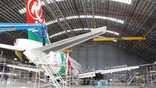
Podcast: A380 Engine Economics—Navigating The Trent 900 Aftermarket
Listen in as James Pozzi, Jens Flottau and Dan Williams discuss Airbus’ A380 program and aftermarket and how key operator Emirates is expanding its maintenance setup for the superjumbo and its Trent 900 engines.
Find out more about Aero-Engines Americas and secure your place here.
Subscribe Now
Don't miss a single episode. Subscribe to Aviation Week's MRO Podcast in Apple Podcasts, Spotify or wherever you get podcasts.
Discover all of our podcasts at aviationweek.com/podcasts.
AI-Generated Transcript
James Pozzi: Welcome to the MRO podcast. I'm James Pozzi, MRO editor for the EMEA Region, and today we are discussing the Airbus A380 program while looking at one of its two engine types, the Rolls-Royce Trent 900. This follows the Dubai Airshow where Emirates, the world's largest operator of the A380, announced plans to add significant in-house maintenance capacity for the Rolls-Royce Trent 900 engine type. So today we are going to look at the current state of the program itself and what the future might hold for both the A380 and the Trent 900 in terms of fleet size and the aftermarket. So just before we begin, a quick look at the background of the A380 program. Of course, it entered into service in 2007 with Singapore Airlines as the launch customer. At one stage it had as many as 15 operators at its peak, but it's fair to say it underperformed commercially.
There are several reasons for that. I guess the industry's move away to more efficient twin-engine aircraft such as the A350 and 787 played a role and there are associated issues as well. High operating costs, for example, and limited airport compatibility, to name but a few. It's a two-engine market as I mentioned, the Rolls-Royce Trent 900 and the rival Engine Alliance GP7200 as well competing for that since the inception of the program. And let's not forget, of course, production of the A380 ceased at the end of 2021, so nearly four years ago now, amazingly. So joining me today to discuss this are Jens Flottau, who is executive editor for Commercial Aviation at Aviation Week Network, and Dan Williams, who is director of Fleet Data Services for Aviation Week Network. Jens, Dan, thanks for joining us.
Jens Flottau: Pleasure.
Dan Williams: Thanks for having us.
So let's start with Emirates, of course. Fresh off the Dubai Airshow. Emirates, as I mentioned, is comfortably the world's largest A380 operator. We have about 116 in-service aircraft at the moment with several other aircraft parked right now. They use a mixed engine fleet. They operate Trent 900s, the Engine Alliance rival option as well. Emirates, it's fair to say, has pretty much driven the entire program for much of its life and the aftermarket, I guess given the much larger volumes of A380s it operates compared to the other carriers that do so. So Jens, we'll start with yourself. You recently spoke with Emirates about its operations, an article you can read on aviationweek.com. It's published at the end of October, and I guess despite production ending several years ago, Emirates still has a big volume of the Superjumbo aircraft as we mentioned. What is Emirates' mid- to long-term strategy for the aircraft program, given this volume? And I guess has anything changed in recent years related to this from Emirates?
Jens Flottau: Well, I guess the structural change that we should mention is the delays in the 777X program, which has meant that it needs to rely on large-capacity aircraft, other large-capacity aircraft for much longer than it thought. For the A380 in particular, Emirates again is kind of the exception in the industry, having decided that they want to operate the fleet or at least part of it until well into the 2040s. That has a lot of consequences for the services MRO part of its operations of course, because it needs to make sure that it can sustain the fleet for that long. Its strategy basically is to what they call immunize themselves in the best possible way, which means taking a lot of MRO in-house, trying to build parts, and this is not to the engine, but to the aircraft itself in-house over time so that they can still fly the aircraft in the early 2040s when a lot of the supply chain will have set other priorities. And that strategy really contrasts with what everybody else does on the A380. I was just with Lufthansa talking about the aircraft and their plan, for example is to retire the aircraft by 2030, 10 years before Emirates. Etihad is probably going to 2033, 2034 maybe. But it's fair to assume that by the mid-2030s, Emirates could well be the only operator worldwide of the A380 and that'll probably put it in a tough spot just to keep it going.
James Pozzi: Yeah, absolutely. I mean you mentioned the in-house capability. Emirates has been ramping that up of course, and we'll look at some of the stuff it's doing with the Trent 900 engines later, but recently it's been undertaking some wing-related repairs, I think, after cracks were found following an extended period of storage in the desert for some aircraft. What can you tell us about maybe some of the work that's gone on there with those inspections and those repairs?
Jens Flottau: Yeah, sure. I mean they have really two big programs, maintenance prongs or programs on the A380 right now. One is the cabin retrofit, they are redoing particularly first-class seats, business-class seats. It's more of a makeover of those seats rather than entirely new seats. 777300ER program that's going on at the same time is going a lot deeper because they're actually putting new seats in. But nonetheless, it's a big program. It takes years to finish. They've moved around from pulling aircraft out of service just for the retrofits and trying to do it during routine maintenance. Obviously the first option is much, much, much faster. The second one you mentioned is the wing repairs. That is something that emerged after the extended grounding during COVID—cracks in some parts of the wing, some that are particularly exposed to particularly strong forces. That is almost the most more complicated part of it because it's very unpredictable.
They've told me that basically the repairs can last from anywhere from three weeks to three months. If you are capacity constrained, as they are, then that obviously is a big problem. It's also not only the extent of the repairs, that is always a surprise to them. It's also what aircraft are affected. So you might think that the youngest aircraft are the least affected, but that's not necessarily the case. Actually, they did find quite serious cracks on their youngest aircraft that came up for all the checks. And then there are repeat checks as well. So once you do the repairs after two years or three years, you have to check again. That obviously means taking the aircraft out of service, looking at it again and then hopefully not having to repair them. But it does have an impact on the size of the in-service fleet.
James Pozzi: Absolutely, and there's a lot going on there of course with the maintenance on the aircraft, but let's bring in the engine side of things as well. Dan, just to start, as I mentioned before, there were two competing engine options for this program, the Rolls-Royce versus the Engine Alliance manufactured engines. For a start, what's the breakdown, I guess, of the competing engines in terms of their market share for the A380?
Dan Williams: Yeah, thanks, and it's a great topic because it's really interesting and Emirates, it's in their best interest to undertake some of this work because like Jens and yourself have just mentioned, it's going to be the backbone of the fleet for years to come, and you can thank Boeing a little bit for that because of the 777X. So in terms of what we have today, now I'm going to just talk about alive aircraft. So we have just under 200 alive aircraft, about 16-ish of those are currently in storage. The engine split of those is about 55-45 in favor of Engine Alliance. So I took those numbers and I had a look at our 2026 Fleet and MRO Forecast as to engine overhauls. We're predicting about 1,200 engine overhauls over the coming decade. And similarly, that split remains in favor of Engine Alliance—it's about 52 split in favor of Engine Alliance. Again, that's in part because of the higher in-service fleet. So there's still plenty of life in the old dog yet.
I will slightly disagree with Jens, which is unusual. I think British Airways will keep their aircraft going a little bit longer because BA are incredibly constrained at Heathrow. And for the same reason Tim Clark and Emirates want to keep the A380—because it can haul a whole heap of people in one slot—likewise, BA. The one thing that always struck me was that BA were never able to buy some secondhand A380s in part because the right Rolls-Royce-powered A380s never really came up at the right time. If we go back a few years ago in COVID, I'm not saying a lot of people wrote the A380 off, but it was understandable why people would. There are certain airline CEOs that were saying they were never ever, ever, ever going to bring the A380 back into service. Yet we still see the skies being graced by Qatar A330s to this very day because it can again carry a whole heap of people in one slot. So in that respect, there's still life in the old dog yet, but there's still life in engine overhauls. It helps. You know, engine overhauls sounds a lot, but obviously when you've got four engines on the aircraft, that's not obviously 1,200 aircraft, it's 300 aircraft over the life cycle.
Jens Flottau: For many other operators. What does hurt the aircraft is that seasonality has increased, right? So they're fine in the summer, but they are impossible to fill at good fares in the winter, particularly when you have the alternative, as we've mentioned of just flying A350s, 787s. The winter is really killing them. And Lufthansa just told me that if they hadn't written off the A380 fleet completely during COVID, they would not fly them today because the winters are just not profitable at all.
James Pozzi: Yeah, yeah, I can imagine. Yeah, absolutely. I think it's worth mentioning about the Trent 900 shop capacity as well. Why I think it is important for Emirates. They're bringing this online from 2027. They signed the MOU with Rolls-Royce at the Dubai Airshow. Obviously, as Jens mentioned earlier, there is a possibility that Emirates may be the only operator of the aircraft—of the A380—from the 2030s kind of time when all these other mooted retirements or phasing out of the aircraft do come into play. Of course, there may be some operators that do keep them on a bit longer. BA were mentioned of course, and Dan is right. BA are very happy with their A380s. I spoke to Andy Best, their director of maintenance, at MRO Europe in October, and he said that was the case that they operate 12 of those and they're happy with those aircraft.
But looking through—a little shameless plug here—compiling The Engine Yearbook, which is coming out in mid-December for 2026, putting together directory sections, which list all the companies in the world and their repair capabilities. There are relatively few Trent 900 repair specialists and of course the competing Engine Alliance option as well. There's very few of those. I think Pratt & Whitney Eagle Services in Singapore come to mind, and actually Emirates already do some repairs for the GP7200 engines. So I think it's important that they've brought this capability online. I know that they will be doing the fan case repairs specifically, and Rolls-Royce of course, who have so much oversight across their Trent network, including the 900, whether it's their joint ventures or internal shops—they're going to manage the module repairs through that network. So those other shops will come into play. I'm thinking of the ones in Europe and of course Asia-Pacific where there's some really prominent Trent 900 repair specialists who are growing their capacity and operations to fulfill that as well.
So I think the TotalCare contracts, obviously putting risk onto the OEM has always made the Trent 900 attractive in terms of its aftermarket infrastructure despite the dwindling, slowly dwindling, fleet numbers. Yeah, and obviously there's a predictable workload I guess in the mid- to long-term for the Trent 900 in terms of shop visit planning and the relatively long cycles between major engine work. Let's talk about the full overhauls, for example. There's that kind of long period between them. So yeah, so I think it's pretty significant that Emirates are doing that. Of course, most of it in-house that they do there, but Emirates Engineering also have a percentage of third-party work that they undertake. So it'll be interesting to see how that develops over the next, I guess, five to 10 years in terms of the engine work on that program and the A380 in terms of the in-house maintenance.
So Dan, back to you. What are you seeing in terms of shop visit volumes for the Trent 900 specifically? I know they rebounded somewhat as A380 utilization increased over the last few years. What are you seeing in terms of the shop visit volumes in the next few years?
Dan Williams: Well, I'm just going to just go back a step if I may, and I agree with you. It's a win-win for Emirates and it's a win-win for Rolls-Royce because it gives Emirates the ability to look after their 900s, gives them full control of it, to look after their fleet, to maintain their fleet. That's wonderful. And it's a win-win for Rolls-Royce because it moves some of their work off their plate potentially and allows them to focus on the Trent 1000, which is still going through the issues that it's going through and it also still allows them to focus on the XWB and the like. So that's why it works perfectly all round. It keeps both camps happy, it frees up space. In terms of switching back to looking at our forecast, we get a chunk of engine overhauls forecast in the very late—like 2029 through 2032—because we get a sweet spot where we’re getting approximately somewhere between 70 and 80 overhauls per year. So it's 40 aircraft worth.
Now, I will caveat this. Our forecast makes an assumption rightly or wrongly that an aircraft is born, lives and dies with the same engines on all the time, which we know is not correct. We don't count for spare engines, so there's going to be a little bit of that that blends into it. But because these aircraft, I'll pick Emirates as the example and other Gulf carriers, they operate pretty much every leg either in or out of quite a harsh environment for engines. So the engine wear is a little bit higher in those, so that therefore slightly decreases the cycles before it can trigger it. And so that's why it brings it forward a little bit. And so the prospect is good. It does dip off a little bit either side of that because we then start entering the period where operators are going to retire these aircraft. Not many A380s are going to get past 24. At 24 an A380 has its second D-check. Incredibly expensive. There are many, in fact A380s that didn't get past 12. For example, Air France aircraft didn't get past the age of 12 because they were just too expensive to do so they retired them. We are going to start seeing the more continued decline towards the early 2030s. Back to what Jens was saying before, Lufthansa going to retire them because yes, they don't make money with them in the winter because they don't operate Hajj flights and the like. And we have seen operators who have tried to do that with these aircraft—Hi Fly, Malaysian and the like, and they've all stepped away from A380 operations. It's a very difficult aircraft to operate and own, but if you can nail it, which Emirates and BA seem to be able to, then that really helps.
Jens Flottau: And one issue that Emirates will be running into over time is kind of lifetime extension, whether that's needed and when that's needed. I think at their kind of levels of utilization right now, they will be able to fly the aircraft for around 20 years, not 25, just 20, and then have to prove to the authorities with Airbus of course, that it's safe to continue flying the aircraft, but there is work to be done at some point. They still have time. I mean the fleet on average is much younger than that, but if they really are serious about flying to the 2040s, sooner or later they'll have to address that, too.
James Pozzi: Absolutely, and I think it's fair to say that there's no secondary market for the A380.
Jens Flottau: Apart from Global Airlines? No.
James Pozzi: Apart from Global Airlines of course, and obviously Hi Fly before you mentioned, but of course that's sort of been and gone. I'm interested to see how the teardown of these older aircraft will develop over time. I'm seeing quite a lot of activity there. Teardown specialists seem quite keen to do this. There’s a couple of companies that come to mind. Tarmac Aerosave, for example, are working with partners to do that. I guess that would create a more stable demand for parts and maintenance for those aircraft still flying, but that could be quite interesting in the next few years. Will we see the volume—obviously we mentioned the retirements, but will teardown specialists be as enthusiastic about this in the next few years as they seem to be right now? That will be quite an interesting development, I think.
Jens Flottau: I'm sure there's going to be a huge souvenir market for parts.
Dan Williams: Yeah, I think it's going to be really hard because yes, teardown is great. However, if no one's going to buy the USM because there's only less than 200 in existence today that can potentially still fly, that's going to make it really hard. I mean, I imagine what Emirates will do is they'll have some sacrificial lambs, and as they go through, if an aircraft reaches a check or an aircraft is reaching its lifecycle limits, they will start—their retirements will be for their own basically self USM, I think initially. They don't need to go buy USM. They can probably just—again, and this is assuming as we record this today, Boeing allegedly are going to deliver 777Xs in 2027 or 2028 or 2029 just in case anybody wants to edit the podcast. So if Boeing can get that going, and again, back to Dubai Airshow, the pressure for Boeing to go bigger, build a 777-10, which doesn't solve Emirates' problem, but it takes the edge off Emirates' problem. Again, all of these things will contribute to how long ultimately the A380 carries on flying.
James Pozzi: Absolutely. A few things to take away from that, I think. Well, we've come to the end of the podcast today. Jens and Dan, thank you for joining us and discussing the A380, the Trent 900 and the associated issues there. Thank you. That's all for today. Don't miss the next episode by subscribing to the MRO podcast wherever you listen to podcasts. And one last request. If you are listening on Apple or Spotify and want to support this podcast, please leave a star rating or write a review. Thanks.



Related Content