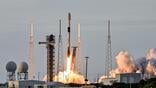
Podcast: Innovate, Compete, Win—Aviation Week's Space Tech Challenge Awards
Aviation Week's Robert Wall and Garrett Reim are joined by Russ Matijevich, space industry veteran and a judge in the Space Tech Challenge Awards. Nominations are now open for the awards—could your solution be a winner?
Find out more and apply here: https://spacetechchallenge.aviationweek.com/
Listen Here:
The Space Tech Challenge Awards connect execution-ready innovations with the government agencies, prime contractors, and commercial operators actively seeking them. From lunar operations to Mars missions, the space industry faces nearly 200 validated capability gaps. The Aviation Week Space Tech Challenge Awards recognize solutions already in development — prototypes tested and advancing toward deployment. Presented at Space Tech Expo USA, this program connects working technologies with government agencies, prime contractors, and commercial operators ready to integrate them.
Subscribe Now
Don't miss a single episode of the award-winning Check 6. Follow us in Apple Podcasts, Spotify or wherever you listen to podcasts.
Discover all of our podcasts at aviationweek.com/podcasts.
AI-Generated Transcript
Robert Wall (00:06): Welcome to Check 6. Today we explore the challenges of bringing about the next revolution in space and perhaps more importantly, how to overcome them. The full economic exploitation of space is getting real, brought down by launch costs that have gotten much cheaper and it's on every government's agenda. No one you talk to in government now would not say they need to have an economic space strategy. And I think nothing made that more clear than NASA administrator Jared Isaacman in his first town hall with NASA staff had something pretty interesting to say I thought, so I kind of wrote it down. We must uncover the long awaited promise of pharmaceuticals, biotech on orbit computing. Anything that can contribute to and perhaps someday entirely justify the cost of maintaining inhabited orbital outposts. Obviously sounds great, but there's still so many challenges to make all this happen. In fact, from Lunar Operations to Mars missions, the space industry faces nearly 200 validated capability gaps.
(01:09): To help address those and find ways to close them, we, at Aviation Week, have set up the Space Tech Challenge Awards with the goal of connecting execution ready innovations wherever they may be with government agencies, prime contractors and commercial operators that need them to realize their ambitions. Joining me today to talk about all this and the challenge awards are Garrett Reim, Aviation Week's Space and Emerging Technologies editor and a key person on this initiative. And one of our Space Tech Challenge judges is our graybeard, Russ Matijevich, a veteran aerospace industry executive. I'm your host for today, Robert Wall, Aviation Week's Executive Editor for Defense and Space. And before I get to you, Russ, to talk about what you're looking for in terms of innovations and ideas, Garrett, perhaps briefly sketch out for the audience what the gaps are we are trying to help bridge.
Garrett Reim (02:01): Thanks, Robert. Yeah, just to elaborate on what you were saying is there's this growing sense that there's a lot of commercial value in space. This is something that people previously had seen mostly as science fiction. Space had been valuable for the military, for communications, for navigation, for observation. Of course, NASA had niche science missions and there were communication satellites up there, but broadly speaking, the space industry was relatively small. But now because of falling costs for launch and electronics, new approaches to engineering, new form factors like the CubeSat, there's this sense that we're getting close enough where we can exploit value in space commercially. You don't need necessarily a big government contractor subsidizing it, but we're not quite there yet. And so there are these gaps, technology gaps that need to take us that last leap to really extract value from space. For example, the moon is talked about a lot, colonizing the moon.
(03:06): There are natural resources on the moon like frozen water ice, H2O, which could be broken down into hydrogen and oxygen. That's valuable for creating rocket propellant. The moon has a smaller gravity well than the earth, so you could conceivably launch satellites or spacecraft to Mars easier from the moon using rockets launched from there. There's also speculation about extracting helium-3, which is used as a refrigerant for quantum computers or other hardware back here on earth. So that's one area where people are trying to develop technologies to extract that value and there are gaps. They haven't quite figured it out, but that's an area people are pursuing. There's also, you're mentioning Jared Isaacman's talk about the biomedical industry and space. How do we exploit microgravity? And so there are gaps in terms of making pharmaceuticals or manufacturing work in low earth orbit space stations. We have four categories that we've sort of divided up the economy into.
(04:17): Colonization, that's like the stuff I talked about relative to the moon, sustaining human presence beyond earth. Industrialization, this also kind of relates to the moon, space resource utilization, but also the microgravity manufacturing, for example. Commercialization, this is sort of the new space economy that I think more people are familiar with. That's stuff like Starlink or these earth observation satellites that are giving us really increasingly clear and rapid pictures of what's going on on earth. And then of course the other older but still big and growing defense industry. You have initiatives like the Golden Dome, well, just really a wide variety of potential military applications in space. And so those are sort of the broad categories. And then we have individual technologies we're interested in and we're looking for people to put forward their own ideas as well.
Robert Wall (05:19): Great. Well, Russ, first of all, thanks for giving us your time, not just for this, but actually for the whole initiative. I really appreciate that. It takes people to really understand this issue to look through all these proposals that we are having come in. But I'd kind of like your take. What is it you're kind of hoping to see? What do you think would excite you? What are you looking for? And maybe even what aren't you looking for so much?
Russ Matijevich (05:48): So for me, as we were going through the different technology areas that NASA had listed and the DOD has listed, we had a very spirited interactive discussion about it. And I just kept coming back to this line from the movie Apollo 13 when they're trying to go through the startup procedure and everybody's talking and stuff and the one engineer's like, "No, it's all about power." If we don't get power, we have nothing. And really, I think that is the inflection point that we need to achieve to make all these other things fall in place. Everything Garrett just mentioned about the activities we want to do on the moon, it's going to require an awful lot of power. And solar arrays just aren't going to be ... They don't have the power density necessary to feed that type of effort. If you look at the space station right now with all the arrays that it has, it generates less than 200 kilowatts of power with those arrays.
(06:57): And so now you're talking about mining and breaking up water molecules into hydrogen and oxygen to create rocket propellants or any other types of mining or just sustaining people on the moon, the life support systems, compute systems, all that, that takes a tremendous amount of energy and where are we going to get it from? So I want to see folks look at ways to increase power, both from an electricity generation perspective because natural gas isn't necessarily going to work on orbit, burning coal isn't necessarily going to work on orbit, steam's not necessarily going to work, but electricity, we've proven it works. You don't think drill baby drill is going
Robert Wall (07:41): to work on orbit?
Russ Matijevich (07:44): Well, I used to scoff at the people who said, "No, we're going to go to an asteroid and we're going to drill on this asteroid and we're going to recover these rare earth elements and bring them back." And I thought, "Oh yeah, that's kind of ... How are you going to overcome the huge cost of doing something like that?" And then I spent two or three hours with one of the investors who was sponsoring it and he said, "Look, if I can get this unbelievably small amount of material back from one of these asteroids at current market prices on the earth, it would pay over and above everything that I had just invested. And I'd only have to do that one or two, maybe three times." And we're not talking train loads of material. We're talking something that you could conceivably be able to get to and say, "Oh, this is achievable.
(08:40): This is doable." So that is, and that kind of gets into some of the things we're looking at is if you're going to do resource mining in space, can you get it? We've demonstrated all the piece parts. We've gone in, we've rendezvoused and we've docked, we've landed, we've drilled, we've collected, we've returned. So there is that opportunity from a technology perspective of how do you do resource collection and mining in space. But coming back to power, it's not only to power the systems and provide power to humans on the moon or Mars, but it's also on the propulsion side. We've got to have some sort of transformative big next step in space propulsion because what we currently have with chemical propulsion and ion hall effect thruster type of propulsion, it works for low earth orbit and it works for cislunar orbit, but I don't think it's a sustainable technology for us to explore our solar system when it takes you at best six to eight months to get to Mars, that is a lot of time stuck not doing your mission and it increases your risk profile of all sorts of bad things happening while you're in transit.
(10:07): So if you could come up with some type of advanced nuke powered fission and plasma, whatever, Star Trek type of stuff. And I'm a Star Trek baby, if we could cut that time in half, just imagine what that could do for decreasing costs, increasing time spent on Mars. And if it is something where you don't have to replenish it as often like you would with traditional chemical propellants, that could be a game changer as well. So my focus really is going to be on the power innovations coming through. I mean, I'll be looking at all the other stuff, but right now I think power is going to be the coin of the realm as we go forward.
Robert Wall (10:53): And are you thinking of it more at a system level because it could also be enabling technologies or would you like to see both, frankly?
Russ Matijevich (11:02): I'd actually, I'd love to see both. There's some really exciting advances in nuclear reactor technology where you've got micro reactors, you've got mini reactors, you've got salt cooled reactors, all this stuff that's kind of percolating on earth as folks look for an alternative to petrochemical electricity production that has greater energy density than solar and wind and better reliability. And you kind of very quickly end up at nuclear being the source and how do we use that? How do we leverage it and take advantage of all the advances that have happened in the past 60, 70 years, and then translate that to earth orbit and use in space. All this talk about putting data centers in space. And I would tell you right now, I am a big fan. I live in Loudoun County, Virginia, the home of the cloud, and I am all for getting those things out of my backyard and putting them either on orbit or putting them under the water somewhere because the impact on just the everyday people who live here, increased energy costs for electricity, increased electricity costs, increased water costs, because those data centers use a crap ton of water to cool and condition.
(12:30): So if we do put those in space, they're going to need a lot of power. And I don't think solar arrays, I don't think you can build a solar array big enough to sustain that over the lifetime to make the data center profitable. So there's got to be an alternative. So at the system level, what is your alternative to solar power or subsystem level? And then at the mission level, what are you going to do with it? And I think once you get to that type of non-solar-based electrical production, electricity production, that opens all these other mission areas, data centers definitely one. On-orbit data centers are definitely one, but think about rendezvous and prox ops, the stuff that Astroscale is trying to do. If you're going to do on-orbit servicing, wouldn't it be great if you didn't have to worry about these massive solar arrays hanging off your RPO vehicle as you're trying to get close to your client?
(13:26): That could be kind of cool. Just imagine if you're part of a Golden Dome architecture where you've rapidly got to be moving around, tracking multiple targets, scanning multiple areas. Wouldn't it be nice if you didn't have to sit there and wait for your solar cells to quit flapping so your settle time is reduced? Or maybe you want to create a network of sensors in Golden Dome that don't have these giant reflective panels that say, "Hey, here I am, come shoot me down." So if we can get away from solar power as our source of electricity for on-orbit operations, it opens up a whole bunch of other mission areas or expands current mission areas in ways that I'm not sure folks have really thought about, but could be game changing.
Robert Wall (14:15): Yeah, very interesting. I wanted to throw one out to either of you, frankly, because not everyone who's listening to this, watching this is going to be familiar with the challenge awards that we're putting forward. It's the first year we're doing them, obviously. So there are a lot of incubators that exist that are startup incubators that are trying to drive at innovation in space, obviously in other fields too. How would you say guys say, what's the difference? What are they doing that is ... Where are our challenge awards different than what they might be doing?
Garrett Reim (14:56): Well, incubators and accelerators are often looking for companies with technologies at a particular point in their life, their technology readiness level. They want to seed the money, help with the business plan, maybe help refine some of the applications or further development, but they want to see a rapid takeoff. And so if you're before or after that stage of life, an accelerator may not be a good fit for you, it may not ... Obviously you're there for the mentorship and the money, the investment, but they also, of course, like a Y Combinator or someone brings recognition. I think this would differ in the sense that we're looking at a huge swath of technologies, and so we're open to much broader group of people and technology readiness levels. So maybe you're at a point where you're too early for an accelerator, you're too late, or maybe you are right there. This is more focused on the technology itself than explicitly a place where you're trying to accelerate into your business or incubate your business.
(16:13): There's a place for accelerators and incubators, but ours is we are a technology publication and we're very interested in the technology itself. And that's my take.
Russ Matijevich (16:24): I would add to that, my approach to this is we're almost not quite the DARPA of commercial space innovation, but it's in that vein of we want to celebrate the technological innovation and the steps they're taking forward towards something that is eventually commercially viable. So in some respects, we are a pre-incubator opportunity for these folks out there. These startups have a great idea, they're trying to get it working, it's showing some promise. They can come in and they can compete against their peers in the industry and get, not to toot our horn too much, but we know a thing or two about space because we've seen a thing or two about it. And I think a technology that has won an Aviation Week award is that is you've passed a litmus test of note. It's not just, "Hey, I've done this and I think I'm great." And my buddy Bob over here agrees with me.
(17:34): He's like, "No, you've been independently weighed and measured and found worthy of recognition and support going forward." And so I think that opens doors to future incubation for those companies or possible direct investment from other sources or hopefully for all the startups out there, the magic non-dilutive capital investment from NASA or from the DOD or other entities that are out there.
Robert Wall (18:05): Yeah. I mean, to play on that, since you mentioned DARPA, we always talk about the valley of death, right? DARPA does help something and then it doesn't go anywhere because the services don't pick it up. I mean, in a way, we're trying to bridge that valley of detection. Someone does something at a university or a small company or maybe even a unit of a company and the parent doesn't even know about it. And by giving them the award or the recognition, other people will know it's there. And then they'll be like, "Oh, maybe we should have that conversation and create that pull." So I always think DARPA's always good to invoke. It always helps with the argument some way or another, even if you don't want to do exactly what they're doing.
Russ Matijevich (18:45): All these different facets of technological development, they all serve a purpose. And if one of them goes away, the entire system suffers because of it. So one is not better than the other. They're just focused on a different facet of the problem of how do you get technology from somebody's idea? How do you turn the science fiction to science fact? And you've got to have all those players playing their part in an orchestrated development effort that eventually gets to something that is completely viable. Just because I am a Star Trek nerd, the Star Trek communicator, in the '60s, this is a non-functioning prop that they used, and now this particular one is an actual Bluetooth headset. And this idea that was put into people's brains led to our actual functional communicators. And now with Starlink doing direct to device, I mean, this really is becoming true.
(20:01): And that I think is the greatest thing about this business, of being able to work with folks like you and having the sponsorship of Aviation Week Network to incentivize these great ideas that folks are working on is this doesn't happen without that support, without that energy and without people caring and saying, "Oh, that's really cool. Have you thought about this or what about that?" Or, "Hey, how much do you need to get to the next step?" And that is what this challenge is all about, is to help those folks who've got that next great idea and the world just doesn't know it yet because they haven't had the stage to stand up on and say, "Hey, look what I've done. Isn't it kind of cool?" And see where it goes from there. And I'm super excited about what we're going to see over the next few months and looking forward to announcing the winners at the SpaceTech Expo this summer.
(21:06): So yeah, I'm excited.
Robert Wall (21:08): Yeah, that's terrific. No, that's a great example. Thanks so much. Garrett, actually, again, just tell our audience a bit, what is it? What's in it for the people? Why should they participate aside from getting to present their great ideas to someone like Russ?
Garrett Reim (21:25): Well, I think both of you are getting at it. The valley of detection is really important to the recognition that is going to come with these awards, you're going to get highlighted aviationweek.com within our premium subscription service, Aviation Week Intelligence Network where you have a lot of big prime manufacturers and venture capitalists who subscribe, and then the magazine, of course, and then at SpaceTech Expo, you'll also be highlighted as well. So that's a lot of exposure, which is important for small people, big people. If you're a startup, obviously it's good for attracting investors. Even if you're a big company attracting partners or getting key vendors, we have a smart panel of judges who are going to give you a lot of feedback and you can never get enough feedback. Along with that, the judges, your fellow participants, there's going to be some great networking opportunities. And frankly, one of the biggest bottlenecks in our industry is talent.
(22:35): This is a recruiting opportunity from the sense that you can meet other people who might be great to work for you, but also that you're, again, getting recognized as doing something cool and people want to work on cool things in the space industry. Engineers these days have choice of any number of six-figure salary jobs. A lot of it comes down to, what am I passionate about? What really intrigues me? And this is, I think, an opportunity for people to stand out, again, within the pages and on the website of Aviation Week, but also at the SpaceTech Expo in Anaheim this summer. So yeah, it's a pretty well-rounded set of benefits.
Robert Wall (23:17): Yeah. Well, I mean, I actually look forward to seeing that stage in Anaheim in early June where all these people can get to present their ideas and we'll see the winners. So I think that'll be really exciting. And for people who don't know the event, it's a very much a space supply chain focused event. We have primes there, we have suppliers there. It's a great place to find people who might be interested in your idea. Well, I think let's leave it there. Thanks Russ so much for, again, for joining us here, but also for all the work you're doing. Garrett, as always, great to have you on this. I also want to thank our producer, Guy Ferneyhough, who's pulling all this together. And I do want to end though with a plea to our audience. If you think you are up to this challenge or if you know someone who should be, do get in touch.
(24:10): The application window is open now. You have until the end of February to apply. So get on with it and get the word out there. There are details that we'll have links to in the show notes. So if you have more questions, look there or get in touch with one of us. We're more than happy to connect you with how to do it. With that, thanks for listening and Russ, Garrett, and I really look forward to meeting up with many of you in Anaheim over the summer. Thanks so much.


Related Content