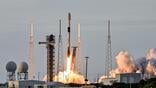
Podcast: How Starlink Became SpaceX’s Cash Cow
The Starlink satellite venture’s stunning success has brightened Elon Musk’s bumpy year, but has awakened China. Editors discuss Aviation Week's recent cover story on what has become SpaceX's cash cow.
Nominations for Aviation Week Network's 2026 Laureate Awards are now open! Submit your nominations by October 16, 2025. Nominate here
Subscribe Now
Don't miss a single episode of the award-winning Check 6. Follow us in Apple Podcasts, Spotify or wherever you listen to podcasts.
Discover all of our podcasts at aviationweek.com/podcasts
AI-Generated Transcript
Joe Anselmo (00:06): Welcome to Aviation Week's Check 6 podcast. I'm Joe Anselmo, Aviation Week's editorial director and editor in chief of Aviation Week and Space Technology magazine. Love him or hate him. When Elon Musk sets out to do something, he goes big. Musk's feuds with President Trump and Tesla's financial woes have gotten a lot of attention in the news media recently. Less talked about is the stunning success of SpaceX's broadband internet service, Starlink. In just 10 years, SpaceX has launched more than 9,000 Starlink satellites. The service now has more than 6 million users across 140 countries and territories. Starlink is now SpaceX's largest segment, powering the company toward $15.5 billion in sales this year. To put that in context, Musk says SpaceX's contracts with NASA will generate just $1.1 billion in revenue this year. Although some critics dispute that number as a bit lowballed. Competitors are racing to catch up, but by many measures they're falling further behind. So what's the secret to Starlink's success and what does it mean for this fast-moving commercial space industry? Aviation Week's Garrett Reim led a team of editors who spent weeks digging into that question. He joins us today from Seattle. Also with us is Irene Klotz, Aviation Week's senior space editor, who is in Cape Canaveral. And rounding out the discussion with me here in Washington is business editor Matthew Fulco, who wrote about China's massive response to Starlink. Garrett, let's start out with you. This is really a juggernaut, isn't it? Starlink?
Garrett Reim (01:50): Yeah, it's upended the industry and it's upending geopolitics. What you see in Ukraine, you see China's response to it. It's totally changed things. You have to go back, not that far, but a decade, 10 years ago, January 2015 to where this formally started. There've been attempts at doing low Earth orbit broadband internet satellite constellations before. But Elon, his vision is somewhat special on the scale of what they've achieved. He also, the short story is Elon showed up in Seattle in January 2015. He had this idea for doing internet broadband constellation. Well, he wasn't the first thinking of this idea. Other people had been circling around it. Other people had tried and failed, like Iridium for example. He came to Seattle because Los Angeles was essentially tapped out. All the aerospace engineers had been hired by SpaceX or others down there like Raytheon. And so he saw a pool of people in Seattle that might be able to make this happen. And he had a recruitment event with them. And back 10 years ago, a video of it leaked online and we report about it in our article and he said essentially, this is all to pay for Mars to generate a ton of cash so we can build a city on the red planet.
(03:24): And then he elaborated his vision in pretty extensive detail. This is going to cost 10 to 15 billion, 10 to $15 billion. We're going to build more than 4,000 satellites. It's going to take 12 to 15 years to complete. In fact, they have built double the number of satellites. He initially proposed more than 9,000 satellites, and they did it in a couple years shorter than he thought. So in some ways, this is one of the most successful products that he has led development on. Starlink is not directly subsidized by the U.S. government. It doesn't get indirect subsidies via what government customers pay for launch vehicles and so on and so forth. But compared to a Tesla Model S where you get a direct government subsidy, this is just mostly living off people who want internet. And there are a couple of pieces to this puzzle. One is the reusable launch vehicle aspect that brought down launch cost.
(04:32): Irene's going to talk about that more, but the part that hasn't been talked a lot about and isn't well understood is he talks about this in 2015 is essentially said he felt that the space industry was not good at mass manufacturing. He said, you're good at designing stuff, but you're not very good at repeatedly manufacturing something. He said we're going to take a new approach. We're going to design satellites like you would an automobile or consumer electronics or even a server farm using cheap PCs to build a server farm. And the idea is that quantity has a quality all of its own. They have a certain margin of satellites, they need to make this network work, they lose some. That's just the cost of doing business. And this has really transformed the thinking in the space industry, which previously for valid reasons had a sort of failure is not an option ethos.
(05:33): That's not actually a NASA saying. It came from the Apollo 13 movie, but it is pretty emblematic of the way that NASA and the space industry operates for good reasons. Like I mentioned, one, you're often dealing with humans, so you can't have such a fast and loose attitude to their safety. And two, launch is expensive. So you want to make sure you maximize every expensive launch with a really high quality satellite that's been qualified and triple checked. But Falcon 9 partially reusable rocket brought down launch costs so that allows them to take more risk on the qualification side of the satellite. And then that allowed them to build the satellites cheaper and at scale and in a scale that's unprecedented. There are more Starlink satellites up there than there are any other satellite or country satellites in the history of the world. It's hard to exaggerate with the scale of this project. So yeah, that's really changed people's thinking and it's made Seattle into the satellite capital of the world. Elon eventually fired the founding team of Starlink and then they went right over to Jeff Bezos and now Amazon is building a rival constellation in the Seattle area. So it's pretty hard to, like I said, exaggerate how much this has changed the space industry. It's very complicated. It's changed geopolitics. There's a lot going on. I want to throw to Irene so she can elaborate on the launch vehicle aspect and the other things that are going on as well.
Joe Anselmo (07:15): A quick question for you. I mean, you're right. There were a lot of fascinating statistics in this article, and you're right, it couldn't have happened without the cost of launch going down several orders of magnitude. But you had one statistic electronically steered antennas. It used to cost hundreds of thousands of dollars. Starlink charges $349. I thought that was mind blowing to me.
Garrett Reim (07:40): Yeah, I get teased a little bit at Aviation Week for being so interested in satellite terminals, which are these basically flat pieces of electronics. You strap at the top of your house and that do not fly, that nobody at Aviation Week is particularly interested in, but it's sort of a bottleneck. If your consumer cannot access the internet cheaply, then what's the point of building a satellite if they can't communicate with it? If they have to pay an enormous amount of money for an antenna, then your whole system won't work. And previously this was less of a problem with geostationary satellites because you just have a parabolic dish that kind of just points in one direction. It's a pretty cheap piece of metal, but with low Earth orbit satellites, these are zooming across the sky. So you constantly have to be tracking or adjusting where you're looking for your signal.
(08:32): And they have brought down the cost essentially using economies of scale. They are mass producing these in Texas, I can't remember the last count, but it's well over a million a year. And typically people had gone to Asia to produce in large quantities, electronics. And so it is pretty remarkable what they're doing on the flat panel antenna world as well. And yeah, Amazon has its own approach to bring down the cost of antennas and they also, their terminals are comparable in price. And I should mention one of the guys who was core to both of these efforts, to Starlink and to Project Kuiper, which is Amazon's rival constellation is a guy named Rajeev Badyal. He was the leader of the Starlink project, SpaceX's VP of satellites.
(09:36): But before that, he worked for Microsoft and he led development of the much maligned Zune, the iPod competitor that's in the butt of many jokes and was not much of a commercial success. And then he also did manufacturing of optical mice, the computer mice that you use, not the most amazing resume, but what he did have at that point was a lot of experience with mass manufacturing. And for whatever reason, Elon saw something in him and he's now led the development of Starlink and Kuiper. So pretty good second and third acts for this guy's career. And it shows you how looking at the problem differently has really changed the equation in the space industry.
Joe Anselmo (10:27): Irene Klotz welcome. Tesla was once the Starlink of the electric automobile industry and others have caught up with them, particularly Chinese ventures. Is Starlink's lead insurmountable or is this just an early start and others are going to be catching up?
Irene Klotz (10:46): Thanks, Joe. So Starlink is fundamentally different in the sheer number of spacecraft that are needed to provide the services. I think it's important to note that Starlink was not the first operational mega constellation. That went to OneWeb, which had lots of issues with launch, with bankruptcy, all kinds of things. And that is a complete network. They're not as well known since they're not a direct to consumer service provider. Starlink itself has it started, it was the ends to create wealth for SpaceX to pursue crewed development of Mars. It's become something entirely different now. It's one thing that I was reading up on a little bit, which I really like. The idea of this is that when SpaceX started launching Starlinks in 2019, there were something like 2000 operational spacecraft by every country, every organization worldwide in orbit. SpaceX is now launching about that number of satellites every year.
(12:13): So it's this sheer volume of hardware going into Earth orbit that's really changed. It's not the only constellation. Of course, there's something like 400 of them, not all of them devoted for communications, but certainly the technology that SpaceX is using and their approach to basically technology development, which is this iteration. It doesn't need to be perfect. It needs to fly, get tested and then improved upon. But it raises all kinds of other questions, which just how this will play out in terms of the effect that having so many satellites in low Earth orbit has on astronomy, the access to space when you're launching now, there's all these collision avoidance periods where you actually can't launch because there's satellites overhead. That's happening more and more the whole way of having all of these objects in orbit at the speeds. If something messes up with a system that doesn't have the ability to deorbit itself or it explodes, it is not like the debris falls harmlessly away.
(13:38): Everything stays in space. So it's definitely on, definitely embarking on a new era here and nobody really knows how this is all going to end up. The entrance of Amazon in this market is interesting because they do have one thing that SpaceX does not have, which is a standing army of customers, all the Amazon Prime members and the ability to deliver a service with that retail experience already extremely well established will be very interesting to see how the whole race to get our internet costs down will be. Frankly, I haven't really seen that much of a change when I have a landline connection and when Starlink and some other options came around, yeah, they dropped the price a little bit, but we're not talking orders of magnitude as far as being a consumer of the services.
Joe Anselmo (14:46): Matt Fulco, welcome. You wrote an article as part of this package with Garrett and Irene talking about China's response. I mean the Ukraine war and the use of Starlink by the Ukrainian military was really a wake-up call to China. So how is the Chinese government market, whatever you call it, responding.
Matt Fulco (15:05): Thanks, Joe. So China has had an ambition to be a space power for years and space was something that really goes back in terms of their ambitions probably to the founding of the People's Republic decades ago, seven decades ago. But you're right, that Starlink's use in Ukraine has been a catalyst for the development of their mega constellations. And Chinese leadership concluded that they did not want to be dependent upon U.S. technology for their own satellite constellations, whether that's commercial or otherwise. And when Xi Jinping visited Russia in May, the Chinese and the Russians put out a joint statement and they didn't name any companies, but it says that two sides condemn the use of commercial space systems to interfere in the internal affairs of sovereign states and armed conflicts involving third countries. So I think we can get an idea of what they're talking about there.
(16:13): With regards to the actual mega constellations, the efforts are pretty recent. The first launch was in August of 2023, and there are about four or five companies that are all competing in this space, but there are two that we really need to watch right now. One of those is based in Beijing. It's called SatNet and it operates the G-Wang Constellation. And the other is called Space Sail, and it's based in Shanghai and operates what's called the Thousand Sails Constellation. There is a third player G-Space, which is owned by the Chinese automotive company, Geely, which owns the brand Volvo. They plan to launch 6,000 satellites, but they're at an earlier stage of development. So with the prominent leaders, SatNet and Space Sail are the leaders of the pack for the moment. One of the interesting aspects here is that if SatNet had been as successful as hoped, it's possible we wouldn't have needed Space Sail at all because each one of these companies has very large ambitions in terms of their mega constellations.
(17:33): How it looks now is that both Space Sail and SatNet are competing in this space. And what's interesting is that SatNet operates more like a traditional state-owned Chinese company. It's fully owned by the government based in Beijing, little bit of a slower operational model, a little more bureaucratic. Space Sail based in Shanghai, a little more of a commercial orientation. They got $933 million early in 2024, got off to a very fast start. And in their early launches, the time between launches narrowed from about 70 days between the first two batches to 48 days between the fourth and fifth. But in recent months, it's interesting to note that Space Sail has experienced some growing pains in the last launch date in March.
(18:31): They hadn't, well, about 70% of the Thousand Sails satellites have not reached their target orbits, and that fell short of the expected performance. And that's based on data collected by the U.S. Space Force because China, Chinese companies do not release a lot of this data publicly. So that is based on data from the Space Force. We think that this deployment pause will probably be used to resolve technical issues with the satellites, perhaps securing new suppliers and retesting certain systems. One challenge for both SatNet and Space Sail is the lack of reusable rockets. And we know that's been crucial for Starlink's launch cadence. Space Sail has publicly tried to procure reusable rockets twice this year, but interestingly, they withdrew their response due to a lack of interest from bidders. And while they both have been well funded today with a lot of government money and also Chinese venture capital firms, that some of that's private money, but a lot of it still links back to the Chinese state.
(19:42): There are some questions about funding in the future. One report published by Chinese media publicly on the Sohu.com site found that or estimates the Thousand Sails constellation will cost about $7 billion U.S. dollars and could struggle to be profitable. However, there are opportunities overseas for Space Sail and it could potentially look at some of these markets where Chinese telecoms giant Huawei has been successful and build on top of Huawei's 5G infrastructure. Huawei is present and more than, I mean I believe it's about 180, 190 countries in the world. So that's also something to take into consideration, especially Huawei having benefited from all those government subsidies. Chinese satellite mega constellations are likely to or are benefiting as well. So one other factor looking ahead that is relevant for both of these companies is the fact that LEO space is getting crowded and that there's limited carrying capacity. So as satellite traffic increases, so does the risk of debris buildup and possible collisions. So China is trying to do things as quickly as possible. That's not the only reason that, that's certainly something to take into consideration. As competition intensifies, they'll speed up their pace of satellite deployment and try to flood the zone and get those orbits.
Joe Anselmo (21:21): Irene is our senior space editor. I was hoping you could bring us full circle on this podcast. You've been covering Elon since 2004. I thought it was fascinating that Garrett said it that noted at the beginning he didn't start Starlink to say, oh, it'd be cool to have a broadband high-speed constellation. He did it because he needed a cash cow to get to Mars. This is his cash cow and it's working right.
Irene Klotz (21:47): Well, as a private company, the evaluation of SpaceX, of course is a little bit open to interpretation, but SpaceX has been very successful in securing business from the U.S. government, all different branches. And the Starlink obviously represents an ability to tap consumer pockets as well. And there's apparently an unlimited demand for internet access. I guess there's an awful lot of cat videos people want to share. I once asked Greg Wyler about why we needed all this. He says he is not responsible for what people are doing with it. Greg Wyler, by the way, is kind of considered the godfather of this whole movement. And he started not in satellites, but with connectivity. He'd be happy to do it by wire if that proved to be a suitable technology. So there are different motivations. I think for Amazon it definitely will be a financial expectation and that should be much more visible since they are a publicly traded company.
Joe Anselmo (23:08): Okay. Well, on that note, we are just about out of time, but I wanted to thank all three of you for taking the time to share your insights with our audience. A special thanks also to our podcast editor in London, Guy Ferneyhough, and to our audience, thank you for your time and have a great week.




Related Content