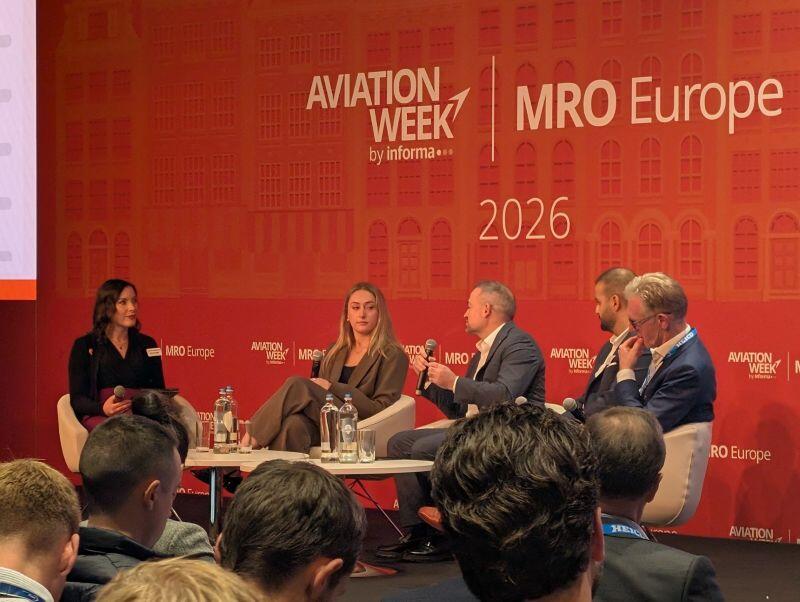
MRO Europe panel on workforce evolution and retention.
AMSTERDAM—Time to competency emerged as the leading workforce concern at MRO Europe, as industry and education leaders called for closer collaboration, improved training and stronger career development to address skills shortages.
The time it takes to develop competent technicians is putting pressure on the maintenance industry, according to panelists discussing workforce evolution and retention at MRO Europe.
An audience poll ranked time to competency as the biggest workforce challenge, followed by skills shortages, recruiting new talent and retention. The results highlighted the difficulty of developing technicians quickly enough to meet operational requirements, even as MRO providers work to attract new entrants.
Kenan Şahan, senior vice president of human resources at Turkish Technic, said the challenge extends beyond recruitment numbers to how quickly technicians acquire the skills and authorizations needed to work independently and safely.
“We are racing against time. It is time to competency,” he said.
Turkish Technic is working with vocational schools and universities to identify candidates early, assess their development and provide practical experience before they enter full-time employment. Its program includes a six-month development process and internships at the company’s maintenance campus.
Şahan said around 55 recruits a year come through the student pipeline, with participants requiring less onboarding time than other candidates entering comparable positions.
Sorush Satar, technical product manager at Lufthansa Technical Training, said training also needs to adapt to the expectations of younger generations, with greater emphasis on hands-on activities, simulators and digital technologies. He highlighted the value of combining classroom learning with practical experience through collaboration between schools and the wider industry.
Henri Werij, dean of TU Delft’s Faculty of Aerospace Engineering, urged companies to engage with students before graduation through internships, research projects and closer involvement in university programs.
“If you just arrive when they graduate, I can tell you that most of them already found a job elsewhere,” he said.
The competition for talent extends beyond aviation. Aerospace engineering graduates in the Netherlands, for example, are being attracted to the semiconductor industry, where their systems-thinking and problem-solving skills are also in demand.
The panel also highlighted the importance of developing broader competencies alongside technical expertise, including communication, critical thinking, teamwork and digital literacy. Kerri Kunkel, business analytics manager at BAE Systems, said reliable data is essential if technology is to support training and transfer knowledge from experienced employees.
Retention, meanwhile, depends partly on the quality of leadership and the career opportunities available to technicians. Şahan described the risk of promoting highly skilled technicians into management without adequately preparing them for the role, potentially losing technical expertise while creating ineffective managers.
Panelists called for clearer development pathways, continued learning and more approachable leadership. They also noted that maintenance careers could be made more attractive by showcasing technicians’ work and the increasing technical nature of their roles.
While artificial intelligence is expected to change maintenance processes and support predictive maintenance, the discussion suggested that technicians will remain essential. The challenge for MRO providers is to ensure training, recruitment and career development keep pace with changing requirements.

Related Content