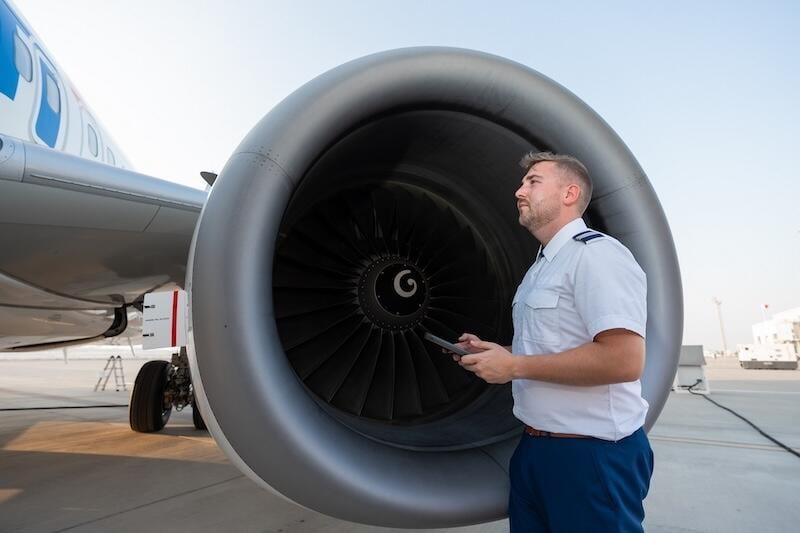
The Middle East's expanding engine MRO capacity has yet to keep pace with fleet growth, but FlyDubai says the more immediate constraint is the availability of spare engines, specific parts and repairable material.
“The region’s biggest operational challenge is not capacity itself; it’s the availability of spare engines, critical parts and repairable material,” says Mick Hills, chief operations officer at FlyDubai. He tells Aviation Week that airlines and MRO providers across the region remain dependent on a global ecosystem of OEM parts, life-limited components, used serviceable material, specialized repair capacity and spare-engine inventories.
While Middle Eastern MRO capacity is expanding rapidly, Hills says regional fleets are growing faster, meaning the increase in capacity has not yet fully closed the gap with airlines' growth plans. The more fundamental issue, he says, is whether the required components are available when needed.
“Shortages of critical parts, longer repair cycles and intensifying competition for used serviceable material significantly impact turnaround times and aircraft availability for every operator across the industry,” Hills says. However, he says the operational impact depends largely on how far in advance an airline has positioned itself to manage the constraints.
For FlyDubai, that has meant extending its maintenance planning horizon. Hills says the carrier historically forecasts maintenance requirements two to three years ahead but now plans more than five years in advance to secure resources before they are required.
The change reflects limited spare-engine availability, supply-chain constraints and extended turnaround times for some repairs, he says. FlyDubai is securing shop-visit slots earlier and maintaining continuous coordination with OEMs and MRO partners, while also ensuring access to spare engines and repair capability.
Hills says FlyDubai has also secured additional engines for its Boeing 737 fleet through purchasing and leasing agreements ahead of typical industry timescales. Its strategic agreement with CFM International for Leap-1B engine support includes spare-engine coverage.
The airline's approach comes as its fleet continues to grow. According to Hills, FlyDubai has more than 97 aircraft, with a further 12 deliveries expected later this year, increasing the importance of planning engine requirements well ahead of operational demand.
The carrier is also due to complete construction of its new aircraft maintenance center at Dubai South toward the end of this year. Hills says the facility will increase FlyDubai's control over its maintenance operations and support shorter turnaround times as the fleet expands.
However, Hills does not expect greater regional MRO capability to eliminate the Middle East's dependence on the wider global aftermarket.
“The Middle East is well positioned to become a leading engine support hub,” he says, pointing to growing fleets and expanding technical capabilities. But he adds that engine support remains highly globalized, with airlines continuing to rely on international OEM networks, specialized repair facilities, material suppliers and global logistics channels.
FlyDubai therefore expects the Middle East to develop into a major regional center within the wider global MRO ecosystem rather than operate as an independent market. Greater local repair capability could reduce turnaround times and dependence on long-distance component shipping, Hills remarks, but global partnerships will remain essential as demand for next-generation engine maintenance continues to grow.

Related Content