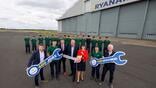
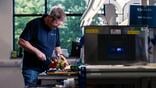
Company founder Bruce Herber (far right), with grandson Landon (center) and son Randy (left).
Bruce Herber started Herber Aircraft as a hose distributor in 1978. The niche company reached $10 million in sales in 1997, and son Randy joined in 2004. Now in its 47th year, the El Segundo, California-based company is reaching $100 million. Although Bruce died in 2024, Randy has effectively been running it since about 2012. He speaks about the company’s growth.
Why did your dad start Herber Aircraft?
He was working for a hose shop that was eventually bought by Aviall (which was then acquired by Boeing) and he just wanted to do better. We started as a distribution company for Stratoflex, which eventually became part of Parker, but he always wanted to be an Aeroquip distributor. Eventually Aeroquip came to him and asked him to be a value-added distributor. I say “value-added” because we build the hoses and distribute the parts, as well. Then, Continental Airlines brought him an EGT harness because of the hoses work he was doing for them, and that’s how we got started in that business. Eventually we added engine mounts from Barry, but later switched to Lord. So while we’re a distributor, we’ve always been a hybrid company because of the multiple avenues for revenue. Today, we manage those three product lines—distribution, value-added distribution and harnesses—separately.

Are the three parts roughly equal in revenue?
No, the distribution business accounts for about 65% of the total revenue, then the hose and harness businesses make up the rest about equally. However, the highest profit comes from the harness business, followed by the hose, then distribution.
Are you thinking about making any changes?
We are looking for an acquisition. Before COVID-19, we started looking for an acquisition to supplement our harness business and got pretty far down the line in a deal. But then the pandemic hit, and it blew up. We’ve just come around again and engaged consultants to represent us in the industry as a buyer.
What’s the M&A market like now? Are you finding many prospects?
We're looking for a small business to acquire, probably in the $10 million market value range, so $8 million-$10 million in revenue and $1 million-$1.5 million in EBITDA. HEICO, TransDigm, Eaton or Parker are not really looking at that level. They're looking in like hundreds of millions.
How has your inventory planning changed due to the supply chain problems the last few years?
It's a balancing act. For certain things that are cheaper on our harness side that we have control over, we try to buy ahead because you don't know when the lead time is going to jump or how late they're going to deliver a part. Parts that were six weeks became three months and then all of a sudden six, nine or 12 months. So we try to stock our most important parts with a good enough buffer, say one year. It's a huge cash investment, but you need that stock buffer in case suppliers are late. But you can also put the company out of business if you do that too much. As far as Eaton and Lord, we do the same thing with them, but we're buying more finished goods. I can't really speak to how far ahead they are buying material such as aluminum, steel or titanium, and whether they are stocking it, but from my experience, it doesn't seem like they're doing that, because we still have a lot of stuff that's late. I’m not going to mention which of our suppliers, but we have a vendor that still owes us parts that were due in 2023.
Is Herber Aircraft affected by the tariff wars?
Yes. Our vendors on the harness side are American, so we haven't seen any tariff pass-throughs, or maybe there are small ones built in that we don’t know about because they’re not substantial. Regarding the manufacturers, Lord hasn't had much of an increase and has been pretty up-front with us—they baked it into their price increase. It was just a few parts that were affected, and the increase was about 1%. Eaton is adding [tariff] pass-throughs line by line. We're talking with them to try to understand all the costs. It's actually quite a large number that they're passing through, so it is affecting us. If we buy a line of parts and there’s a tariff associated with it, and we sell those 100 parts to 10 or 12 or 20 customers, it’s hard to figure out who is owed what because we usually don’t get the tariff notification until after a part ships to our customers.
For price increases from Eaton and Lord, we can pass those on. That's easier than tariffs, which we are absorbing a lot of them because we're getting them a month or two after the part ships to our customers. We're about customer service, so to come to a customer after you've sold them the parts and say, “Hey, by the way, you owe me $2,000 for tariffs,” it's just not something that we can easily do. That cost isn’t in the quote or contract.
We have more than $30 million in inventory, so we could sell stock that's pre-tariff, that doesn't have a tariff associated. We could sell that stock today and not charge the customer a tariff cost. But, we also have ordered long-lead time parts nine months or a year ago, even though we're taking delivery now a year after it was quoted, we're getting hit with the tariff. It's when the part came into the country or when the raw material arrived. We are negotiating with those vendors.
How’s your market?
We're seeing a general slowdown in the industry, which I think is due to tariffs. Everybody I talk to says their bookings are down for 2025 compared to last year. We're pretty healthy. Our bookings are slightly below the plan that we had for 2025, but we feel it is a timing issue with the tariffs. So if [the tariff wars] get solved, then we think that the market could come back. We have a pretty large backlog, so we can remain healthy and keep the shipments up and survive it.
Is Herber getting any different requests or seeing any trends?
It’s changed from a seller's market to a buyer's market a little bit. With the supply chain issues, lack of material, high inflation and price increases that come with that, it was all you could do to keep up with price increases recently. There was one year we actually got four price increases from some of our vendors throughout the year. So we had to updates our prices in order to not lose money. It was so crazy that people who needed a part so badly were getting gouged by vendors. We didn't gouge, and I don't think our vendors gouged. We were just trying to keep up with the increases.
I think it's a lot more stabilized and subdued now. We did see a mid-year price increase this year from some of our vendors, but it's not the 4% or 5% increases we saw a couple of years ago—it’s closer to 2%-3% mid-year. I see a lot of customers now pushing back on price increases, so I think it's turned to more of a buyer's market. We're getting back to negotiating and best prices and all that kind of stuff, where before it was a seller's market for sure.

Related Content