This article is published in Aviation Week & Space Technology and is free to read until Dec 11, 2025. If you want to read more articles from this publication, please click the link to subscribe.

Component MROs Adapt As Supply Chain, Workforce Issues Persist

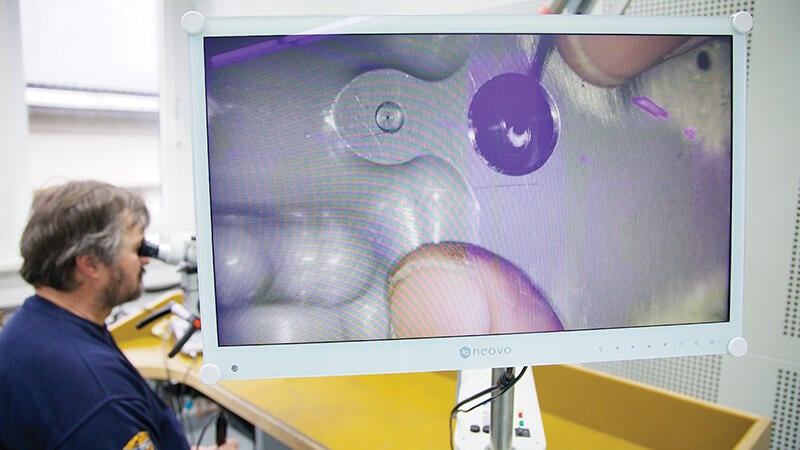
Lufthansa Technik technician at work

Some component repair providers have struggled to replace skilled staff lost to other sectors during the pandemic.

Credit: Lufthansa Technik

Components generate about one-fifth of total maintenance demand, making them the second most important part of the market after engines. Globally, component maintenance is worth roughly $25.9 billion per year and is projected to rise to nearly $36.4 billion by 2034, according to Aviation Week Network’s 2025 Commercial Fleet & MRO Forecast.

The data also shows that current-generation aircraft, including the Airbus A320ceo and Boeing 737NG, still account for most component work—about $18.5 billion this year, or 71% of the component maintenance market. By 2034, this is expected to slip to $12.4 billion, or 34% of the market, as the global fleet composition shifts in favor of newer aircraft.

By 2034, Aviation Week forecasts that new-generation models—such as Airbus’ A220, A320neo, A330neo and A350; Boeing’s 737 MAX, 777X and 787; and Embraer’s E2—will generate about two-thirds, $24.1 billion, of total component maintenance. Aviation Week calculates this by assessing maintenance demand for all components outside the engine, including exhausts, thrust reversers and auxiliary power unit parts.

Demand for component services has surged in line with the rest of the maintenance market since the end of the COVID-19 pandemic. MRO providers consistently highlight the segment as a strong driver of revenue growth.

AJW Group Chief Commercial Officer Scott Symington tells Inside MRO that the UK parts specialist’s component revenue flows from sales and trading, flight-hour-based service contracts, third-party repairs and managing customer-owned repairs.

“Since the end of the pandemic, demand across all these areas has grown significantly,” Symington says. “Delayed aircraft deliveries, supply chain shortages and extended use of older fleets have all fueled a greater reliance on component maintenance.”

That said, while maintenance demand is back to or even above pre-pandemic levels in certain regions, the process was uneven at first, observes Jim Berberet, senior vice president of component services at AAR Corp. “The end of the pandemic was a long, drawn-out process as some global regions recovered much slower than others, but we remained nimble and agile to support customers to keep aircraft operational, as we are a global MRO,” he says. “Now demand has picked up significantly.”

Lufthansa Technik technician at work
Many component specialists are investing in new repair technologies to offer their customers alternative solutions. Credit: Lufthansa Technik

Supply Chain Response

Supply chain delays remain an issue for the component aftermarket; shortages of spare parts and other materials continue to affect turnaround times.

“Turnaround times remain under pressure, largely due to the all-too-familiar supply chain delays and extended lead times on spare parts,” Symington says. “To offset this, we rely heavily on [used serviceable material (USM)] where available and on our substantial serviceable inventories, which allow us to keep customers’ fleets operational.”

It is a similar story at AAR, where Berberet says that “from adhesives to piece parts, shortages have impacted our component repair.” Turn times have suffered, he adds, and AAR has responded by developing repairs and using USM where customers approve.

However, USM supply remains tight due to the extended service lives and delayed retirement of many popular aircraft, although it can boost the repair side of its business, Symington says.

“With the continued shortage of spare parts and older aircraft not being retired or parted out at the pace expected, operators are relying more heavily on repair service providers, such as AJW, so our component MRO repairs are thriving,” he says. “To support this, we’ve invested in inventory, ensuring we can meet these demand trends and provide customers with consistent, reliable component availability.”

Technology also has a role in MRO providers’ responses to supply chain difficulties. Symington says AJW uses digital tools to predict demand variations and ensure better provisioning; artificial intelligence-supported technology updates these forecasts in real time. “This is then fed to our supply chain team to ensure parts are provisioned as early as possible in the process,” he says.

Some companies are more insulated from supply chain delays due to their vertically integrated businesses.

“We don’t rely too much on anybody else—we don’t rely on the OEMs, and we don’t rely on very many other suppliers,” says John Maffi, executive vice president of engine component repair systems at gas turbine specialist Chromalloy.

“We make our own alloy, we cast our own parts, we cut our own holes, we coat the parts, so we control our supply chain,” he explains. “I think we had fewer supply chain challenges and interruptions than anybody else that I know of.”

Chromalloy has leveraged this advantage by selling guaranteed availability of packages of parts that it specializes in, such as turbine blades and nozzle guide vanes, although it can still suffer indirectly from supply chain problems when its repairs feed into engine overhauls, throughput of which can be delayed by other suppliers.

“When somebody brings an engine to be overhauled, we can get the repairs back and forth and get our parts in pretty well,” Maffi says. “But if there are parts that the rest of the supply chain can’t supply, the engine doesn’t get delivered, and the engines start stacking up in the shop.”

aerospace technician at work
With the supply chain under pressure, demand for component repair remains very strong. Credit: AFI KLM E&M

Staffing Shortages

MRO providers often cite external component repairs as a bottleneck in a period of surging maintenance demand for mid-to-late-life aircraft. Aside from the materials shortages mentioned above, a big reason for this has been the struggles of smaller, specialized repair providers to rehire staff lost to other industries during the pandemic or to replace the senior skilled technicians who retired or otherwise left the industry.

Maffi says that repair work in the cargo sector gave Chrom­alloy a lifeline during the pandemic, in large part due to its extensive capabilities on the General Electric CF6-80 and Pratt & Whitney PW4000 engines that power Boeing 747 and 767 aircraft. He adds that although the COVID years were “very painful,” the company still managed to “retain at least the core of our very highly technical workforce.”

AAR also lost staff during the pandemic, during which the company operated 5-6 days each week. “Now we are growing again,” Berberet says. “There is an industrywide shortage impacting skilled labor, but we have career pathway programs, onboarding and mentoring that help us recruit and improve retention.”

In the UK, AJW has taken similar measures to bolster its workforce, Symington says. “At the height of COVID, there was a reduction in aerospace employees being trained, and this shortage put pressure on us and the aviation supply chain,” he notes. “We addressed these issues by increasing training programs and offering incentives to attract aerospace workers into our organization, driving awareness of career opportunities at AJW.”

New Capabilities

“We’re seeing a definite trend toward customers asking us to develop repairs rather than replace components outright,” Symington says. “Although cost is the main driver, it’s also about overcoming supply chain delays that even three years post-COVID show little improvement.”

AJW’s recent investment in Advanced Test Equipment Corp. (ATEC) automated test equipment and its certification by Honeywell as an OEM-approved facility for HG2030 air data inertial reference units have allowed it to offer complete repair, loan and exchange services for the avionics system. AJW plans to add capability on the HG2050 this year. The company has also begun inspection and repair for quick engine change parts on legacy and new-generation equipment, as well as capabilities for A220 slides and 787 LED lighting.

AAR also has new-generation aircraft in its sights. “Our new product development focus has been on 787, 737 MAX, A350 and A320neo platforms and their associated accessories and structures,” Berberet says.

At Chromalloy, Maffi notes that older legacy engines—such as the Rolls-Royce RB211, GE CF6 and CFM International CFM56-3—still generate significant revenue for the company, while product development for repairs and parts manufacturer approval (PMA) parts focuses on the IAE V2500 and CFM56-5 and -7 models.

Chromalloy received FAA certification in November 2024 for a CFM56-5B/-7B first-stage high-pressure turbine Stage 1 vane—the second of five CFM56 parts planned to feed into a joint venture with module exchange specialist FTAI Aviation. Under the joint venture, Chromalloy supplies CFM56 PMA parts at discounted rates to support FTAI’s engine shops. FTAI also receives a share of parts sold to third parties.

“We have multiple new PMA parts on the CFM56 and V2500 that are looking to come to the market here very shortly,” Maffi says. “Both the new parts and the repairs are probably where most of our focus is across the new-product introduction portion of our businesses today.”

Alex Derber

Alex Derber, a UK-based aviation journalist, is editor of the Engine Yearbook and a contributor to Aviation Week and Inside MRO.