RAMSGATE, England—As aircraft component repair demand accelerates and industry capacity becomes increasingly constrained, Ametek MRO is stepping up investment in environmental controls, product improvements and next‑generation digital process tools, according to Andy Wheeler, managing director at Ametek MRO and its UK subsidiary AEM.
Wheeler tells Aviation Week that post-pandemic recovery in component repair has accelerated faster than expected, particularly in complex segments such as landing gear, heat exchangers, hydraulic and mechanical assemblies, and component repairs.
“We’ve certainly seen a bounce back,” Wheeler says, adding that shortages are now emerging across the market, reinforcing the need for careful planning, strengthened quality controls and reliable repair capacity.
One of the most immediate pressures facing component MRO providers is environmental compliance, especially in machining, plating and coating operations, which are increasingly regulated in Europe. Wheeler reports that Ametek MRO has made significant capital investments to ensure long-term compliance.
“We’ve probably invested in excess of £1 million [$1.3 million] over the last couple of years on upgrading our chromium abatement plant,” he says.
By removing chromium from extracted vapors before atmospheric release, AEM is taking a proactive role in supporting the industry’s transition away from legacy chromium and cadmium plating, which has been accelerated by environmental and European Union REACH (Registration, Evaluation, Authorization and Restriction of Chemicals) regulations. As OEMs and MROs introduce alternatives such as hexavalent‑chromium‑free technologies and zinc‑nickel, AEM continues to operate within a mixed repair landscape where strong demand for legacy parts still requires traditional processes.
In addition to advanced emissions controls, Ametek MRO is investing in wastewater reduction and recycling to further promote sustainability. Its Ramsgate, England, facility has commissioned three large evaporators that minimize hazardous waste output through water recycling—an initiative acknowledged across the wider Ametek organization.
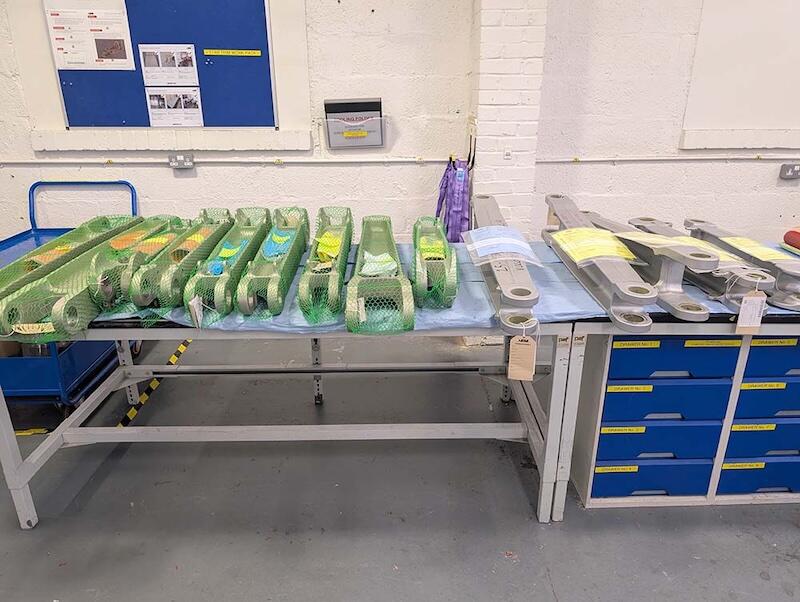
Operationally, demand remains strong for landing gear and hydraulic component repair, particularly on aging narrowbody fleets. Ametek MRO continues to support Boeing 737-400, -500, -800 and -900 platforms, alongside Embraer E190 landing gear, under a licensed agreement. Wheeler notes that corrosion, obsolescence and traceability requirements are increasing demand for repairs, with many requiring more complex and time-consuming processing.
“There’s a lot of what I would call corrosion in service wear and traceability issues,” he says, noting that limited parts manufacturer approval availability for landing gear often leaves repair as the only viable option.
The company has also expanded adjacent capabilities with the addition of nondestructive Barkhausen noise testing, more precision grinding machines to support the demand for chrome repairs, and heat exchanger repair, which Wheeler describes as a relatively recent addition to the Ramsgate operation. “That was a new product introduction for AEM probably around three years ago now,” he recalls, adding that the business has moved from basic testing into full repair capability, including welding.
At the same time, Ametek MRO is beginning to deploy artificial intelligence-enabled digital tools aimed at improving process consistency, training and traceability. The system captures video of repair tasks, generates work instructions and supports augmented reality guidance for technicians.
While compliance remains firmly based on OEM manuals and approved data, Wheeler says digital tools offer an opportunity to mitigate skills shortages, accelerate training and drive improvements in quality and process repeatability—key contributors to maintaining and strengthening aviation safety.
Recruitment is challenging due to the site’s coastal location and limited regional industrial base. Wheeler explains that the industry needs to position itself as a forward-looking, technology-driven career option for young people, blending digital innovation with traditional craftsmanship.
Looking ahead, the Ramsgate-based MRO will likely move cautiously into 737 MAX repair capability, though asset acquisition costs are a barrier.

Related Content