This article is published in Aviation Week & Space Technology and is free to read until Jan 07, 2026. If you want to read more articles from this publication, please click the link to subscribe.

Pegasus Targets MRO Investment To Counter Supply Chain Woes

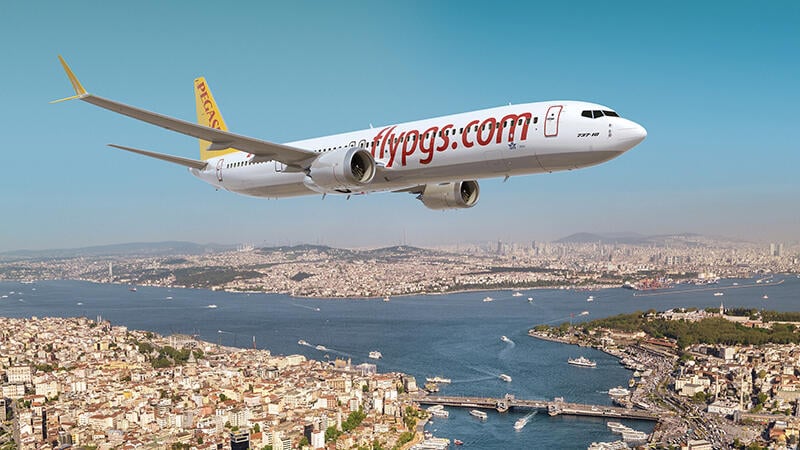
Pegasus Boeing 737 MAX 10

Pegasus will begin receiving deliveries of Boeing 737 MAX 10 aircraft in 2028.

Credit: Boeing concept

Low-cost carrier Pegasus Airlines is investing in its in-house MRO infrastructure in Turkey to address the lack of slot availability and ongoing supply chain challenges.

“MRO and the technical side of aviation is very crucial for us,” Mehmet Nane, chairman of the board of directors of Pegasus Airlines, said in September at the Aviation Week Network’s AeroEngines Europe in Hamburg, Germany. “You can buy the aircraft, you can supply the aircraft with the equipment, but if you do not have the maintenance facilities right on time, you cannot make the aircraft fly.”

As part of its long-term maintenance strategy, Pegasus plans to invest in two new in-house MRO facilities: one for line maintenance and another for base maintenance at Sabiha Gökçen Airport in Istanbul. The carrier’s line maintenance facility was scheduled to open last month with five bays and one painting hangar. “This is because we couldn’t find enough slots for our maintenance,” Nane said. “In the summer season, we use our aircraft, and starting from the winter season, we get the maintenance. But even at Sabiha Gökçen, we are finding a shortage of bays for line maintenance.”

Nane said in one instance, the airline had to use a general aviation hangar at the site to service an aircraft. “These two facilities that we’re going to start operating are going to be lifesaving for us and will also save us both time and money,” he added. Its base maintenance location is under construction and is expected to open in 2026, starting with five bays but with the capacity to expand to five more if needed.

The Pegasus chairman said supply chain disruptions are still creating pain points for operators. “The disruption on the supply chain is not only on the engine side and not only in the delivery of aircraft but also on the supply of spare parts,” he said.

Investing in internal maintenance capabilities should solidify the growth of the airline, which has a domestic share of about 29% and an international market share from Turkey of about 14%. The operator aims to grow 16% this year, and anticipated growth has led to ambitious fleet expansion plans. As of September, Pegasus was operating 124 aircraft, the majority of which are Airbus A320ceo and A320neo and A321neo variants; it also has a small fleet of Boeing 737-800s. The airline abandoned plans for an all-Airbus fleet last year, opting to continue its mixed-fleet business model. In late 2024, the airline ordered up to 200 Boeing 737 MAX 10 aircraft—comprising 100 orders and 100 options. Deliveries of the initial 100 MAX 10s are expected to begin in 2028 and continue through 2035. Pegasus also anticipates delivery of 44 A321neos.

The airline has experienced challenges related to delivery of specific aircraft and engine types, which has led to difficulties in planning its summer schedules, typically done 6-7 months in advance of the peak travel season when it commences selling passenger tickets. Airbus’ inability to source engines for its A320neo-family aircraft—for which Pegasus was a launch customer in 2016—has impeded that planning. Nane said the airline has taken delivery of nine of the A320neo-family aircraft powered by Leap-1A engines as of October.

To fill the gap, Pegasus has sought to lease aircraft on a short-term basis. “At the end of May, we started to search for two additional wet-lease aircraft,” Nane said. However, this exposed the airline to the heightened lease rates experienced on some models where demand outstrips supply. “When you’re going to rent for a short period of time, and when you need it immediately, the rates can be much higher than normal,” he explained. “These are hurting us, and we need to find a solution.” He also noted that engine lease prices remain high.

The airline has endured significant delays in engine maintenance, too, particularly on the Leap-1A program. “Previously, if you took an engine to a shop, it would take at most 10 weeks, but now if you take an engine to the shop, you can get it back in nine months, if you are lucky,” he said.

Looking forward, the airline has explored the potential of artificial intelligence while investing in predictive and preventive maintenance platforms. “Using the data and predicting what . . . mistakes or what malfunctions can occur is technical data analysis, and we try to use this in our facilities,” Nane said.

James Pozzi

As Aviation Week's MRO Editor EMEA, James Pozzi covers the latest industry news from the European region and beyond. He also writes in-depth features on the commercial aftermarket for Inside MRO.