This article is published in Aviation Week & Space Technology and is free to read until Dec 06, 2025. If you want to read more articles from this publication, please click the link to subscribe.
The Singapore operation of Fokker Services Group will continue to pivot its maintenance focus toward Embraer E-Jet and ATR aircraft as the global Fokker fleet winds down over the next five years.
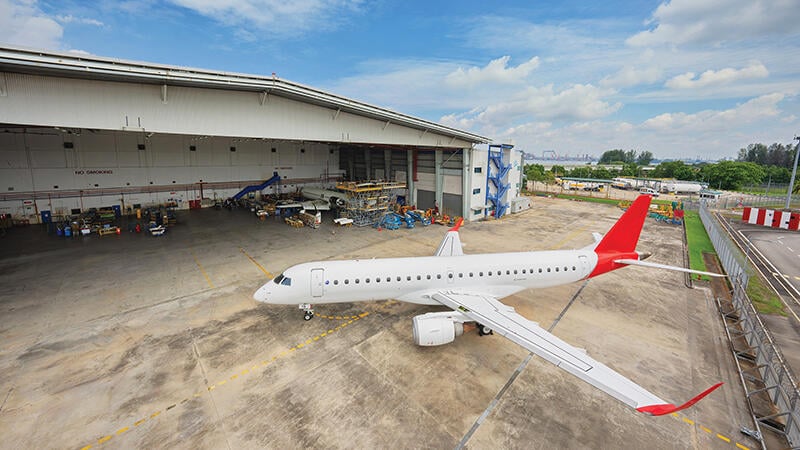
Fokker Services Asia (FSA) operates in the Asia-Pacific region as part of Fokker Group’s global network, which also comprises a facility in the U.S. and three in the Netherlands. The Singapore site’s capabilities focus on Fokker 50 turboprops, Embraer 190s and ATR 42/72 aircraft.
“We’re serving niche markets,” FSA Managing Director Thomas Kennedy told Inside MRO at the company’s hangar at Seletar Airport in northeast Singapore. “If you look up and down the runway, as well as within the Asia-Pacific region, there are very few MROs that are doing 100-seat-or-less commercial aircraft.”
FSA has sought to increase its volume of Embraer aircraft in the past two years. After becoming an Embraer Authorized Service Center (ASC) in September 2024, the MRO has approval to conduct maintenance on E1-family aircraft, with a focus on the prior-generation E190. Last year’s ASC approval followed an August 2023 certification from Australia’s Civil Aviation Safety Authority. That certification enabled FSA to service aircraft registered in Australia, and the MRO inducted an E190 operated by Brisbane-based Alliance Airlines shortly thereafter.
Kennedy said becoming an ASC for the Brazilian airframer fits FSA’s long-term strategy as well as the needs of customers transitioning to Embraer from Fokker aircraft. “We’re also seeing other operators that we currently support also taking on the E190 in the future,” he noted. “A lot of the regional E-Jet and Fokker fleets are concentrated on Australia, while the ATR aircraft we service are mostly operated out of the South Pacific or Southeast Asia region.” The company expects its hangar to handle a second E190 aircraft line by year-end.
Production of Fokker aircraft ceased in 1997, and the MRO provider projects that the global fleet will be mostly retired by 2030. The Aviation Week Network’s Commercial Fleet & MRO Forecast shows 52 Fokker aircraft this year in the Asia-Pacific region—just less than half the global fleet—but they will dwindle to a handful in five years.
Fokker aircraft traditionally held the lion’s share of work at the facility, but lines are now typically split between Fokker, E-Jet programs and ATR content. “In the coming year, we expect more E-Jet work, and then as Fokker aircraft phase down, maybe less content in that space but an opportunity to increase our content of ATR aircraft,” Kennedy said.
FSA is evaluating the feasibility of adding the E-Jet E2 to its capabilities in the not-too-distant future, he added, as several of the region’s Embraer operators have fleet renewal decisions due. “The E2 would be a natural fit, given a lot of the content on the E190 is common between the E1 and E2 platforms,” he said. “Given that our customer base is going to either be operating E1s now or would be operating E1s or E2s in the future, this would enable us to further open our customer base.”
Kennedy said one of the driving factors for work on ATR aircraft is that the Singapore facility holds European Union Aviation Safety Agency (EASA) certification for them. “This fits well for any of the French Polynesian islands, which also have an EASA requirement—not to mention that our facility complements a very strong ecosystem here in Singapore for the ATR,” he said. Other maintenance shops in proximity can aid a one-stop shop service, he added. “If an operator brings an ATR aircraft into the facility for a heavy check and requires, say, lease return and lease transitions, or any type of engines or landing gear or even paint, we can facilitate those in combination,” Kennedy said.
Although Singapore has a large aviation industry and is an attractive location for expatriate workers, Kennedy said FSA is facing challenges in both recruiting and retaining people, as are most businesses in Singapore’s competitive environment for talent. The company is actively looking at ways to mitigate this, and Kennedy stressed that FSA is more alert to the problem than gravely concerned over it.
“How do we continue to find the right talent and develop the right skill sets in order to be sustainable long term?” Kennedy asked rhetorically. “Singapore is not a low-cost nation compared to bordering countries, so we have to have a value stream of why people would come here. And certainly, skills and quality would be one of them.”
Given the cost considerations, he said FSA is exploring ways to remain competitive within the region. “We have to have something to offer to our customers as to why they would come to us,” he said.
Fokker Services Group Vice President Leon Kouters cites part scarcity and availability of engines as two of the market’s primary supply challenges. “The pressure is not so much on us but more so on operators to find slots, get major components back on time and reduce turn times, which has increased and is making it more difficult for everyone,” Kouters says. This concerns OEM parts especially, although there is some scarcity in the used serviceable material market.
“While [turnaround times] of major components have gone up, they are still plannable,” Kouters says.
FSA employs approximately 104 staff at its Singapore operation. “There’s ability to increase capacity if we add head count,” Kennedy said. “We’re typically running the operation 5-6 days a week, depending on the type of contract we have with the customer.”
The MRO has increased labor hours over the past few years, up to 100,000 in 2024 from 70,000 in 2023. “This year is very similar to [last] in terms of sustainment, and we’ve had three full bays for the majority of the year,” he said. “Next year, we’ll look to increase capacities between 5% to maybe 10%, mainly through efficiencies.”
FSA plans to target these gains through an ongoing digitalization program in its hangar. This year, it signed terms to roll out EmpowerMX maintenance software in Singapore. The process commenced in April and is expected to be completed in the fourth quarter. “We’re in the implementation phase, and we expect at least 10% efficiency gains through that process,” Kennedy said. “There have been three phases of implementation, and we’re currently in the middle of the second phase.”
By rolling out EmpowerMX, Kennedy said FSA is embarking on ways to reduce turn times, overall labor hours and ground time per check and passing the benefits to its customers by lowering costs. Implementation of the software will take the Singapore operation mostly paperless, although Kennedy conceded that paper is rarely ever fully eliminated in MRO operations.
“In an aircraft’s transition period, we have to do things in a mirror,” he said. “One is the digital side, and then the other is still having that paper back up until you get to the point of full digital signature and the customers accepting it as well.”
FSA also intends to invest substantially in staff training and development aimed at creating more in-house MRO capabilities and reducing dependency on the wider market.
“For the nonlicensed staff, we see good opportunity to improve in that area,” he said. “For licensed staff, there are still some challenges and hurdles to access them, and even getting them trained up to our type certificate is not as common as, say, [for] Boeing or Airbus aircraft.”