We will be performing site maintenance behind the scenes on Sunday, December 14th starting at 5:00am EST and anticipate this update will take approximately 6 hours. You may experience intermittent issues during this time. We apologize for any inconvenience. 

This article is published in Aviation Week & Space Technology and is free to read until Dec 19, 2025. If you want to read more articles from this publication, please click the link to subscribe.

Dubai’s Newest Engine MRO Takes Shape At Dubai South

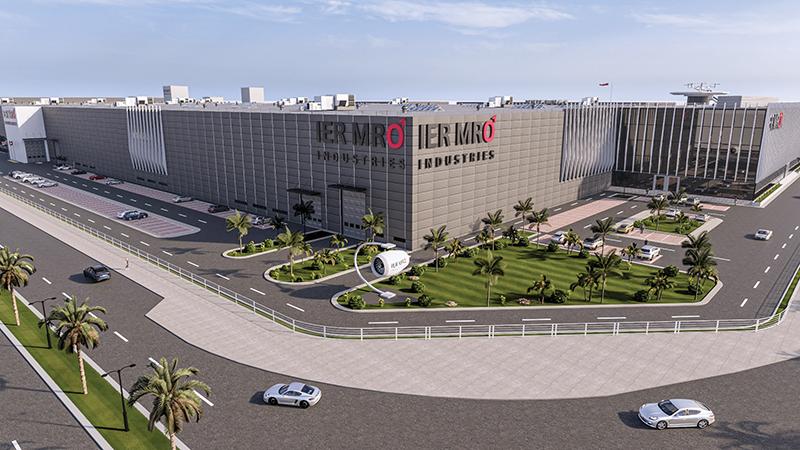
IER MRO Industries facility concept art

The MRO plant is set to open at Dubai South in the first half of 2028.

Credit: IER MRO Industries

IER MRO Industries, the maintenance business of industrial gas turbine specialist International Energy Resources, intends to expand the scope of its planned commercial engine facility in Dubai by targeting GE Aerospace GEnx services in addition to narrowbody engine maintenance and testing.

Since announcing plans for a new commercial engine aftermarket operation at Dubai South last year, IER MRO has announced it aims to expand the greenfield site further from the originally earmarked 1.3 million ft.2 The volume is now planned for about 1.5 million ft.2 An additional building—named MRO Four—is to be constructed adjacent to the site, and the first building is slated to open at the new complex in late 2026. The site is planned to comprise three MRO shops, located in the main building.

“We’re taking additional space in the area to accelerate the overall program, and a new building will be constructed on a fast-track basis,” Chairman and CEO Larry Howie tells Inside MRO.

He estimates that IER MRO Industries has spent almost $117 million to date and committed to more than $150 million in addition for the project. “The overall project is growing from $800 million to around $1 billion in total,” Howie says. Once operational, the facility is planned to focus initially on CFM International CFM56-7Bs, for which the company already holds a license, and eventually add Leap-1A and -1B and International Aero Engines V2500 repair capabilities. Howie says the company holds existing knowledge and capability with GE’s LM2500 based on the CF6-6 commercial engine and LM6000 gas turbines based on the CF6-80C2.

Key construction milestones include internal design completion of the main building, now supported by a team of 30 engineers in Hamburg, Germany, with detailed design packages underway for the construction tender. The test facility, a crucial component of the program, is on track to open in 2027, with selection of contractors for the test cells nearing finalization.

“We’ve whittled it down to two contenders, and we’re in final discussions on whether it’ll be one company or a combination,” Howie says. “We’re still aiming for 2027 for the test cell facility to be in place.”

He notes that IER MRO is expecting 550 engine shop visits annually once ramped up, and 1,000 engine tests annually when fully operational, with the main MRO facility set to start operating in the first or second quarter of 2028.

Now the company is looking at the GEnx, which it determined it could work into the design of the main building. The GEnx-1B variant powers Boeing 787 aircraft, and the -2B powers the 747-8. “Once we did the full design, we found we had spare capacity in terms of the workshop,” Howie says. “We have some 72 separate bays that we can have engines in at any one time, so we decided to add the GEnx to this.”

Howie adds that any potential heavy workscopes would be conducted starting in 2034, outside of hospital visits, with testing capability also included. “We’ll be able to test that engine when the test cell is finished, dependent on correlations and adapters [being] available,” he says.

IER MRO is in discussions with airlines that are based in the Middle East or fly into the region. “We see a huge market—[the] Middle East, Europe, India, Africa,” Howie says. “Dubai is literally 2 hr. away from a lot of potential work.” India’s 2-hr. proximity brings it into consideration as a potential customer base. “They have their own MRO programs in place and are trying to address expansions and capability growth, but we see a lot of work spinning off from that,” he notes.

Coinciding with the Aviation Week Network’s MRO Europe in October, IER MRO announced a deeper cooperation with U.S.-based Chromalloy, a specialist in FAA-certified parts manufacturer approval (PMA) parts and Designated Engineering Representative repairs for engine parts, starting with immediate effect. The strategic partnership focuses on a PMA parts program for the CFM56-7B engine.

“We’ve committed to more than 20 sets of full part programs for the CFM56-7B engine,” Howie says. “That will then also escalate into larger orders.” He explains that IER MRO Industries was already active with Chromalloy on the industrial side of its business, and the agreement marks a further strengthening of ties.

The company has also extended its licensing agreement with CFM International and is in talks with the OEM about purchasing new Leap engines. IER MRO has purchased three CFM56 engines to date, which Howie says are used for leasing. “There are tenders out on five other engines at the moment, so we are building up the inventory, which is key to the operation once we start,” he says, adding that building up inventory is an early means of addressing any lingering supply chain issues that could arise once operational.

IER MRO plans to employ 400-450 people at the site, with training commencing for the new venture at the company’s existing site at Dubai’s Jebel Ali Free Zone. Howie says the number is smaller than the typical workforce at a facility of that size because IER MRO plans to integrate advanced digitalization and artificial intelligence controls into operations, which are currently being developed and supported by four doctorate-level engineers.

“We projected about 1.5 million man hours in a standard MRO business for the work we’re going to do, which we’re going to cut back to around half of that with all of the automations and programs,” Howie says. “We’ve got a full training academy designed and in place with the support of our existing industrial business. There are people being trained up who are used to aerospace engines and components. There’s a big capture area in the Middle East—Dubai itself is an attraction to expatriate workers—and surrounding regions.”

Howie says that the buzz from announcing a new commercial MRO shop in Dubai—which the business is funding itself so far—has attracted interest from would-be investors, such as private equity firms. Some have already spent several days in Dubai analyzing operations.

“We’re not really looking for investors, but we’re looking for people who bring added value, ideally with aerospace backgrounds or relevant business portfolios,” he adds.

James Pozzi

As Aviation Week's MRO Editor EMEA, James Pozzi covers the latest industry news from the European region and beyond. He also writes in-depth features on the commercial aftermarket for Inside MRO.