This article is published in Aviation Week & Space Technology and is free to read until Nov 28, 2025. If you want to read more articles from this publication, please click the link to subscribe.
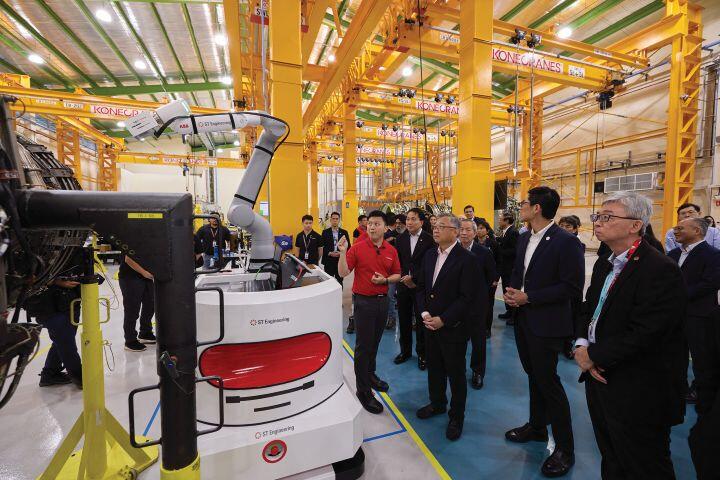
Government and industry guests viewed ST Engineering’s artificial-intelligence-enhanced visual evaluation technology for engine receiving inspection in the MRO’s new engine maintenance facility in Singapore.
ST Engineering is spending millions of dollars to convert two large hangars in Singapore into dedicated maintenance shops for CFM International engines.
One, formerly used for component warehousing, is now dedicated to CFM56 engines. The second, previously used for a range of engine maintenance, is being built up for Leap-1A and -1B engines. The large engine shops will enable ST Engineering to increase shop visits gradually to 300 annually from 150 by 2027.
ST Engineering redelivered its first Leap-1B in 2022 and became a CFM Premier MRO provider in 2023. The company has inducted 88 Leap engines so far and expects to reach its 100th in November. Today, ST Engineering offers quick turnarounds and is transitioning toward performance restoration shop visits (PRSV), which restore the engine’s exhaust gas temperature margins by servicing core modules. A PRSV covers 60-70% of an overhaul, according to the MRO.
By the first quarter of 2026, ST Engineering “will be ready for full engine overhaul workscopes” for both Leap-1As and -1Bs, says Jeffrey Lam, president of commercial aerospace. The Leap-1A powers Airbus A320neos; the -1B, Boeing 737 MAXs.
“The expansion reflects our commitment to staying ahead of industry demand,” Lam says.
The preliminary 2026 Aviation Week Network Commercial Fleet & MRO Forecast projects that the in-service Leap engine fleet will grow to more than 32,000 in 2035 from about 9,200. Combined, the Leap and CFM56 engine families are expected to drive $9.2 billion in engine overhaul demand in the Asia-Pacific region and China in 2035, according to the forecast.
In addition to increased engine MRO capacity, ST Engineering is investing in part repairs and technologies at its maintenance shops. For instance, the company will soon add artificial intelligence to its robotic engine receiving inspection tool to identify and flag missing or damaged parts, which should improve efficiency.
ST Engineering plans to add 300 new jobs for its engine MRO operations in Singapore. These skilled jobs “will give Singaporeans better access and exposure to advanced technologies, including AI and robotics,” Singapore Economic Development Board Managing Director Jermaine Loy says.
ST Engineering did not disclose its exact investment in the engine facilities but said it was “multimillion dollars.”
Coupling this site with its CFM56 engine facility in Xiamen, China, the MRO is targeting at least 400 engine shop visits annually.
ST Engineering started its engine MRO business in 1975 by servicing military powerplants for the Republic of Singapore Air Force.