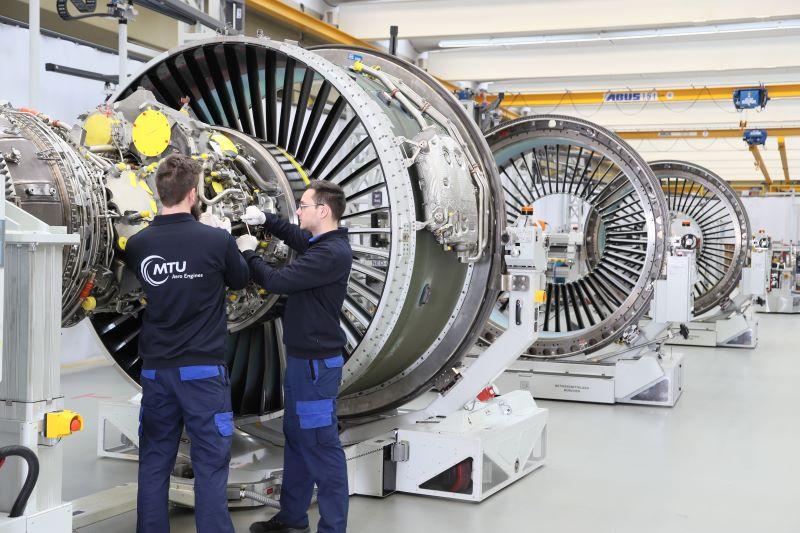
MTU projects year-over-year growth in the low-to-mid-teens for its commercial MRO business, with Pratt & Whitney PW1000G geared turbofan (GTF) work outpacing other platforms.
The German engine specialist saw commercial MRO surge 33% in the first quarter, with strong demand for PW1100G engines that power some Airbus A320neos as well as GE Aerospace’s GE90, CF6-80, and GEnx widebody engines. PW1000G work accounted for 34% in the quarter, CFO Peter Kameritsch said on the company’s recent earnings call.
As the year progresses, the PW1000’s share of MRO revenue will increase, totaling perhaps 40% of full-year sales, the company said. This would translate into year-over-year growth of 20-25%.
MTU CEO Lars Wagner reconfirmed plans to release a PW1000G upgrade package in 2026 that will bring many of the improvements incorporated into the PW1000G’s Advantage spec that will debut later in 2025.
“The certification of an upgrade package is in the making,” Wagner said. “[This will] incorporate significant durability improvements from the Advantage configuration into the existing fleet during MRO shop visits. Target is to have this package available for its customers next year.” Pratt & Whitney parent RTX revealed plans for the upgrade on a recent earnings call.
Wagner said the PW1000G fleet inspection plan for parts with contaminated powder metal (PM) is progressing according to plan.
“We see progress in shop turnaround times and material flow,” he said. “Therefore, we are quite optimistic that the aircraft-on-ground situation will start to trend down in the second half year.”
The Aviation Week Network Fleet Discovery database shows some 700 PW1000G-powered aircraft have been out of service for at least 30 days. Not all of them are idle because of powder metal inspections, however. Pratt has said the average number of aircraft grounded due to the PM checks will be around 350 through 2026.