This article is published in Aviation Week & Space Technology and is free to read until Nov 13, 2026. If you want to read more articles from this publication, please click the link to subscribe.
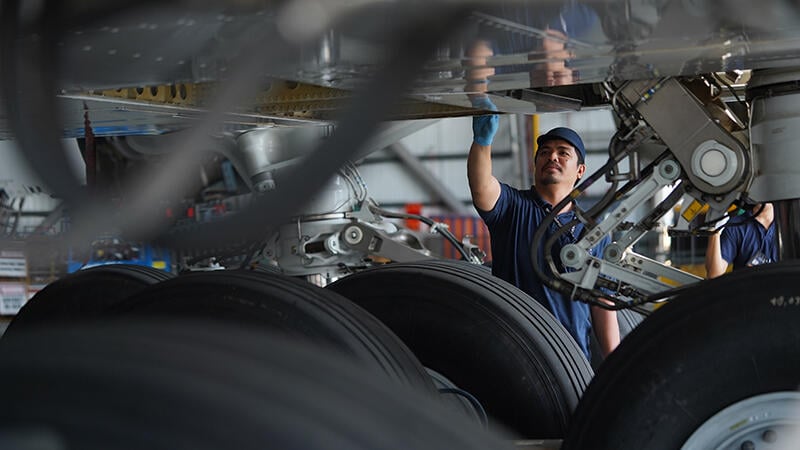
U.S. airlines must start to catalog work done at FAA-approved shops outside the country.
The FAA is diligently rolling out standards and guidance on how to comply with new mandatory requirements linked to work done on U.S.-registered aircraft at FAA-approved shops located outside the country.
Congress introduced the mandates via the 2024 FAA Reauthorization Act’s Sec. 302, “Global Aircraft Maintenance Safety Improvements.” Among the new requirements is an annual list of heavy maintenance work conducted. Carriers must list what work was done and where, as well as any related faults or failures that happened within 30 days of the aircraft’s return.
The FAA will analyze the data and determine if there are any safety issues directly linked to work done at non-U.S. shops that it approved, which number more than 900 in 65 countries.
Sec. 302 also stipulates minimum standards for supervisory personnel and technicians who issue return-to-service approvals, as well as mandatory drug and alcohol testing (Inside MRO October 2025, p. MRO 8).
Labor representatives and other backers of the new requirements laud them as long-overdue changes that will close regulatory loopholes that make non-U.S. shops less safe. So far, only the drug and alcohol requirements have been implemented. In January, more than 100 members of Congress urged FAA Administrator Bryan Bedford to codify the other new requirements.
“While all of these facilities technically hold the same certification, those outside the U.S. continue to operate under lower safety standards due to long-standing FAA exemptions,” the lawmakers wrote.
Sec. 302 will fix this, they argue. But how much is changing?
Take the licensing requirement. Proponents of the new laws wanted supervisory and return-to-service work to be handled by FAA Part 65-certified mechanics unless the repair station is in a country that has a bilateral aviation safety agreement with the U.S.
The FAA’s new inspector guidance, contained in Order 8900.1, expands the qualifications to include any country with an aviation authority that enforces licensing requirements consistent with International Civil Aviation Organization (ICAO) standards. The guidance also sets minimum qualification standards, including the “ability to understand, read and write English.” Both seem reasonable, given aviation’s reliance on English and ICAO’s role as the global standards-setter.
While the licensing requirement adds some new wrinkles, the data collection and analysis mandates are largely duplicative. Part 121 already requires airlines to keep lists of contracted maintenance, track and analyze faults in a continuing analysis and surveillance system and file defect reports to the FAA as service difficulty reports.
The Sec. 302 requirements introduce a few extra details, such as tail-number-by-tail-number breakdowns of what work was done. An annual filing to the carrier’s designed Certificate Management Office also is new.
An Information for Operators notice the agency issued in August outlined what industry can expect under the new mandates. “The FAA will use this data to analyze safety trends and may require appropriate actions by Part 121 or Part 145 [repair station] certificate holders in response to any safety issue identified,” the notice states.
New U.S. Transportation Dept. regulations under 49 U.S.C. §44733 linked to the provisions are more direct. The FAA “will analyze information provided . . . to detect safety issues associated with heavy maintenance work on aircraft performed outside the United States,” the rules state.
Analyzing in-service data to find safety issues is a solid premise—and something design approval holders are embracing to improve both safety and fleet reliability. But the FAA’s track record is spotty at best, as the probe into November 2025’s fatal accident of UPS Flight 2976, a McDonnell Douglas MD-11, has shown.
NTSB investigators determined that a broken bearing collar, or race, played a key role in starting the fatal accident sequence by causing the MD-11’s left engine and pylon to break away during takeoff. Investigators found the FAA had six reports of similar MD-11 bearing race failures in the 17 years before the accident. Boeing knew of three more.
Not only did the FAA fail to raise any concerns, but it approved a Boeing request to expand an inspection interval on the pylon area. The maintenance interval review did not include asking the airframer to compare notes on failure data.
The investigation is still ongoing, but recommendations on approving safety data-sharing and analysis are a near certainty. Implementing them will be a key step on the way to flagging possible risks posed by foreign repair stations—and everything else the agency oversees in commercial aviation.

Related Content