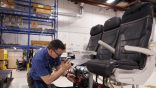
For all the challenges OEMs face in ramping up new aircraft production, airlines are adding to delays by demanding bespoke interior products that can run into certification hurdles, the CEO of the world’s largest lessor told CNBC.
“Airlines are overcomplicating seats. The customization levels are so high,” AerCap CEO Aengus Kelly said on CNBC’s Squawk Box on Sept. 8. “If it’s good enough, it’ll do,” he added, noting that delayed certification of a new seat design could push back a new aircraft delivery by up to a year and add 3-4% to its price.
While Kelly was discussing the configuration of new aircraft, cabin refreshes of used aircraft are also challenged by extended lead times.
“The biggest challenge has generally not been demand but component availability,” Joern Dahmen, senior director special engineering services at Lufthansa Technik, tells Aviation Week. “Lead times for seats and selected avionics components have at times increased significantly. Lufthansa Technik has responded through closer supplier collaboration, earlier procurement and engineering-driven mitigation measures.”
Jim Leech, AAR’s director of proposal and business development for engineering services, agrees, noting that “supply chain challenges have impacted virtually every segment of the aircraft modification industry.” He blames extended lead times for seats, monuments, electronic systems, connectivity equipment and certain certification-critical components for complicating planning and execution.
Lead time challenges are easing, though, as customers adjust to structural changes in the supply chain, says Tan Yen Ping, senior vice president and head of cabin interiors and engineering solutions at ST Engineering.
“The situation has improved somewhat as airlines and integrators move earlier in the planning cycle to secure required components and kits, helping to provide better visibility and mitigate potential schedule disruptions,” Tan says. “At the same time, we continue to help customers manage such constraints by leveraging our in-house capabilities, including 3D printing and thermoforming, to produce select cabin and interior parts where appropriate.”
For a full analysis of the modification market, stay tuned for the October issue of Inside MRO.

Related Content