The Lufthansa Group is testing Aeroshark “sharkskin” surface film for the first time on an Airbus aircraft, an A330, and evaluating possibilities for newer-generation aircraft.
Lufthansa Technik (LHT) entered the final phase of supplemental type certification for its drag-reducing surface film on the A330-200 and -300 at the end of August.
“We expect certification for the Airbus A330 in the foreseeable future and currently assume that we will receive it by the end of the year,” an LHT spokeswoman told Aviation Week on Sept. 9. “The exact timing depends on the final assessments and approvals by the responsible aviation authorities.”
The Aeroshark technology, developed by LHT and Surventis, is based on the structure of shark skin. LHT says the product is the only riblet technology on the market approved for commercial aviation, noting it is currently certified for Boeing 777F, 777-300ER, and 777-200ER aircraft.
“In its current configuration, applied to the fuselage and engine nacelles, the technology reduces fuel consumption and CO₂ emissions by approximately 1%,” the LHT spokeswoman said. On a 777-300ER, this saves around 360 metric tons of kerosene consumption and approximately 1,125 metric tons less CO₂ emissions per year. By extending the application to other aircraft areas, such as wings and tail surfaces, the potential savings could increase significantly in the future.
The spokeswoman said that Aeroshark typically recoups its investment costs within about two years, making it a cost-effective solution.
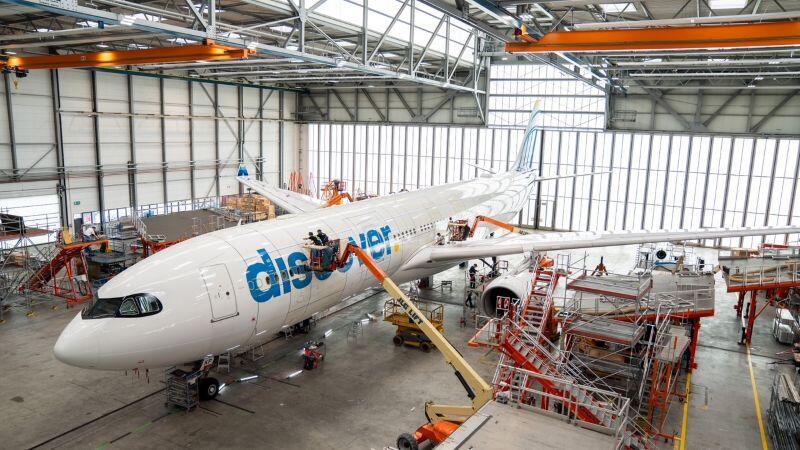
Before and after the modification at Elbe Flugzeugwerke in Dresden, the particular aircraft—an A330 from Lufthansa’s leisure unit, Discover Airlines—undergoes test flights over several weeks. Whether Aeroshark will be rolled out across the entire A330 fleet of the Lufthansa Group, including Swiss, ITA Airways, Lufthansa and Brussels Airlines, depends on the results.
“Our current focus is on successfully completing the certification for the Airbus A330-200 and A330-300. We will provide information on potential fleetwide installations and rollout plans in due course,” the spokeswoman said. However, with the certification, LHT is initially creating the technical basis for broader use of the technology on this aircraft type.
In principle, Lufthansa Technik sees potential for Aeroshark on various aircraft types. When selecting potential candidates, factors such as fleet size, operational profile, remaining service life and potential savings play a role.
“The A330ceo was a logical next step for us, as it is widely used around the world and will continue to operate on long-haul routes for many years, where Aeroshark delivers its greatest benefits,” the spokeswoman said. Aeroshark can improve the efficiency of older aircraft and is not limited to new generations of aircraft.
“Of course, we are continuously evaluating further potential applications. Looking ahead, more modern aircraft types such as the Airbus A350 or Boeing 787, whose structures are largely made of composite materials, could also offer interesting fields of application,” the spokeswoman said.
Aeroshark is already being used on engine nacelles and therefore on components made of composite materials. “We are currently unable to announce any specific certification programs for additional aircraft types,” she said.
Aeroshark delivers its greatest effect during cruise flight, so long-haul aircraft are particularly well suited to the technology. “However, we cannot specify a general minimum flight time, as the economic viability depends on factors such as annual flight hours, the route network and individual fleet planning,” she said.
The film weighs approximately 150 kg (331 lbs.) in total when applied to an A330ceo. The additional weight of the film is taken into account when designing and certifying the modification. The efficiency gains achieved through fuel savings outweigh the impact of the film’s additional weight.
As of August 2026, the Lufthansa Group has equipped 22 aircraft with Aeroshark, saving around 19 metric tons of kerosene and about 60 metric tons of CO₂ every day, the company said.
Other airlines are also already using or planning to use Aeroshark on their long-haul aircraft, including ANA, EVA Air and LATAM.

Related Content