Materialise's advanced 3D printing technology for aviation maintenance applications.
LYON—Materialise, a specialist in additive manufacturing, has been producing titanium latches for Lufthansa Technik, which uses them to replace less reliable polymer parts in Lufthansa-operated Airbus widebodies.
Another application of additive manufacturing in maintenance, the latches show the value of the technology when a small number of components are needed. The joint work by Lufthansa Technik and Leuven, Belgium-based Materialise also adds competition for suppliers that offer expensive spare parts.
A polymer galley latch on Airbus A330s, A340s and A380s kept failing and could not be replaced individually without replacing the entire roller shutter set. The latch retains the roller brake and end cap in place. The original component, made of injection-molded polymer, was not strong enough for the wear it experienced in service, Gert Brabants, business line manager, series manufacturing at Materialise, explains. The cost of a complete roller shutter assembly is in the four-digit ballpark, he adds.
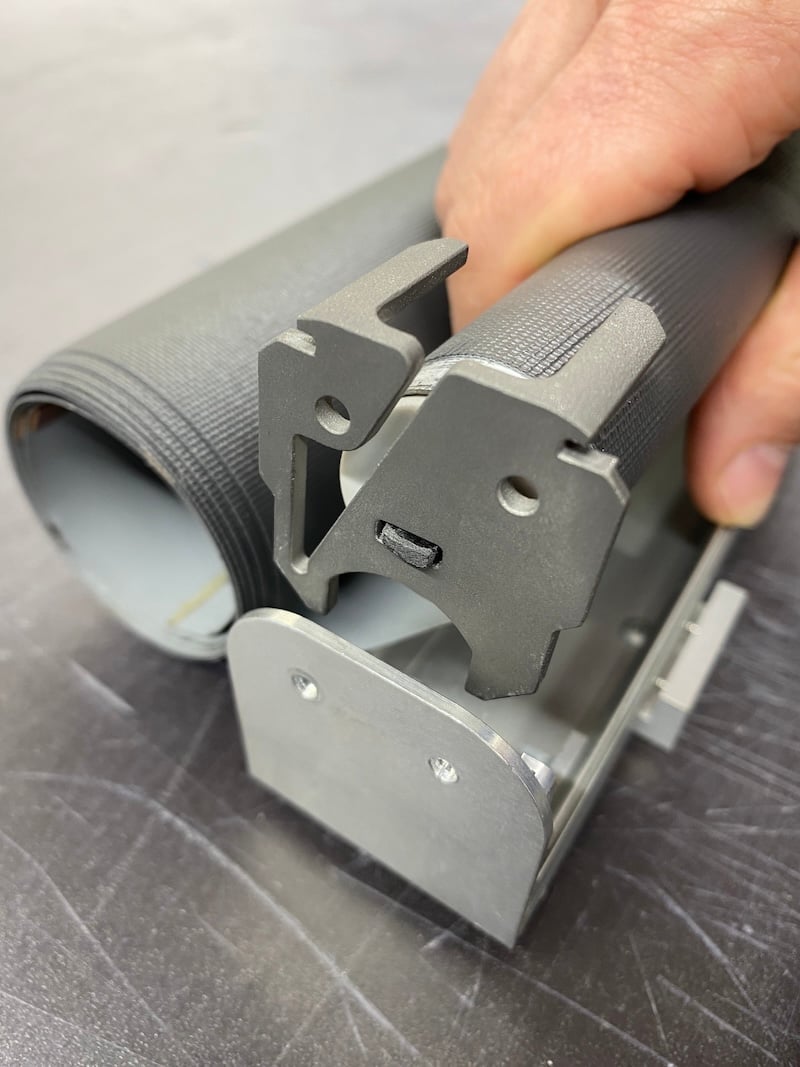
Lufthansa Technik identified the component as a good candidate for a 3D-printed replacement. It aimed for a better part, in titanium, that would not need frequent replacement. “Lufthansa Technik holds the design organization approval,” Brabants says. “We manufacture according to their specifications.” Moreover, obtaining the newly designed part is faster than waiting for the full assembly.
Industry has gained significant experience with additive manufacturing in recent years. The maturity of the technology enabled the project, Brabants says. “With polymers we started 10 years ago and, initially, the certification burden was quite stringent, despite the low criticality of the parts,” he explains. “We needed to prove a lot of things that were no longer required with other manufacturing processes. Civil aviation authorities have since eased the certification burden for polymer parts, thanks to all the data available.” Metal parts are seeing the same trend, he adds.
Lufthansa Technik’s engineers adapted the latch’s geometry for the conventional titanium-aluminum-vanadium alloy they selected. Materialise’s metal competence center is located in Bremen, Germany, which holds EN9100 certification for additive manufacturing. The two companies started discussions in the fall of 2025, and parts are flying now. “For this project, we use laser powder bed fusion,” Brabants says. “Our success with low critical parts, like this one for Lufthansa Technik, opens the door to more complex applications.”

Related Content