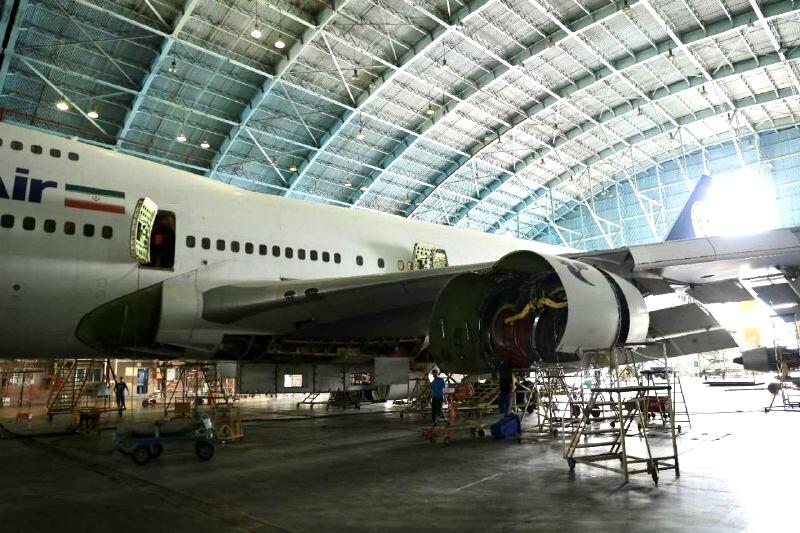
Iran Air says it is performing a D check on a Boeing 747-200C for the first time.
International sanctions on Iran mean MROs in the country cannot access support from OEMs and face supply chain challenges in obtaining spare parts and other technical support to support the country's aging fleet.
The D-check work commenced on Sept. 28 and is being carried out with the participation of all engineering and maintenance departments, Iran Air said via its Telegram channel on Oct. 24.
Aviation Week Fleet Discovery shows that the aircraft, registered as EP-ICD and carrying Serial No. 24134, was delivered on Sept. 26, 1988, to Martinair and has been with Iran Air since 2008. It has flown a total of 17,320 cycles and 86,039 hours.
Aviation Week Tracked Aircraft Utilization shows that EP-ICD has operated only 44 flights and logged 184 hr. so far this year.
According to Flightradar24, in August and September the freighter mainly operated from Tehran Imam Khomeini International Airport to Tianjin, China. It has also occasionally flown to Macau.
According to Iran Air, the project marks the completion of Iran’s first-ever 20,000-flight-cycle check on the 747 and the first non-destructive testing (NDT) inspection of Section 41, the forward-most fuselage section, in the country.
The work includes structural reinforcement of the fuselage at the landing gear attachment points and an NDT inspection of all riveted joints in the upper deck section. Specialized tools have been manufactured in-house to support the modification work.
The heavy check will include inspections of all fuselage sections and the overhaul of the landing gear.
One of the key stages of this project is the implementation of a modification to the aircraft’s horizontal stabilizer assembly. The required modification kit has been procured, and the specialized tools needed to carry out the work have been manufactured by the airline’s mechanical workshop.
This process has involved reviewing the manufacturer’s instructions and technical requirements, procuring the necessary materials and components, and preparing the specialized tooling required for the modification.
The initial estimate for completing this project is at least six months. However, the final duration will depend on the inspection findings. If issues such as cracks, corrosion or component damage are identified, further inspections and corrective actions will be required, potentially extending the overall maintenance period.
Iran Air also said via Telegram that in the first nine months of 2026, it offered a total of 750,000 seats, with 68.5% of this capacity provided on international routes.

Related Content