This article is published in Aviation Week & Space Technology and is free to read until Nov 13, 2025. If you want to read more articles from this publication, please click the link to subscribe.
British Airways has invested in technology such as artificial intelligence and augmented reality as part of a multibillion-dollar transformation program.
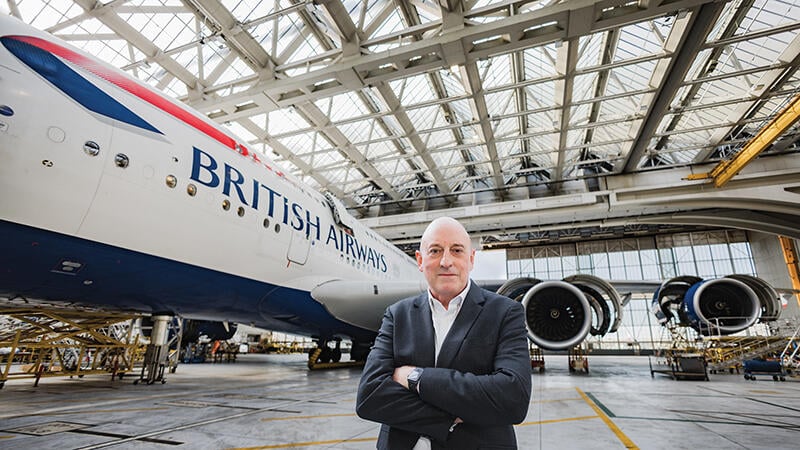
Andy Best, chief technical officer at British Airways, discusses with James Pozzi how the airline is navigating fleet and supply chain challenges while tapping into predictive maintenance and artificial intelligence to drive MRO efficiencies.
Have OEM production and delivery issues that affected British Airways’ fleet had a knock-on effect on the maintenance division? Like many airlines, we are experiencing delays in the delivery of new aircraft. As a result, we are flying our older aircraft longer, which leads to a significant increase in aircraft downtimes for heavy maintenance. Our engineering teams have been proactive in finding solutions to resolve issues caused by delivery delays, such as developing their own capabilities as well as securing long-term deals with suppliers.
How is the maintenance division planning for further fleet growth and modernization? We’re excited to be planning for our new batch of GE Aerospace GenX-powered Boeing 787-10 aircraft, which begin delivery next year, as well as further Airbus A350-1000 and [Boeing] 777-9 aircraft deliveries thereafter. We always run a robust entry-into-service process for new aircraft types before welcoming customers on board. This includes everything from the initial provisioning of spare parts to engineering training and hangar fit checks.
Roughly, what are the percentages of in-house maintenance and work outsourced for International Airlines Group (IAG)? Our teams oversee 60% of all aircraft maintenance including narrowbody and widebody aircraft. We understand the importance of our punctuality to customers, which relies heavily on our aircraft receiving the necessary maintenance in a timely manner. That’s why we are currently increasing our in-house MRO capabilities and looking at the strategic optimum for IAG to ensure our aircraft spend more time in the air and less time on the ground.
How does British Airways (BA) leverage IAG partners such as Iberia Maintenance? We have an excellent relationship with Iberia’s engine shop that goes back over 20 years to the Rolls-Royce RB211-535E4 engines. We’ve continued working with them on products such as the International Aero Engines V2500, where they typically perform around 20 shop visits per year for us. They also perform several lines of narrowbody heavy maintenance for us, subject to demand.
Last year, BA bought the London Gatwick Airport MRO hangar formerly operated by Boeing Global Services. How has this aided your capacity needs, and what is the volume of aircraft moving through the facility? The purchase of the Gatwick facility was a great opportunity, as it has allowed us to carry out maintenance support for both the 777 fleets and Euroflyer fleets based at London Gatwick Airport, providing significant resilience and aiding our sustainability commitments. We are investing in two lines of heavy maintenance at this location with [Airbus] A320-family approvals and maintenance operations set to commence [this month] with one line, and the second line in October 2026. The hangar also supports our operation at London Gatwick Airport with A320 and 777 capabilities already driving improved operational performance due to the flexibility of the hangar.
The MRO supply chain remains difficult. Where do you identify primary challenges now? British Airways continues to review all its product lines to make sure materials are available when needed. Supply chain problems are still affecting everything from basic parts to expensive equipment. It’s been five years since the pandemic, so it’s fair to expect aircraft manufacturers and OEMs to have returned to normal operations by now. We believe it’s important for suppliers and partners to take ownership and stay focused on current needs, rather than looking back.
Has BA encountered parts shortages? If so, as an airline, how has it mitigated these? We continue to dynamically manage inventory levels to counter the unpredictability of parts shortages and supply. In some cases, we have had to make the decision to increase investment to mitigate supply challenges. This is where we expect our suppliers and partners to lean in and do their part. It is just not equitable to expect cost increases to constantly flow down to the door of the airline.
How is shop capacity looking across your network? Overall, global MRO capacity across many product lines—from aircraft down to component level—has often been strained since the operational increases following the [COVID-19] pandemic. We continue to enhance our own capabilities in parallel with developing increased capacity through strategic partnerships and external sourcing. We don’t just accept capacity constraints but will look to innovate, for instance by maintenance program optimization to make sure we are performing the right maintenance, in the right place, at the right time.
BA is several years into its transformation program, which includes investment across its maintenance and engineering operation. What have been some of the results produced so far and how has it aided that side of the operation? As part of our £7 billion [$9.4 billion] transformation program, we’ve invested in technology in targeted, thoughtful ways to strengthen our core operation. From predictive maintenance to automated planning, augmented reality to live dashboards, we’re equipping our people with smarter tools and better data, enabling faster decisions, greater consistency and greater resilience.
Already our results show that technical dispatch reliability is improving, maintenance plans are stabilizing, risks are being flagged earlier and mitigated, and our engineers are spending less time searching for information and more time taking action. Our transformation in engineering is helping to drive the wider transformation program across BA, which will benefit all our stakeholders, particularly our customers.
How will artificial intelligence (AI) play a role in the maintenance operation? We are utilizing aircraft and operational data to use AI predictive tools to support quicker and more accurate analysis of component failure rates. This supports a more real-time plan for component changes and reduces impact on the operation. As an example, all the 787 brake changes in the last six months were predicted in advance. This allowed parts to be provisioned without causing a delay or impact on the operation.
Live AI data is starting to feed into our supply chain models to provide better provisioning and support development of the maintenance program through predictive reliability. We are also using data to reduce the no-fault-found component removals with first-time-fix effectiveness. We are also in the process of introducing AI-based operational planning optimization tools to support better utilization of the asset.
Technical and engineering skill recruitment is an ongoing industry challenge. How have initiatives been successful in recruiting people into the BA engineering division? We’ve worked hard to ensure that we have the right technical skills coming into our engineering and maintenance teams, with our growing number of technical apprenticeships alongside our graduate programs in technical, planning and supply chain functions. We’re particularly proud of our military partnership programs, too, accessing the valuable skills and experience of members of our armed forces, and we were honored recently to be awarded the silver standard in the [Defense Ministry] Employer Recognition Scheme. We also support outreach in schools and colleges via our network of dedicated [science, technology, engineering and mathematics] ambassadors, to ensure we are capturing the imagination of future generations of engineers.
Can you share any sustainability updates across the BA maintenance operation since we last spoke two years ago? Sustainability is a focus for us, as part of the wider BA Better World initiatives. Our teams continue to pursue initiatives such as reducing waste to landfill and single-use plastics, as well as early resolution of aircraft defects, which may carry a fuel-burn penalty, to help reduce our carbon footprint. A good example of where we have leveraged technology to improve sustainability is our adoption of the E-Logs aircraft electronic technical log, which alone saves nearly 1 million pieces of paper per year (and the impact of storing those for the life of the aircraft).
As part of sustainability within engineering operations, we are tracking aircraft fuel-burn improvement with focused health packages. This includes an 80% reduction in fuel-burn/performance-related defects items, including seals and fairing gaps. The team has built data analysis tools to show fuel burn and performance and cost impact of each defect to support a more focused approach to fixing fuel-burn-related issues.
FACT FILE
About British Airways
Headquarters: London
Fleet: BA’s mainline fleet comprises about 276 aircraft. Its mainline narrowbody fleet is made up of Airbus A320-family aircraft, while its widebody aircraft consist of A350, A380, Boeing 777 and 787 aircraft. Subsidiaries BA Euroflyer and BA CityFlyer operate A320s and A321s and Embraer 190 aircraft, respectively.
MRO facilities: BA performs both widebody minor maintenance and narrowbody heavy maintenance in Glasgow, Scotland; it has three widebody heavy maintenance lines and two modifications lines in Cardiff, Wales; and it has two lines for narrowbody and widebody heavy maintenance along with one minor maintenance line at London Gatwick Airport. The airline’s London Heathrow operations base covers line maintenance and operational activity.
Line stations: The airline operates 51 stations across North America, Europe, Africa, the Middle East, Asia and Australia.
Employees: BA Engineering and Maintenance has 4,300 colleagues, including across its subsidiaries.