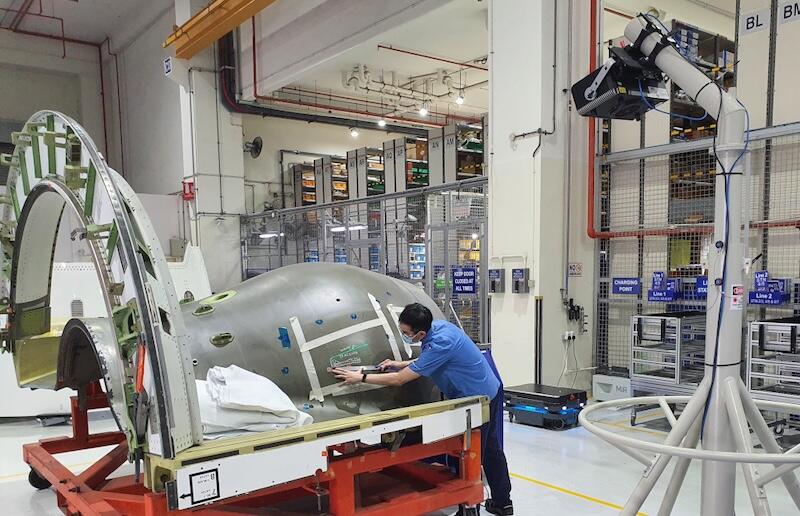
SINGAPORE—Collins Aerospace’s Singapore-based nacelle repair business expects its MRO activity to grow by approximately 30% over the next five years as more aircraft in the Asia-Pacific region reach major nacelle maintenance thresholds.
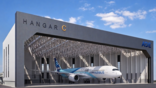
Goodrich Aerostructures Service Center-Asia (GASCA), a joint venture between Collins Aerospace and Singapore Airlines Engineering Company, has already increased its repair volume fourfold over the past decade. The business attributed this to process improvements and the use of digitalization and automation technologies, enabling it to accommodate that expansion with essentially the same workforce across a 550,000 ft.2 footprint at its site close to Changi Airport.
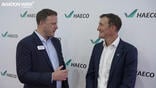
“Even though our MRO volume has increased four times over the last 10 years, we’ve been able to deal with that four-times increase with essentially the same workforce size and the same footprint area,” said Rodney Hua, regional general manager at Collins Aerospace, who added that much of the 30% growth over the next five years will be generated within the Asia-Pacific region.
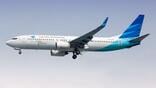
Established in 1995 and operating as part of the advanced structures business unit within Collins, GASCA’s MRO capabilities include repairs for nacelle components across most major aircraft platforms currently in service, such as the Airbus A320ceo and the Boeing 737NG, as well as 787, A350, A320neo, and A220 aircraft. These capabilities extend to some products manufactured by other suppliers.
Collins operates eight facilities in its global nacelle MRO network, supported by approximately 1,200 employees worldwide. “We have the full range of MRO capabilities for nacelle components on virtually everything that is in service today, including non-Collins, third-party nacelle components,” Hua said.
Further demand is anticipated as newer generation widebody fleets mature. “Next-generation nacelles are driving us toward a much more integrated, proactive maintenance proposition for customers, including midlife service activities,” said Kevin Browne, aftermarket and customer support vice president at Collins Aerospace. “It’s amazing to think the 787 has been in service now for 15 years. We’ve got our first A350s coming into 12-year checks, so these aircraft are starting to age.”
Given the high optimization rate of composite-material nacelles operating around hot-running engines, the components are exposed to wear as flight cycles accumulate. Collins expects airline nacelle strategies to shift from reactive repairs to more proactive MRO, with increased use of predictive maintenance.
Factoring in this future strategy, GASCA has introduced digital damage mapping and laser-guided composite ply installation to improve the speed and precision of manual advanced composite repair processes. It has developed automation projects such as “Fetch,” an automated line-back logistics robot that transports repair materials to technicians, and “Spot,” which inspects engine ducts and harnesses, checking whether the correct duct is installed and whether the component is present. “That allows us to create an automated inventory record that we furnish to our customers. It reduces a lot of the person-hours that were required before Spot came along,” Hua said.
Forward-positioned rotable assets form another part of Collins’ support strategy. “These are big components that are highly optimized, especially the new generation of nacelles,” Browne said. “What we need is that kind of local-global footprint worldwide. They’re not easy to move, they’re not cheap to move around the world when they’re off-wing, and they require a great deal of expertise.”

Related Content