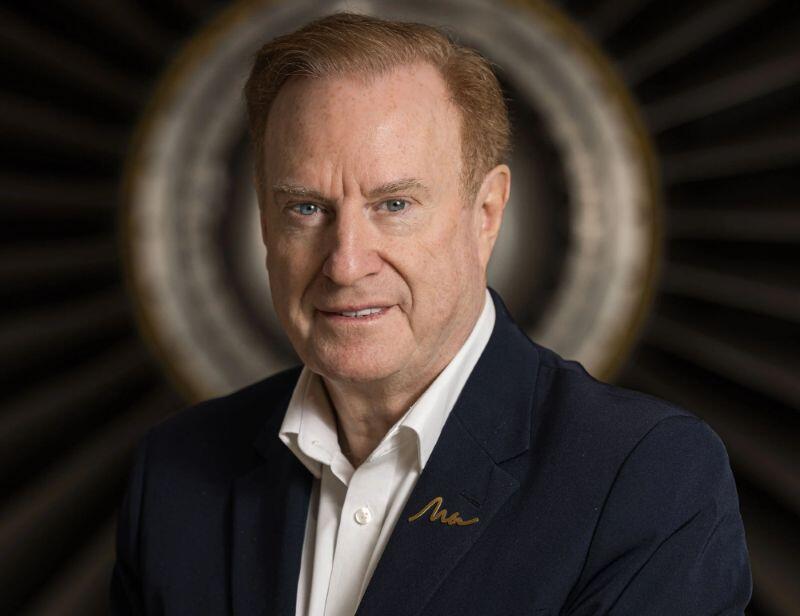
IER MRO Industries CEO and Chairman Larry Howie discusses the progress of the company’s future engine MRO and test facility in Dubai, where it plans to service CFM56 and Leap engines from late 2027.
IER MRO is set to start its Dubai engine MRO operation, starting with its MRO 4 facility coming online at the end of 2026. What role does this facility play in the wider operation?
MRO 4 is located adjacent to our test facility at Dubai South, directly across from the Emirates pilot training runway. To start, the facility will operate as the project office for the main MRO construction program. Operationally, it will handle engine storage, leased-engine management, engine cleaning, inspections, preservation, and logistics support. MRO 4 comes online in December 2026, ahead of the main test cell facility, which will become operational at the end of 2027 and remain operational through the second quarter of 2028. Long term, MRO 4 will transition into the central operations hub for the entire business—managing equipment, machine oversight, and day-to-day physical operations. As this is a heavy industrial activity, it requires dedicated operational management infrastructure, and this building will ultimately house that leadership function.
How is the construction of the test cell and main facility progressing?
The primary design work is essentially complete. We are now finalizing the bills of quantities, cost validations, and detailed processes to ensure the budgets are precise before moving into full construction. We expect to complete that phase by the end of March, with main construction contracts targeted for late April or May. The test cell is a critical differentiator. While it’s not a strong standalone revenue generator, it drives overhaul demand because customers want integrated test capability. It’s also a highly complex system, each cell will have six preparation bays, multiple adapter configurations, and sophisticated data acquisition and software systems. We are deliberately taking extra time to get it right, learning from others’ past mistakes. It’s a significant investment, but it anchors the overall MRO proposition and will provide engine test capability for 1,000 engines per annum.
With global supply chain pressures, how challenging has sourcing equipment and inventory been?
We’ve approached procurement strategically. Because we’re not under urgent operational pressure, we’ve avoided paying inflated market premiums. We are sourcing selectively and buying opportunistically, often directly from operators and equipment owners. At present, we are about 80% through the machinery selection and costing process for the main facility, amounting to roughly $280 million in equipment alone. We’ve also executed strategic upgrades to the existing plan, such as installing two clean lines instead of one to future-proof capacity. In parallel, we’re continuing to acquire engines, tooling, and materials to build inventory ahead of the start of operations, with a significant $150 million investment.
As the company scales up, how is the recruitment strategy developing?
There has been strong inbound interest, but our immediate focus is on senior leadership—CEO-level and senior management hires who can structure and scale the organization. On the technical side, we are training our current workforce within our existing facility.
Because we are not yet performing overhauls for third parties, we can use our own engines to train staff without the risk of cross-contamination, creating a skilled nucleus team ready to transition.
We’re also pursuing collaborations and memorandum of understanding with other MROs to exchange expertise and potentially share workforce resources. There is strong interest from skilled labor markets, including India, the Philippines, Ethiopia, and Morocco. At the same time, we are making heavy investments in automation, artificial intelligence, and digitalization—supported by a team including four doctorate-level specialists—to reduce manual dependency and design highly automated shop processes from day one.
How do you see IER’s role within the wider Dubai South and regional MRO ecosystem?
We will be the only independent engine MRO with an on-site test facility at Al Maktoum International Airport, operating within the free zone. Outside of Emirates’ facilities, we will be the largest engine MRO presence at the airport. The Middle East continues to face a significant narrowbody engine capacity shortfall, and even multiple facilities of our size would struggle to fully meet regional demand. While we are building a global business model, the local and regional opportunity alone is substantial. We’ve previously said that we are not seeking financial investors. Instead, we are looking for strategic partners who can bring operational capability, service expertise, or customer access.

Related Content