Ascent Aviation Juggles Spirit Surge Ahead Of IAI P2F Program Launch
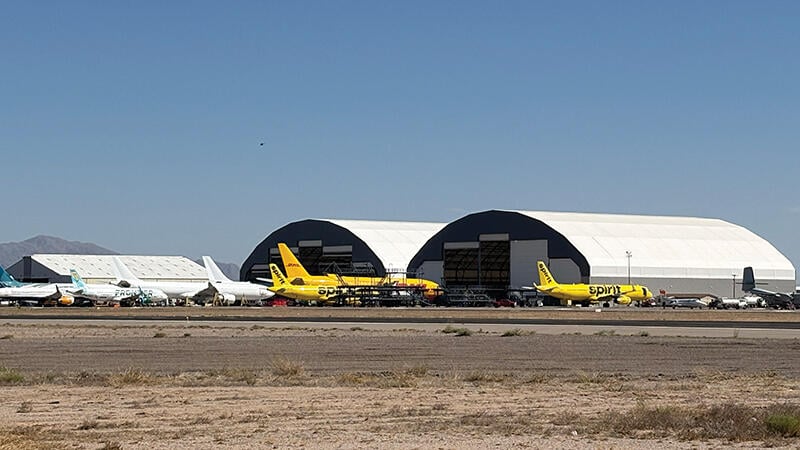
Ascent’s first passenger-to-freighter conversion for Israel Aerospace Industries is expected to start on Sept. 1.
MARANA, Arizona—An influx of liquidated Spirit Airlines aircraft and significant new investments in heavy maintenance are keeping Ascent Aviation Services’ two new hangars busy as they await the induction of their first Boeing 777-300ER passenger-to-freighter (P2F) conversion on Sept. 1.
Ascent opened the two new 90,000 ft.2 widebody hangars in December 2025 to support its 15-year contract with Israel Aerospace Industries (IAI) to perform 777-300ER P2F conversions. The approximately $100 million investment, backed by Monroe Capital, also included tooling, training and hiring to support the conversions. The company says the new hangars will increase its capacity in Marana by 200%.
While Ascent waits for the first 777-300ER to arrive in mid-August, there has been no shortage of demand for the maintenance capacity. “Since we’ve opened the hangars, they’ve been very busy. We’ve had work to keep them quite full,” Ascent CEO David Querio tells Aviation Week.
The first of the two hangars will be fully dedicated to IAI P2F conversions once that program is up and running, but while “the timing is in limbo” on the second, Querio says the company will continue to accommodate other customer demand. However, he notes that balancing both demands will be “a delicate dance.”
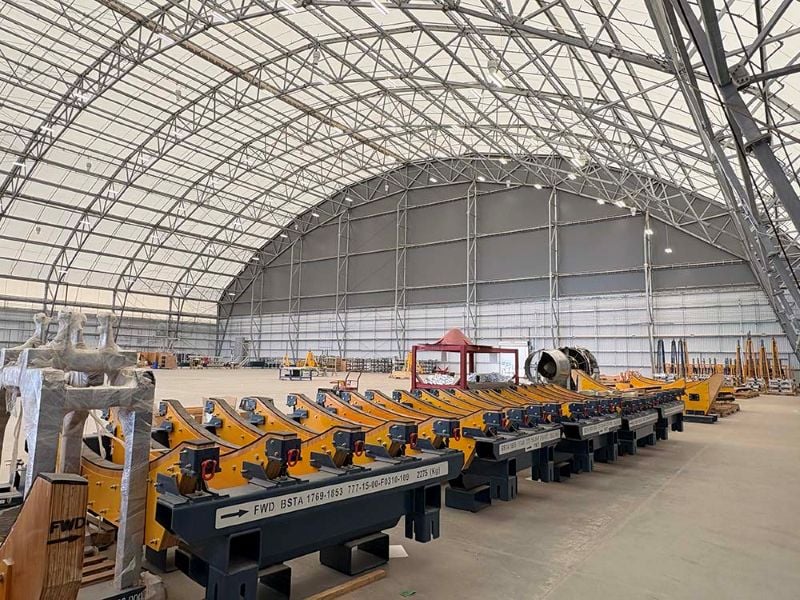
Scott Diaz, SVP of sales and marketing at Ascent, says the company is focused on “balancing our labor resources to please all our customers” as it juggles “the massive surge that we just encountered with Spirit.”
All told, Ascent has received nearly 100 Spirit aircraft, although Querio says “some have already departed” and he expects “a few more stragglers coming on.” Most aircraft are being temporarily stored while aircraft are remarketed to buyers, and Diaz says “a few of them are ahead of the curve already” with letters of intent from airline buyers, so the company is performing work to transition them to the next phase.
Querio notes that at least one Spirit aircraft is being disassembled. The most recent aircraft Ascent acquired from the airline “will probably turn quicker because they were flyers and they’ll continue to be flyers,” he says, but he notes that dozens of the first Spirit aircraft to hit its facility before the airline ceased operations were there due to Pratt & Whitney geared turbofan engine issues, so they could remain in storage for multiple years as they wait for engines to come back.
Tim McGuire, Ascent’s president and COO, says the Spirit surge “has really set Ascent up on the heavy maintenance flight line side for probably the next year. It’s unfortunate for airlines when they go down, but for us, business booms.”
One serendipitous side effect of Spirit’s collapse is a new pipeline for qualified talent as Ascent continues hiring to meet its target of adding 300-400 jobs to support P2F conversions and heavy maintenance growth. Diaz says Ascent is “bringing some of those guys on board,” which will supplement the hiring it has already done ahead of starting the IAI work.
McGuire says the first 777-300ER conversion is expected to take around six-to-seven months. Ascent plans to roll out a second line of 777-300ER conversions next year. “We’ll do two lines consecutively with a staggered start, so we can move specialty skills from one airplane to another at full run rate once we get the learning curve down in a couple of years,” says Querio. “When we hit run rate at aircraft six, we’ll be kicking out six airplanes a year.” All told, the company expects to perform upwards of 60-70 P2F conversions for IAI.
To prepare for the conversions, Ascent launched an eight-week Structures Apprentice Program in January 2024, through which students are paired with structures technicians to gain hands-on experience, both in Marana and at IAI’s facility in Tel Aviv. Each cohort has had between 10-12 students, and McGuire says Ascent has now run around five cohorts.
“Several of those apprentices who graduated [from] our first class are actually leads for us now,” he says. “They progressed really well. They’re learning everything. They’re not just structures [technicians] now—they’ve changed engines and they’re learning the [airframe and powerplant] side as well.”
Ascent has also been working to obtain new certifications to support the P2F conversion program. It obtained ISO 9001 quality management system certification and has applied for AS9100 certification at IAI’s behest. It is also in the process of obtaining certification from the Civil Aviation Administration of China to support conversions of Chinese-registered aircraft.
Querio’s goal is to grow “billable hours of top line revenue” by more than 50% between 2025-28, and he believes the company is on track to achieve this thanks to new customers and ongoing investments.
For instance, Ascent is expanding its landing gear capabilities to reduce outsourcing and turnaround times by setting up a new landing gear shop for Airbus A320 family and Boeing 737 aircraft. It has also continued investing in capabilities for the A330, with the intention of becoming a full A330 service center.
Ascent is also in the process of constructing some additional support buildings, such as back shops and customer offices, to modernize infrastructure from some of its remaining World War II-era buildings. Querio says one should be completed within the next month, and the other two should be finished by year-end.

Related Content