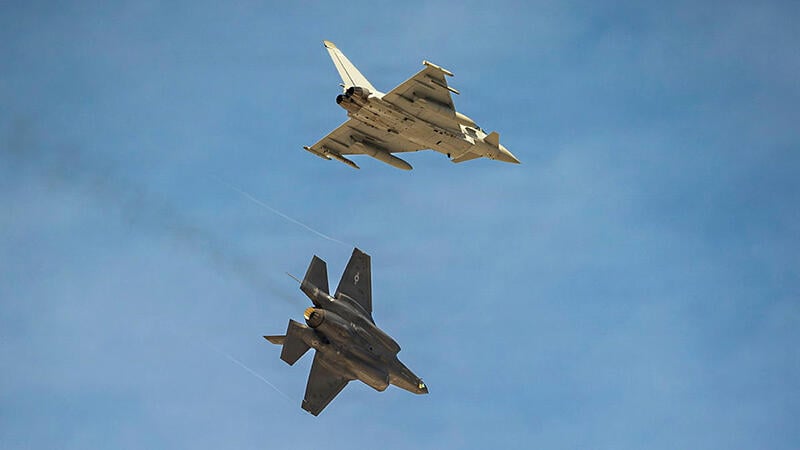
Eurofighter Typhoon (top) and Lockheed Martin F-35 backlogs have grown as global defense spending ramps up.
LONDON—The UK's aerospace sector may be booming, but it is also being throttled by geopolitical uncertainty, rising costs and supply-chain pressures, trade association ADS says.
The sector contributed £46.8 billion to the UK economy, generated £110 billion in turnover and supports almost 470,000 jobs, according to figures released by ADS ahead of the Farnborough Airshow.
But the sector could perform even better were it not burdened by rising costs, constrained access to finance and continuing supply-chain pressures, ADS Chief Executive Kevin Craven said.
The sector has shown "remarkable resilience," Craven told journalists here July 7, but the challenges it faces "limit investment, slow growth and ultimately affect our competitiveness.
“This is a sector in a global marketplace, a world stage, so we need to remain competitive with the rest of the world, and unlock the full potential of our industries,” Craven added.
The industry is approaching a pivotal moment, Craven argues, as Britain seeks to secure work on future commercial aircraft programs, support higher production rates and prepare for increased defense spending under the government's Defense Investment Plan (DIP), published last month.
Yet the business environment remains challenging. Among the biggest concerns is geopolitical uncertainty as companies navigate U.S. tariffs introduced by President Donald Trump and retaliatory measures imposed elsewhere. They also face higher energy prices following the conflict with Iran, while domestically the resignation of Prime Minister Keir Starmer has created further political uncertainty just two years after the last general election.
“That sort of uncertainty in the macro environment has really become quite a big feature for many of our members,” Craven said.
Brexit remains another hurdle, more than a decade after the referendum.
Although industry has adapted, companies continue to face additional costs and administrative friction when trading with Europe, Craven said.
More concerning is the UK’s defense industry’s lack of ability to access the huge funds being made available to European nations to recapitalize their militaries through mechanisms like Security Action for Europe (SAFE) loans, he says.
“Our limited ability to access that [SAFE funding], is not a disaster, but it is definitely an opportunity cost that we would rather didn't exist,” Craven said.
Access to finance has become another major concern for small and medium-sized defense companies. Having previously struggled with environmental, social and governance lending policies, many are now finding banks increasingly reluctant to accept defense-sector risk.
Craven points to the example of Ukrainian companies, of which ADS now represents 25 who have struggled to secure investment because they cannot foresee when they will generate a return on investment with no clear end to the war or indication of when those Ukrainian technologies will become exportable.
Publication of the DIP brought some relief and sent "welcome signals" on drones and other modern capabilities, although Craven said the overall funding settlement still fell well short of expectations. Those funding shortfalls already have led to the resignation of two defense ministers and are beginning to leave the UK lagging behind European peers.
Craven argues that the Treasury continues to regard defense spending as a cost rather than an economic investment capable of generating wider growth.
ADS analysis suggests raising defense spending to the equivalent of 3% of GDP would create around 50,000 additional jobs, rising to 85,000 if spending reached 3.5%.
Around 45% of those jobs would be created in Scotland, the organization estimates.
According to Craven the UK Ministry of Defense’s own analysis also found that there would be a 1.8x multiplier effect for every £1 spent.
However, “none of those arguments seem to have come to any fruition,” Craven said.
Craven says the DIP will probably “fall short” of covering every eventuality, but “industry has to make the best of it.”
The prolonged uncertainty over defense spending forced many British companies to focus on exports instead, a strategy that proved successful.
Defense exports reached £10.8 billion in 2025, contributing to sector turnover of £36.5 billion.
“Against all these odds,” Craven says the aerospace industry is continuing to invest and continuing to innovate and attract foreign investment.

Related Content