This article is published in Aerospace Daily & Defense Report part of Aviation Week Intelligence Network (AWIN), and is complimentary through Aug 24, 2026. For information on becoming an AWIN Member to access more content like this, click here.
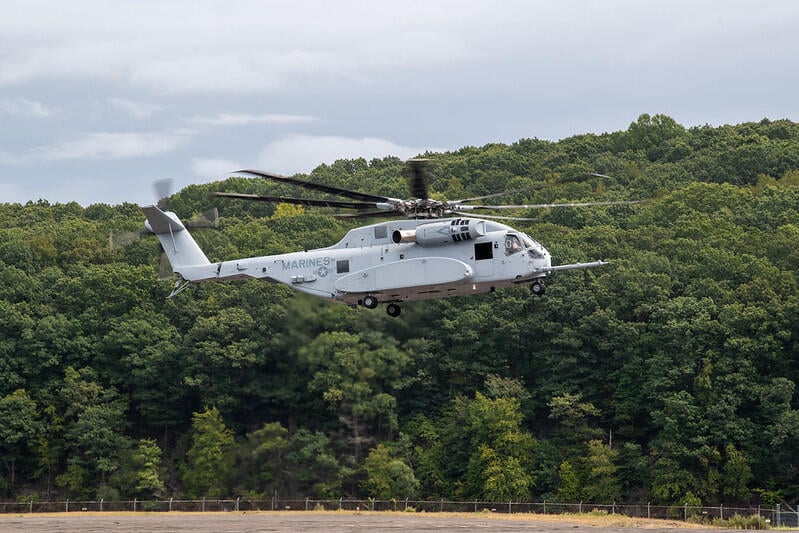
Spirit Defense builds fuselages for Sikorsky’s CH-53K King Stallion heavy-lift helicopter.
FARNBOROUGH—During the 2024 Farnborough Airshow, one of the biggest defense headlines emerged on the third day. Boeing’s reacquisition of Spirit AeroSystems was being finalized. As that process played out, Aviation Week learned that Bell was going to drop Spirit as a supplier for its tiltrotor it is building for the U.S. Army.
The news was not entirely unexpected, as Bell and Boeing still had some scar tissue from the early days of building the V-22. It turned out to be the only major breakup, so far at least, that emerged from Spirit’s defense portfolio.
In a conversation at the 2026 Farnborough Airshow, top leaders of Spirit Defense (the company’s rebrand after the reacquisition) tell Aviation Week the Future Long Range-Assault Aircraft (FLRAA) situation is long out of the rearview mirror, and the company has made it clear to its non-Boeing customers that Spirit operates independently of its parent, is committed to protecting intellectual property and continuing on its path to re-establish itself.
“We have to demonstrate that we are an independent company, because I think that’s going to be the biggest thing over the next year—that ‘We’re Boeing’ is wearing off, and it’s ‘We’re Spirit Defense,’” company CEO Keith Schrader says.
The Bell FLRAA situation was unique, as the program was still in its very early stages, so the breakup was relatively smooth. Spirit has “plenty of work,” so all of the staff on FLRAA shifted to other programs, says Jarrod Bartlett, Spirit’s director of business development and strategy.
Other major, and publicly announced, programs were much further along at the time of Boeing’s acquisition. For example, Spirit is a named supplier on the Northrop Grumman B-21. As a supplier on the program, and a highly secretive one at that, the company cannot talk much about its work. This includes questions on potential production ramp increases that Northrop Grumman leaders and the U.S. Air Force have said are under discussion. However, Schrader says he hopes to talk about progress over the coming year.
Spirit builds the fuselages for Sikorsky’s CH-53K King Stallion heavy-lift helicopter, with production having increased to more than 18 per year.
While under Boeing’s umbrella, Spirit Defense has a consent decree to have some “rules of engagement” in place to protect customers’ intellectual property. “There’s been zero instances of ‘contaminants or leakage,’ and we’re very prideful of that, and all of our customers know we operate like that,” Schrader says.
Going forward, the company expects to see growth and is investing in hiring about 100 more people along with building expansions. Spirit’s primary focus is on next-generation aircraft, including uncrewed aircraft, though company leaders avoid naming specific programs.
Spirit Defense is also looking at increasing its work in the hypersonic missile space. “We don’t have significant work there today, but we believe we have capabilities that align with that marketplace,” Bartlett says. The company is also looking at large structure work for space programs, he says.
With Farnborough 2026 now over, Schrader says he hopes discussions at air shows over the next year will continue to focus less on Boeing’s control of the company. “It’s really that Spirit Defense has solidified its name in the market,” he says. “People are beyond ‘Is it Boeing, is it not?’ We’re our own company.”