This article is published in Aviation Week & Space Technology and is free to read until Oct 19, 2026. If you want to read more articles from this publication, please click the link to subscribe.
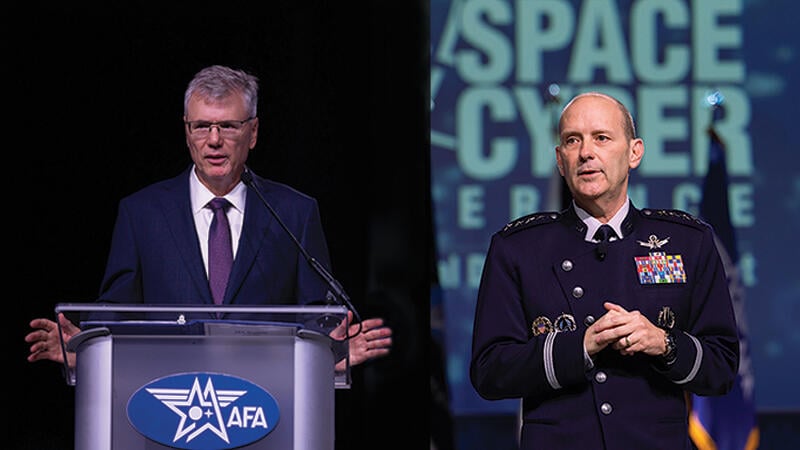
The U.S. Space Force’s top civilian and military leaders, including Air Force Secretary Troy Meink (left) and Chief of Space Operations Gen. Douglass Schiess, were united in acknowledging space-based weapons at a recent trade conference in National Harbor, Maryland.
The U.S. has moved from hinting at its ability to fight in space to acknowledging that it has weapons in orbit, a shift that senior military leaders say is intended to make deterrence more explicit as China and Russia expand their counterspace capabilities.
“Today, we continue to ensure we remain ready to meet the challenges of evolving threats wherever they exist,” Air Force Secretary Troy Meink said in a keynote speech Sept. 14 at the Air & Space Forces Association’s annual Air, Space and Cyber Conference in National Harbor, Maryland. “This is why the United States now has on-orbit space control weapons capable of defending the joint force against hostile adversary action.”
- The Space Force requests a budget boost to support new missions
- China and Russia warn of escalating space arms race
Meink declined to describe the weapons in subsequent sessions, and he would not share any details about deployment timing or testing results. “That phrase was very well thought out,” he said during a fireside chat at the conference.
Gen. Douglas Schiess, who became the Space Force’s third chief of space operations on Sept. 3, reinforced Meink’s message in his own keynote speech Sept. 15, stating: “Today, Guardians operate on-orbit weapons that can defend the joint force against space-enabled attacks.”
The message, Schiess told reporters later at the conference, was intended to signal deterrence to China, which has demonstrated the ability to dock with another satellite and move it to a different orbit, and Russia, which the U.S. has accused of developing “nesting doll” satellites that could conceal some type of orbital weapon.
“It was time within the Department of War,” he said, using the secondary title for the Defense Department. “We’ve talked about it, and it’s time to talk about [the fact] that we have the capabilities to make sure that we can do what the joint force needs us to do.”
Space observers have long surmised that the U.S. has militarized space, and outside experts suggest the disclosed weapons are likely radio jammers rather than kinetic anti-satellite weapons. But the two statements at the Air, Space and Cyber Conference marked an unusually direct acknowledgment from senior U.S. military officials.
The disclosure does not necessarily mean the U.S. has violated the 1967 Outer Space Treaty. Article IV of the treaty prohibits countries from placing nuclear weapons or other weapons of mass destruction in orbit, requires the Moon and other celestial bodies to be used exclusively for peaceful purposes, and bans military bases, weapons testing and military maneuvers there. The treaty does not broadly prohibit conventional weapons from operating in Earth orbit, leaving room for military activities in space that fall outside those specific prohibitions.
In recent years, the U.S. military has increasingly characterized space as a warfighting domain. Gen. Chance Saltzman, the Space Force’s former chief of space operations who retired Aug. 13, described space control as “a new function for our fledgling service” in a 2025 speech. In recent months, the Space Force has published an expanding body of doctrinal papers that envision a more dynamic and competitive orbital environment by 2040.
Meanwhile, Gen. Dan Caine, chairman of the Joint Chiefs of Staff, called on the U.S. military to adapt to fight in global contested environments “from the seabed to cislunar space” in an appearance at the industry conference.
China and Russia—countries that the U.S. considers potential space adversaries—have responded. Guo Jiakun, an official with China’s Foreign Affairs Ministry, called on the U.S. to “stop its military buildup in outer space” in a Sept. 15 statement. A day later, Russian Deputy Foreign Minister Sergei Ryabkov similarly warned of a military space arms race based on Meink’s remarks, calling for a “legally binding instrument” that would prevent the use of force against space objects.
Speaking during a media roundtable at the Air, Space and Cyber Conference, Meink rejected the premise that his words could incite an arms race and stated that “potential adversaries” have been developing space-based weapons for more than a decade. Coorbital counterspace options range from satellite jammers that can disrupt or degrade an adversary’s space activities to physical damage or sabotage using kinetic weapons or robotic appendages. At the extreme end of the spectrum are nuclear detonations or electromagnetic pulses.
A running space threat fact sheet released by the Space Force notes that China has deployed satellites with robotic arms and experimental, maneuvering spacecraft—capabilities that point to a desire to perform counterspace operations. Russia, meanwhile, has launched satellites that demonstrate more dynamic orbital maneuvers and has asserted that “quasi-civilian” commercial satellites used for military purposes “may become a legitimate target for retaliation.”
U.S. Space Command Commander Gen. Stephen Whiting highlighted the need for more space domain awareness (SDA) capabilities in a Sept. 16 speech at the Advanced Maui Optical and Surveillance Technologies Conference in Maui, Hawaii. The number of objects on orbit has doubled in the seven years since his command was reestablished, to about 50,000 now from around 25,000 in 2019, he told reporters after the speech.
Those capabilities are even more important as the Space Force moves deeper into cislunar space, Whiting noted. “We must ensure the SDA architecture is scalable,” he said. “Otherwise, we risk leaving deep space unmonitored and vulnerable to exploitation by our opponents.”
The European Space Policy Institute suggested in a Sept. 16 statement that U.S. officials might hope a more blunt message will spur investment in space capabilities and sustain momentum on major programs such as the Golden Dome missile defense architecture amid a challenging fiscal environment.
Congress passed a continuing resolution on Sept. 1 to keep the U.S. budget at current spending levels through Dec. 11, and lawmakers are already predicting an extension past that date.
The Space Force has considerable momentum at stake if a new budget is not passed soon. The service requested $71.3 billion for fiscal 2027 funding, more than $12 billion of it coming through a second reconciliation bill that Congress appears reluctant to pursue.
If enacted, the Space Force’s new budget would reflect a nearly fourfold increase over 2021 funding levels and the largest percentage increase for a military service since 1952, according to a recent budget report by The Aerospace Corp.’s Center for Space Policy and Strategy. But about 10% of the service’s programs are on hold until Congress moves past its budget impasse, Schiess told reporters.
The proposed growth largely focused on classified programs, which would make up about 30% of the total growth, according to the report. Command-and-control capabilities, moving target indication and missile warning activities would also jump considerably.
Meanwhile, the service hopes to grow its force to an end strength of 25,000 Guardians by 2031—up from about 10,400 in 2026—and up to 12,500 civilians.
“We can’t continue those things without the budget we requested, both baseline and reconciliation,” Meink said.
As the Space Force turns seven this year, its leaders see the disclosure of orbital weapons as a critical step toward increasing public awareness and understanding of the threats that the service was established to combat.
“This is about normalizing the domain, talking about it the same way that we talk about other domains, and giving the tools to our warfighters the same way we give tools to them in the other domains,” Whiting said.