This article is published in Aviation Week & Space Technology and is free to read until Sep 13, 2026. If you want to read more articles from this publication, please click the link to subscribe.
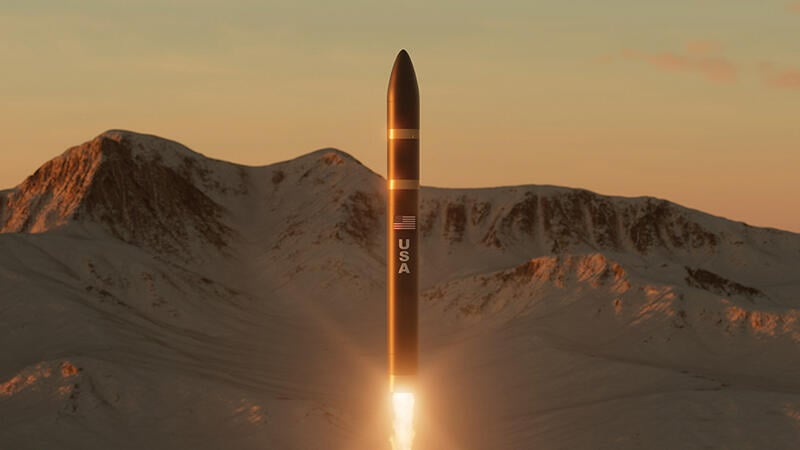
The Missile Defense Agency expects the Next-Generation Interceptor to be operational in 2030.
Lockheed Martin is ready to begin manufacturing the next-generation ground-based interceptor to protect the U.S. from ballistic missiles. Meanwhile, the Pentagon’s longer-term funding plan is coming into view, and a large increase in demand is expected through the Golden Dome program.
The Missile Defense Agency (MDA) says critical design review for the Next-Generation Interceptor (NGI) will come this year, confirming that the design is mature enough to enter full-scale fabrication. The overall NGI program is slated for fielding in 2030—a slight delay from a prior plan but still relatively quick for the Ground-Based Midcourse Defense (GMD) interceptor replacement.
- Lockheed Martin expands the supply chain amid delay
- About $2 billion budgeted for production over five years
“The game-changing step increase in capability that NGI brings to bear will help us to defend both the rogue nation threat as well as the peer adversary ICBM in the future,” U.S. Air Force Lt. Gen. Heath Collins, director of the MDA, said at a U.S. House Armed Services Committee hearing in April. “It is critical to be able to do that.”
The Pentagon’s fiscal 2027 budget request says the MDA will focus next year on delivering hardware and beginning silo modifications for an initial flight test. Procurement is to begin in fiscal 2029; $323 million is expected to start the process, followed by $550 million in fiscal 2030 and $1.17 billion in fiscal 2031. An award of $1.1 billion is expected in November for continuing NGI development, following a $1.3 billion award from November 2025, according to budget justification documents.
Lockheed Martin in late May formally opened its new NGI assembly plant, where it expects to start production in 2027. The 88,000-ft.2 facility builds on the company’s Terminal High-Altitude Area Defense and hypersonic work, using digital design capabilities and modular manufacturing components with the goal of scaling as needed.
“We can rapidly scale the facility up to handle future quantities,” says Johnathon Caldwell, vice president and general manager of strategic and missile defense systems at Lockheed Martin. “We certainly anticipate that there will be a request for an increased production rate, and we’re prepared to do that in a timely manner.”
That rate increase is expected to come with the new Golden Dome for America architecture, beyond the existing plan to replace the 44 GMD interceptors at Fort Greely, Alaska, and Vandenberg SFB, California.
In the April hearing, Space Force Gen. Michael Guetlein, the direct reporting portfolio manager for Golden Dome, told lawmakers that the NGI is the ground layer of defense, to be combined with forthcoming space-based interceptors and new sea-based systems to ensure U.S. defense does not have “any exploitable holes.”
U.S. Northern Command leader Gen. Gregory Guillot added that it is critical to keep the NGI on track because adversaries, such as Russia and China, collaborate in multiple ways to find gaps in U.S. defenses.
“It’s extremely important that we keep NGI on track and, if possible, even pull it to the left,” he said. “The NGI is essential to ensure that we can outpace those groups.”
That schedule had been in question because the MDA had originally expected a rapid development process for the NGI. Collins reported to lawmakers in 2025 that there was an 18-month delay linked to development of the L3Harris-owned Aerojet Rocketdyne solid rocket motor.
Caldwell told reporters that Lockheed Martin has been focusing on collecting multiple suppliers for most components of the system, including solid rocket motors and sensors.
“We need a robust supply chain, and our intention is to make sure that for NGI, we have primary and backup suppliers for many of the systems,” he said. “So we have been investing, and we’ll continue to make investments, across the supply chain to make sure that we can build whatever quantity and rate that the nation asks us to build.”
Amid the delay and design process, Lockheed Martin has been in a “methodical design and development cadence,” testing individual components ahead of the all-up-round test expected this year, Caldwell said.
“We have done a rigorous job of burning down the technical risk of the program,” he explained. “And we’ve had a number of successful test events over the last 18 months, with almost every element of the system showing that we’re on a good path technically.”