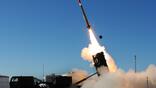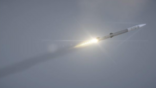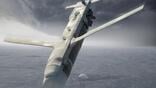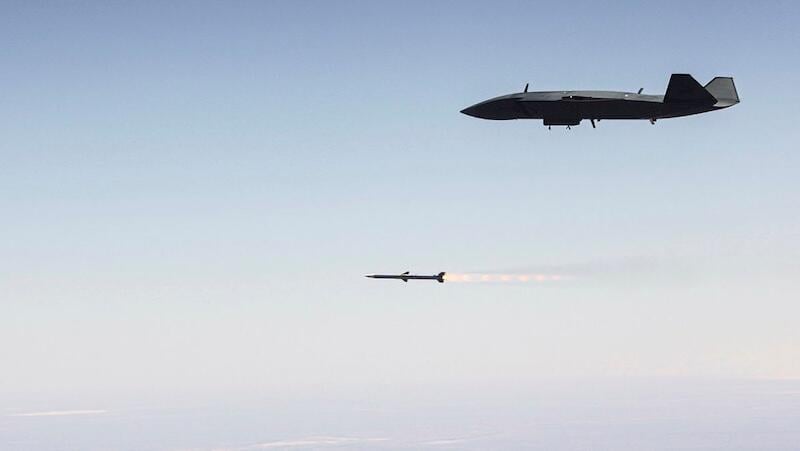
SINGAPORE—Australia is expanding the Boeing MQ-28 Ghost Bat program on the heels of its first air-to-air live-fire test with the collaborative combat aircraft (CCA) launching an AIM-120 Amraam against a drone target.
The Dec. 8 the firing occurred from Royal Australian Air Force Base Woomera in South Australia, with the MQ-28 flying as a loyal wingman to an E-7A Wedgetail and supported by an F/A-18F Super Hornet.
A day after the test, Canberra awarded Boeing Defense Australia an AU$754 million ($500 million) contract for a third tranche of MQ-28s through 2028. The order covers seven additional Blk. 2 and Blk. 3 aircraft. There are currently eight Ghost Bat Blk. 1s and three Blk. 2s in the final production or testing phases.
The Amraam shot took place as part of Trial Kareela 25-4, an exercise being held Nov. 17–Dec. 12, to demonstrate air-to-air weapon use in operationally relevant settings.
For this mission, the MQ-28 carried only an infrared search-and-track sensor and a bespoke electronic warfare system for data transmission. Boeing said an E-7A operator served as the MQ-28’s “mission execution custodian,” maintaining safety and engagement oversight, while the Super Hornet provided sensor coverage and shared targeting data across all three platforms.
Once the order to fire was issued, the MQ-28’s autonomous systems took over, configuring the aircraft and maneuvering to optimize missile performance. The CCA also provided midcourse guidance to the Amraam via its standard data link.
Colin Miller, vice president and general manager of Boeing's Phantom Works, told reporters the MQ-28 received only four high-level commands: take off, enter a combat air patrol, commit and intercept.
MQ-28 Global Program Director Glen Ferguson added that while data sharing and engagement typically occur within seconds, the test sequence was deliberately slowed to ensure safety.
Boeing declined to disclose the engagement range but said it was “operationally representative” of a beyond-visual-range shot.
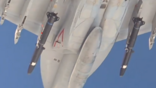
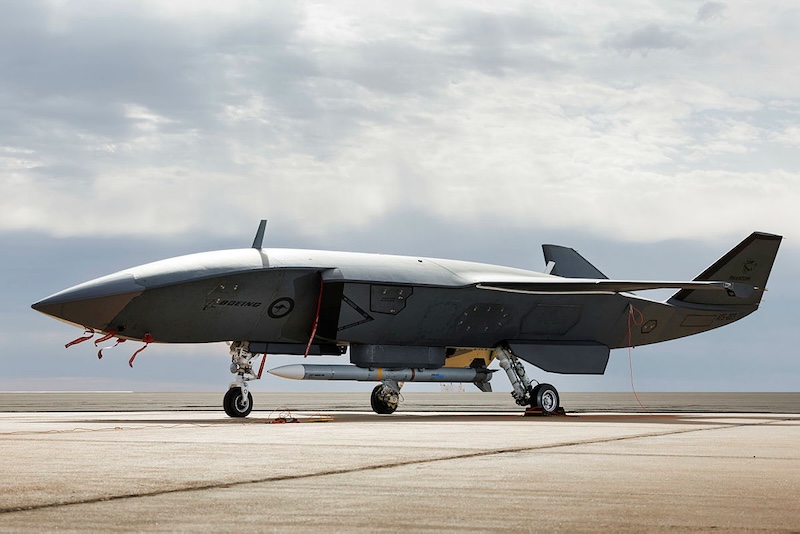
Because the Ghost Bat’s internal weapons bay will not appear until the later Blk. 3 configuration, the missile was carried on a specially designed external pylon mounted on the port side of the belly centerline.
Ferguson noted the MQ-28’s digital open architecture enabled Blk. 1 aircraft to be upgraded rapidly with air-to-air capability. “Much of what you’ve seen is Blk. 2 and Blk. 3 technology pulled left and applied to Blk. 1 to de-risk it,” he said. “When Blk. 2 aircraft enter flight testing early next year, that technology will be directly applicable.”
The milestone follows a similar demonstration by Baykar on Nov. 28. The Turkish company says its Kizilelma CCA fired the Gökdoğan beyond-visual-range missile and struck a target during a test exercise.

Related Content