This article is published in Aviation Week & Space Technology and is free to read until Oct 04, 2026. If you want to read more articles from this publication, please click the link to subscribe.
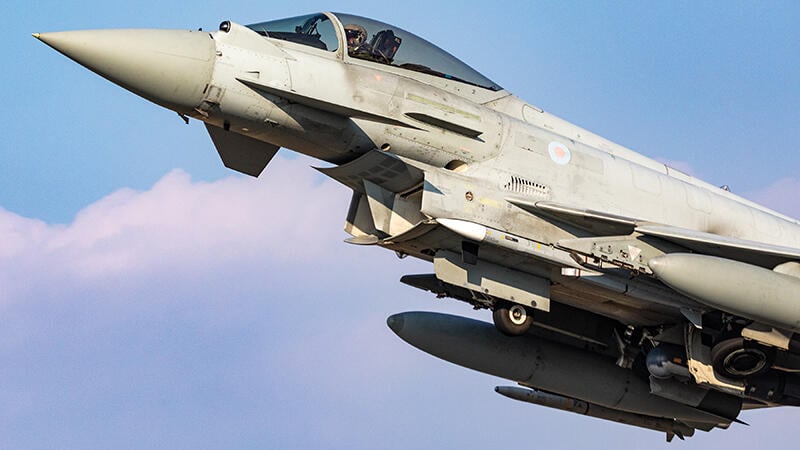
MBDA’s Meteor, pictured on the Eurofighter’s recessed cheek station, appears to have a long life left.
The UK has embarked on development of what could become Europe’s flagship new-generation, beyond-visual-range air-to-air missile, but that does not mean MBDA’s ramjet-powered Meteor has reached the end of the road.
The UK Defense Ministry describes the Future Beyond Visual Range Air-to-Air Missile (F-Bvraam) as the Meteor’s successor and the first product of its Future Air Superiority Effectors program.
- Like the Meteor, the F-Bvraam is set to become a broader European effort
- Missile development prompted by new-generation Chinese air-to-air weapons
- The Meteor is set to arm Gripen fighters donated to Ukraine from Sweden
- New missiles to feature novel propulsion systems and sensors
The initiative aims to develop air-to-air capabilities to counter threats emerging in 2035. Preconcept studies are underway at MBDA’s UK business to determine the technologies required for the weapon.
Industry officials close to the initiative tell Aviation Week that the F-Bvraam will introduce “next-generation propulsion systems” and “new sensor technologies,” with particular emphasis on defeating emerging countermeasures. The missile also is to form part of a network-enabled kill chain that would coordination among multiple weapons in a fashion similar to MBDA’s proposed Orchestrike system, which synchronizes missile attacks. The UK also wants the weapons to cost less so that more could be stockpiled.
Industry leaders suggest the weapon initially will be fielded on a fourth-generation fighter, such as the Eurofighter Typhoon, and then by the aircraft emerging from the Global Combat Air Program (GCAP) and the Royal Air Force’s new Storm Fighter collaborative combat aircraft family that was announced in July.
The F-Bvraam is being influenced heavily by the rapid development of Chinese-made air-to-air missiles, such as the PL-15 and PL-17, which are seen as the “pacing threat.” Weapons emerging from Russia are at least one or two generations behind their European and U.S. counterparts. Chinese-influenced tactics employed by Pakistan against India during last year’s brief conflict, using export-standard missiles, suggest that Beijing probably has retained even more capable systems for itself.
The FASE program is analogous to the UK’s Selective Precision Effects at Range (Spear) program, which produced several air-to-ground weapons, including MBDA’s Brimstone and Storm Shadow as well as the forthcoming Spear 3 mini cruise missile and the in-development Stratus-LO air-launched cruise missile.
Like the Meteor, the F-Bvraam is set to become a multinational European effort. Under the Lancaster House 2.0 pact signed in April, France and the UK agreed a memorandum of understanding for a joint F-Bvraam study and established a road map for its development. That arrangement is expected to be formalized in the coming months, and other nations are likely to join the effort.
The F-Bvraam is unfolding in parallel with the Comet program, an urgent French-only effort to field an even longer-range air-to-air missile that will likely use existing technologies.
Funding originally earmarked for a Meteor midlife update—which has since been halted by the missile’s six partner nations (France, Germany, Italy, Spain, Sweden and the UK)—is going toward development of the F-Bvraam.
That shift has prompted suggestions that the Meteor program could be nearing its end, even though the missile entered service only relatively recently—on the Saab Gripen in mid-2016 and the UK’s Eurofighters at the end of 2018.
Industry officials insist that is not the case and suggest that the Meteor is coming into its prime. The Meteor’s range and capability remain “virtually unmatched” in Western arsenals, they tell Aviation Week, thanks largely to its ramjet propulsion system. The weapon also has undergone continuous evolution.
The missile has evolved through largely unpublicized obsolescence-removal efforts. Unlike some U.S. weapons, there is no B-, C- or D-model Meteor marking successive iterations. Depending on the F-Bvraam’s final architecture, the new weapon could complement the Meteor for years to come.
The Meteor could make its debut soon in Europe’s largest conflict since World War II, as Ukraine is set to begin operating Saab JAS 39 Gripens capable of firing the missile. That could pit the Meteor against the Russian-made threats that it was originally conceived to counter in the 1990s.
The Meteor’s user base is expanding elsewhere, too. Korea Aerospace Industries is adding it to the KF-21 fighter, and Turkey is acquiring the missile for its Typhoons.
Lockheed Martin released images in December showing Meteor missiles fitted inside the F-35’s weapon bay during ground testing in late 2025; initial flights occurred in late 2024. But there are concerns within the European missile industry that Lockheed Martin’s new AIM-260 Joint Advanced Tactical Missile (JATM) could be integrated on the F-35 before the Meteor. That could give the U.S. weapon a first-mover advantage as the fighter’s premier long-range air-to-air missile, potentially damaging Meteor export opportunities.
Australia is set to become the first AIM-260 export customer. In August, the country announced that it would spend $520 million on an unspecified number of missiles. A U.S. arms sales notification published this year covering the proposed JATM sale to Canberra outlined a potential purchase of 450 missiles and associated equipment worth $3.16 billion—equivalent to about $7 million per missile if simply divided across the package. The final agreement suggests Australia might buy only a fraction of the number originally envisaged.
The F-Bvraam may be the Meteor’s designated successor, but the Meteor program appears to be in no hurry to make way for it.