This article is published in Aviation Week & Space Technology and is free to read until Jan 07, 2026. If you want to read more articles from this publication, please click the link to subscribe.
United Arab Emirates Locks On Missile Expansion
The United Arab Emirates has set its sights on establishing local air-to-air missile development and production capacity, underscoring the country’s commitment to broadening its weapon portfolio.
Within the next five years, Edge Group plans to have an air-to-air missile program up and running, said Saif Ali Al Dahbashi, president of missiles and weapons at the state-owned defense technology company. Edge may look for an international partner to underpin the initiative, but in such a scenario, the goal would be to develop a system jointly rather than localize a foreign weapon, he said during the Dubai Airshow.
Beyond an interest in having a greater variety of weapons, the United Arab Emirates (UAE) demonstrated during the biennial gathering its goal to diversify its suppliers. The Tawazun Council for Defense Enablement—the country’s defense materiel agency—announced a 6.14 billion dirham ($1.67 billion) order for weapons made by Calidus, a rival state-owned defense company. The order is for the Al Heda air-to-ground and ground-to-ground modular missile, which comes with different seeker and warhead options and has a range of about 10 km (6.2 mi.).
- Edge and Calidus unveil new weapon projects
- MBDA plans to establish a subsidiary in UAE
Foreign suppliers are looking to parlay the UAE’s ambition into business. South Korea’s Hanwha, for instance, signed an agreement with Edge to explore cooperation in areas such as air and missile defense and long-range strike. Rival LIG Nex1 shook hands with Calidus on the development of next-generation air defense systems and the production of associated missiles in the UAE.
In addition, European missile manufacturer MBDA used the event to announce that it is establishing a wholly owned subsidiary in the UAE to pave the way to in-country production. The move follows MBDA’s establishment of a Missile Engineering Center in Abu Dhabi three years ago.
MBDA engineers in the UAE are working on the SmartGlider and SmartCruiser family of small air-launched standoff weapons and an associated pylon adapter called the Hexalauncher that would allow platforms like the Dassault Rafale—ordered by the UAE—to carry 18 of the weapons at once.
The company also is looking to develop in the UAE its Diamond-Shaped Loitering Munition, first unveiled at the International Defense Exhibition & Conference in Abu Dhabi in February. The troop-portable system is 4 ft. in length, and its wingspan is derived from an uncrewed aircraft system designed by Reunion Island, France-based developer Fly-R. It is planned to be adapted to the loitering munition role with the addition of an MBDA warhead, guidance computer and artificial intelligence to support its operation.
The system, which MBDA markets as highly maneuverable with a speed of 270 kph (170 mph) in a dive to pursue targets on the move, could be ready in two years, says Patrice Hajjar, MBDA vice president for the Middle East and Africa.
The company also said it is working with Tawazun Council to bolster the local missile supply chain. MBDA said it is encouraging ASB Group to open a new business—Emirati Thermal Batteries—to produce the crucial components that provide power to onboard electronics, can withstand highly varied temperatures and can be stored for years.
Edge also signaled it is looking to address critical missile component needs, showing progress on establishing a solid rocket motor production capacity that also could support its space industry. Pilot plans have been established; the lead time for needed tooling is the pacing item to ramp up, Al Dahbashi said.
Edge and Calidus used the gathering to showcase progress on new weapons that address a range of missions, from short-range air defense needs to long-range strike.
Calidus disclosed development of the Al Deraa, a short-range air defense system designed to tackle uncrewed aircraft systems and loitering munitions. The system mixes soft- and hard-kill intercept systems to reduce the engagement cost against inexpensive drones. Calidus officials say the Al Deraa system will put a “protective shield” around critical infrastructure and ground formations against drone swarms, but they declined to provide details on the development timeline.
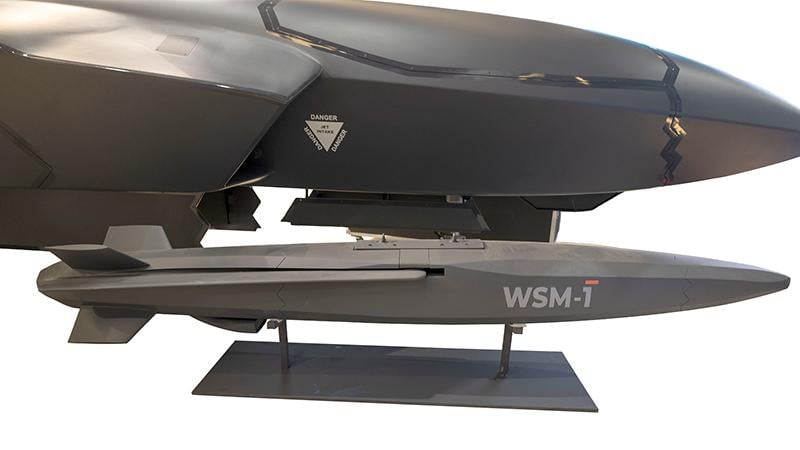
Edge unveiled a family of long-range, stealthy cruise missiles with a loitering capability. The satellite-guided Fast Responder series debuts in three variants sized at 125 kg (275 lb.), 250 kg and 620 kg. Edge also introduced the WSM-1, a Mach 0.7, 290-km-range stealthy-looking missile with foldable wings capable of delivering a 220-kg warhead. The missile is designed for inflight retargeting and has an imaging infrared seeker for terminal guidance.
Edge also took the wraps off of the Dark Wing, a modular air-to-ground weapon, and the Thunder-ER, a folded-wing addition to 113-kg and 227-kg guided bombs. The system should boost range beyond 80 km while retaining 3-m accuracy. Development of all weapons began recently and is being fast-tracked, Al Dahbashi said. Testing of the Dark Wing is near its end after a one-year development phase, the Thunder-ER should be finalized in mid-2026, and the WSM-1 is on an 18-month development timeline.
The company also displayed the 250-km-range Elyah-250GL, a surface-to-surface ballistic missile.
Al Dahbashi said that his organization’s product strategy has evolved in recent years to reflect changes in customer demand from a focus on high-end weapons to having offerings across the cost and capability spectrum.