This article is published in Aviation Week & Space Technology and is free to read until Sep 13, 2026. If you want to read more articles from this publication, please click the link to subscribe.

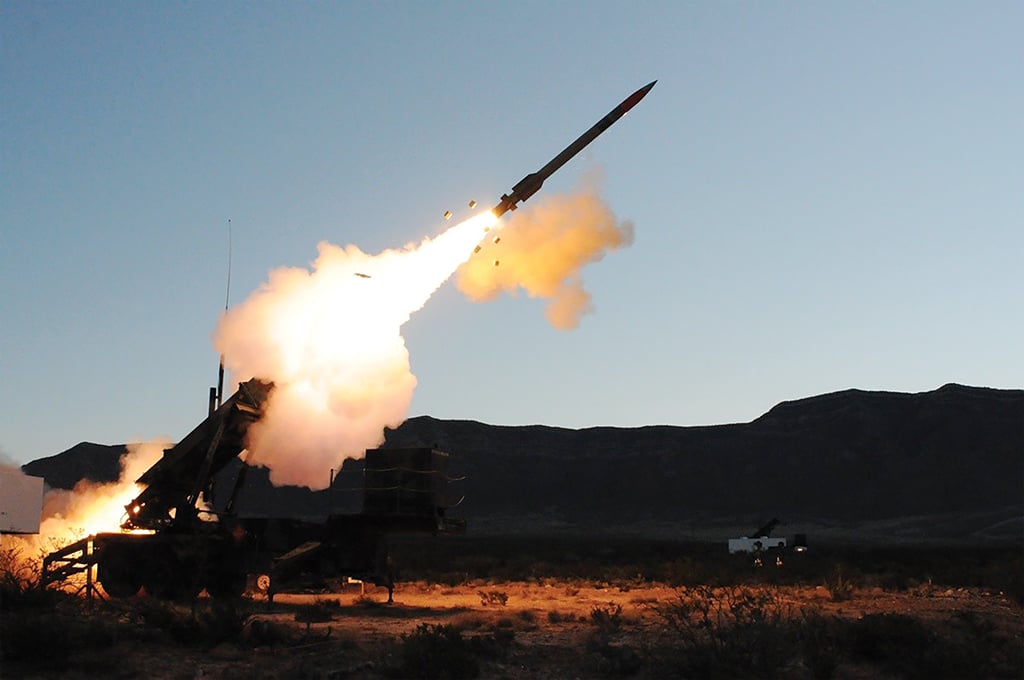
The SM-3 missile, pictured during a 2024 intercept test in Guam, could be augmented with lower-cost defensive systems in the Golden Dome architecture.
More than a year has passed since U.S. President Donald Trump announced a $175 billion plan in May 2025 to build the Golden Dome shield by 2029, saying it would achieve a success rate “very close to 100%” against air and missile threats. Much has changed since then.
The Trump administration’s commitment to fielding the Golden Dome’s sprawling defensive system as quickly as possible remains as strong as ever.
- Pentagon disputes Congressional Budget Office's $1.2 trillion estimate
- Upcoming East Coast experiment promises new affordable track
But Iran’s missile and drone barrages since Feb. 28 have highlighted the difficulty of defending even a relatively well-protected region, such as the Middle East, which covers about three-fourths the area of the U.S. Through mid-July, Iranian drone and missile strikes had killed at least nine U.S. soldiers and more than a hundred civilians in allied and partner countries.
As details about the cost, schedule and scope of the Golden Dome have also evolved, the administration’s strategy to finance the project outside the normal appropriations process is raising questions about its financial viability. Last year, Congress approved the first $25 billion in mandatory reconciliation funds to kick-start Golden Dome development, but the administration’s request for another $17.1 billion through the same process hangs in legislative limbo.
The funding drama is playing out as details of the Pentagon’s secretive architecture continue to dribble into the open. Alongside headline-grabbing concepts of a futuristic, space-based layer of interceptors circling the planet, the Golden Dome architecture has championed the development of a new class of surface-launched, mass-producible interceptors with prices an order of magnitude lower than for current state-of-the-art offerings.
If the requested funding is approved, the Missile Defense Agency (MDA) plans to start demonstrating these low-cost alternatives by the end of next year, starting with boosters, seekers and interceptors against traditional air and missile targets. Another demonstration, Project Maverick, will attempt to show an affordable approach to seeking out, targeting and destroying the more elusive threat posed by hypersonic glide vehicles.
The architecture itself expanded this year when the Pentagon inserted another three programs—namely, airborne moving target indicators and two distinct data networking systems—already funded elsewhere under the Golden Dome banner.
The changes added $10 billion to the military’s projected cost for the comprehensive shield, but the updated official $185 billion estimate still paled in comparison to independent assessments that the price could exceed $1.2 trillion.
As the program expanded, officials also acknowledged that Trump’s three-year timeframe for full deployment in 2028 reflected the schedule for an operational demonstration of a new defensive layer of space-based interceptors (SBI).
The full Golden Dome architecture is not scheduled to be operational until 2035, which still would entail a relatively brisk 10-year sprint from concept to reality for such a sprawling defense program.
The details of that programmatic sprawl continue to be debated intensely. When critics, including the Congressional Budget Office (CBO), complain about the $185 billion estimate, they cite known costs of scaling up the military’s existing air and missile interceptors into a nationwide shield, the projected cost of adding a new layer of SBIs and the expense of the sensing and command-and-control systems needed to support them.
Working with an assumed architecture, the CBO analysis, published in May, estimates the acquisition costs of the system alone to be $1.2 trillion. The CBO’s version of the Golden Dome is divided into four layers—space, upper wide area, lower wide area and regional. It consists of 7,800 space-based interceptors, more than 160 ground-based midcourse interceptors, four Aegis Ashore sites with 172 SM-3 Block IIAs and 35 regional sectors equipped with a mix of Glide Phase Interceptors, SM-3 Block IBs, Terminal High-Altitude Area Defense (THAAD) systems, SM-6 Block IBs and Lockheed Martin Patriot PAC-3 Missile Segment Enhancement missiles.
This multilayer system would offer multiple, overlapping opportunities for defenders to shoot down incoming threats and position several of the world’s most advanced interceptor missiles to strike a wide range of targets in the boost, midcourse and terminal phases. But CBO analysts caution that their trillion-dollar version of the architecture still falls far short of providing an impenetrable shield.
“The system would have the capacity to fully engage an attack mounted by a regional adversary (that is, one with limited capabilities, such as North Korea) or a small-scale attack mounted by a peer or near-peer adversary (one with military capabilities similar to those of the United States, namely Russia or China),” a May 12 CBO analysis states. “However, the system could be overwhelmed by a full-scale attack mounted by a peer or near-peer adversary.”
The missile threat of a full-scale attack by a peer adversary, such as China, looks very different by 2035. In addition to hundreds of nuclear-tipped intercontinental and submarine-launched ballistic missiles, China could have as many as 5,000 land attack cruise missiles, 4,000 hypersonic aeroballistic missiles or glide vehicles and 60 fractional orbital bombardment systems with the range to strike the U.S. homeland, according to a 2025 report by the Defense Intelligence Agency. An architecture that cannot only engage—but also defeat—a large-scale attack with such an arsenal requires a different approach.
The Golden Dome program office, led by U.S. Space Force Gen. Michael Guetlein, counters that the CBO and others have missed the point. Without citing evidence, due to the classification of most elements of the architecture, Guetlein argues that the $185 billion architecture can be achieved because it relies on affordable technologies.
Even the highly touted SBI layer—often described as a foundational element of the future Golden Dome—is not necessarily a guaranteed feature. Instead, the defense industry first must prove that the space-based layer of the architecture can be achieved affordably, representing a fraction of the overall $185 billion projected cost, Guetlein told lawmakers in May.
It is unclear if there is a viable path to a low-cost SBI. Each orbital interceptor is likely to be the size of an SM-3, which costs more than $20 million. To be effective, the Pentagon might need to buy thousands of SBIs to provide coverage over all potential launch points at any one time.
But Guetlein has argued that the Golden Dome architecture can be effective even if SBIs prove unaffordable or infeasible in upcoming demonstrations. The program office has identified alternative pathways to providing a defense against all threats.
The MDA’s fiscal 2027 budget justification documents offer clues about those options. While traditional programs like the Ground-Based Interceptor, Next-Generation Interceptor, PAC-3, SM-3, SM-6 and THAAD likely would have a role in the overall system, the Golden Dome program is experimenting with low-cost, terrestrial-based alternatives.
Specifically, the MDA is leading an effort to demonstrate rapidly a low-cost, $1 million interceptor for hypersonic missiles, aiming to lower the cost of production by 10-20 times the current rate of an SM-6 Block IB or SM-3 Block IIA. The effort includes investments in low-cost divert and attitude control systems, seekers and kill effectors and advanced boosters capable of high-throughput production.
The concept will be put to the test with the MDA’s Project Maverick. A planned flight test in fiscal 2027 on the U.S. East Coast would attempt to track and engage a hypersonic glide vehicle with tracking data provided by a network of elevated sensors.
Fourteen months after a go-ahead decision, the Golden Dome program still faces basic questions about its cost and effectiveness. But the program’s existence has directed an initial $25 billion—or roughly three times the MDA’s annual budget—into homeland defense technologies, resurrecting decades-old concepts for space-based and low-cost terrestrial interceptors that could move into rapid development.

Related Content