This article is published in Aviation Week & Space Technology and is free to read until Sep 13, 2026. If you want to read more articles from this publication, please click the link to subscribe.
Defense Companies Unveil Lower-Cost Ways To Defeat Missiles
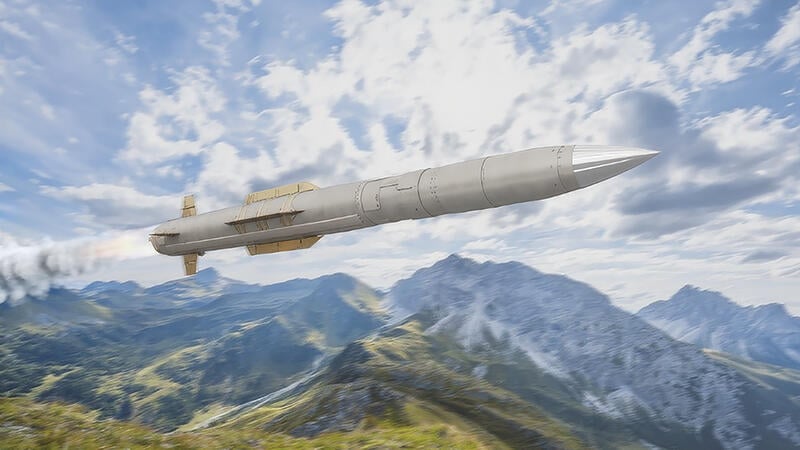
Lockheed Martin says its new Patriot interceptor will cost about half as much as its current model.
Ukraine, the U.S. and other Western militaries have been clamoring for months for more missile defense interceptors at lower costs. Industry is starting to listen.
Established providers and startups are rolling out ideas for ways to shoot down ballistic missiles and other threats at scale without breaking the bank. Lockheed Martin’s vaunted Patriot interceptors are among the low-cost solutions—sort of.
- Destinus unveils antirocket interceptor
- Rafael chairman sees lasers downing ballistic missiles
The Patriot Advanced Capability-3 Missile Segment Enhanced (MSE) has been the gold standard of air defense interceptors, and its high capability is in massive demand, but a single one costs approximately $4 million. At the Farnborough Airshow, Lockheed announced it is developing the PAC-3 Advanced Capability Effector (ACE). Tim Cahill, president of the company’s Missiles and Fire Control business, said its price will be about half that of the MSE.
Lockheed Martin promises to introduce the system quickly. Still, at roughly $2 million per round, the cost remains on the high end for most customers.
Cahill said the company is looking to assemble the missile abroad with a new provider that has demonstrated the capability, such as Saab in Sweden or Diehl in Germany.
Cahill would not specify the performance trade-off associated with reducing the cost. The goal is to use ACEs to “thin the herd” of incoming threats and allow MSEs to go after high-priority incoming missiles, he said. Unlike the hit-to-kill MSE, the ACE is designed to take out threats with a proximity blast fragmentation warhead specifically for air-breathing targets, such as aircraft and cruise missiles, he explained.
“You need an outstanding missile; you don’t need a phenomenal missile,” Cahill said. “We’re going to capture the heritage of MSE but make some design changes to make it a little more efficient in the production, because it’s designed in a different era. It’s designed in 2026.”
The announcement comes as Lockheed’s biggest customers compete to field less expensive systems. The U.S. Army announced an effort in July to build an interceptor that works with its M903 Patriot launch system at a cost of less than $1 million. The Missile Defense Agency similarly rolled out a program in August 2025 seeking an interceptor with a target cost of about $750,000.
RTX-owned Raytheon, which makes the Patriot launcher and the PAC-2 Guidance Enhanced Missile-Tactical interceptor, has been expanding its supply base to focus on price and producibility. Tom Laliberty, president of land and air defense systems, said the company is responding to the Army’s program with a “wide range of interceptor technologies.”
“We’re trying to find that sweet spot between maximizing the threat types that it can defeat against the cost curve,” he said.
Raytheon’s Coyote counterdrone interceptor has become the Army’s primary system to defend against incoming drones; it has made about 600 intercepts during the Pentagon’s ongoing conflict with Iran. The company is continuing development of a reusable high-power-microwave directed-energy version of the Coyote. A recent test showed a 19-for-19 intercept rate.
Lockheed Martin announced at the show a similar drone interceptor called Morfius, which also uses a high-power microwave and recently had successful tests.
The Army’s push for lower-cost interceptors is attracting newcomers. X-Bow Systems used Farnborough as an opportunity to unveil the Buckler interceptor, the first all-up round for a company that typically provides solid rocket motors. The company is aiming for the interceptor, which recently had its first flight test, to cost about $100,000 per round with a focus on Shahed-type drones. X-Bow Chief Operating Officer Mike Bender said the system is designed for ground, sea and air launch.
Ukraine, the country most affected by the dearth of available Patriot interceptors, has embarked on a multi-path effort to deal with the issue. Kyiv has secured U.S. approval for eventual license production of the missile, but that could be years away. France also said it will allow Ukraine to build MBDA Aster 30 air defense missiles under license.
Ukrainian President Volodymyr Zelenskyy has secured support from Denmark, France, Germany, Italy, the Netherlands, Norway, Spain, Sweden, Ukraine and the UK for the Integrated Anti-Ballistic Missile Coalition, too. The partners are to support quick development of a ballistic missile intercept capability in Ukraine’s Freya program.
“By bringing together our defense industrial base, our research and our operational experience, we aim to build a shared antiballistic missile capacity for Europe and support relevant contributory activities,” the participants said in a statement.
During a visit to France, Zelenskyy said an initial system could be ready at scale within a year.
Like Lockheed, other suppliers are suggesting ways to use lower-cost interceptors to defeat lower-end threats, leaving systems such as the Patriot to deal with ballistic missiles.
European missile startup Destinus, best known for providing cruise missiles and drone interceptors to Ukraine, is adding a counter-rocket interceptor to its portfolio. The company plans to have the system, called Vorexon, customer-ready in 2028. Designers are developing the ground-launched rocket to achieve a range exceeding 20 km (12 mi.) and carry an 8-kg (17-lb.) warhead, CEO Mikhail Kokorich said during the system’s unveiling. The roughly 160-mm-dia. (6-in.) rocket is designed to carry a radar seeker for terminal guidance.
Vorexon is intended as a lower-cost way to intercept fast, relatively cheap rocket artillery threats and glide bombs that can be launched in large numbers, Kokorich said. It also should be effective against cruise missiles, if ground radars can detect them and cue the interceptor.
Kokorich said the interceptor’s price should be on par with what it costs to make or produce the threats.
Meanwhile, Rafael is looking to expand interceptor production for its Iron Dome system, given demand. It might set up a manufacturing partnership in Germany, Chairman Yuval Steinitz says.
The company would like to expand its lower-cost intercept option through the Iron Beam laser system that is now operational in Israel. The system is principally designed to go after drones, missiles and rockets, with a shot-per-kill cost of a few dollars.
But Steinitz expects the Iron Beam laser system to be able to evolve to take on higher-end threats. “It’s my estimate that 3-4 years from now, we will be able to have a laser that is also capable of shooting down large ballistic missiles from far away,” he told Aviation Week during the Farnborough Airshow.
Recent breakthroughs in laser defenses are poised to gain pace, Steinitz suggested, insisting that in 10-20 years, the main missile defenses in Israel and other countries in the world will be based on laser technology.


Related Content