This article is published in Aerospace Daily & Defense Report part of Aviation Week Intelligence Network (AWIN), and is complimentary through Nov 26, 2026. For information on becoming an AWIN Member to access more content like this, click here.
Textron Confident In U.S. Navy Trainer Bid With All Competitors Out
As the competition to build the U.S. Navy’s next trainer played out, a series of competitors raised concerns and eventually dropped out based on issues with the service’s requirements.
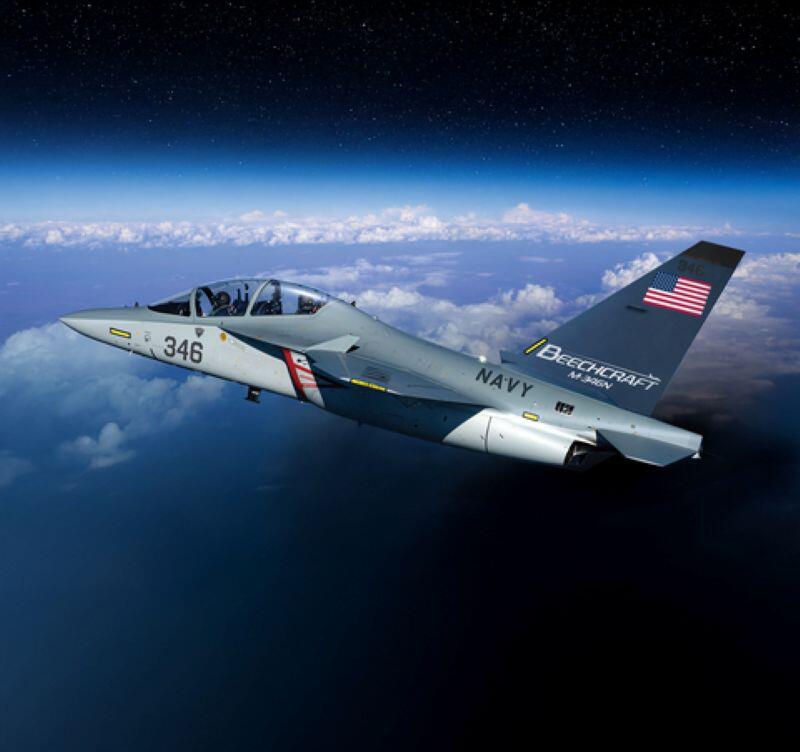
One team, however, stayed steady and was the only major competitor to stick it out to the end, and that team of Textron Defense and Leonardo with its Beechcraft M-346 remains confident during the final stages of the Undergraduate Jet Training System competition.
“The Navy ran a thoughtful and disciplined process,” Travis Tyler, president and CEO of Textron Aviation Defense, tells Aviation Week. “They’ve been engaging industry for an extended period of time on this; they sought feedback from industry through multiple [requests for information] and ultimately, in our opinion, offered a clear solicitation on what they were looking for, which allowed companies to make their own business and technical decisions.
“We chose to compete and submit a fully compliant proposal,” Tyler said.
Throughout this year, Lockheed Martin was the first to drop out of the program. Boeing followed suit in June, citing issues with requirements in the proposal that would have required long-lead development on its T-7A Red Hawk and adding that it instead chose to focus on other development projects. It specifically focused on the Navy’s own F/A-XX competition.
Following Boeing’s announcement, Northrop Grumman announced it too was leaving the team led by SNC for the competition to focus on the then-upcoming F/A-XX downselect. SNC last month announced it was dropping out, specifically citing the Navy’s limited initial funding and fixed-price requirements for low-rate initial production.
This left the Textron team as the last competitor standing, and Tyler says the decisions by other competitors have not shaken its approach. While the other teams raised issues during and after withdrawing, Textron did not see surprises through the process.
“We have a high level of confidence,” Tyler said when asked about the Navy’s funding requirements. “We felt very confident from the outset, and we submitted a fully compliant proposal. Of course, it still has to withstand the Navy’s evaluation and, I’d say, decisions about the structure and the future and how that procurement works belong to the Navy, but we stand by confident to deliver on what they asked for in the proposal.”
The Navy hopes to move quickly to replace its aging BAE-Boeing T-45 Goshawks, which have faced sustainment issues. There are service life extension plans in place to keep them flying as UJTS plays out, but Tyler argues the process needs to continue to meet the service’s needs.
The M-346 is already flying with several services around the world, and Tyler says the companies shaped their proposals with ground-based training and simulations focused on the Navy’s priorities. The Navy made a controversial decision to not require UJTS to either go to a ship for landing practice or conduct field carrier landing practice or touchdown. It was a step to avoid large development bills on potential trainers. Instead, the service opted to focus carrier landing practice on simulation.
SNC with its Freedom trainer design argued it could still conduct the field carrier landing practice, the only competitor to include this.
Textron and Leonardo for its M-346 proposal opted to comply with what the Navy detailed.
“If they don’t need an airplane trainer to go to the boat and hook ... that’s not what they’re asking for, and that’s not where we’re going to push,” Tyler says. “We’re going to deliver to them exactly what they’re asking for, and that’s what that airplane has the capability of doing.”
Textron already builds the T-6 Texan II the Navy uses, along with the T-54A multi-engine training system, and Leonardo builds the TH-73A for Navy helicopter training—experience the company touts for the UJTS program. The company’s Wichita location will serve as the final assembly site for the M-346N, with Honeywell already announcing plans to onshore its production of the F124 engine for the aircraft. Textron, however, has not outlined specific plans for when and where early aircraft production would take place, as Leonardo’s M-346 line is in Italy.
“Training is literally what we do,” Tyler says. “We don’t build fighters here, we don’t build bombers. We build trainers. ... We’ve been very confident, we’ve been very disciplined in this process, and we’ve not made a lot of noise. We’ve just stood by and submitted a compliant proposal.”

Related Content