This article is published in Aerospace Daily & Defense Report part of Aviation Week Intelligence Network (AWIN), and is complimentary through Jun 29, 2026. For information on becoming an AWIN Member to access more content like this, click here.
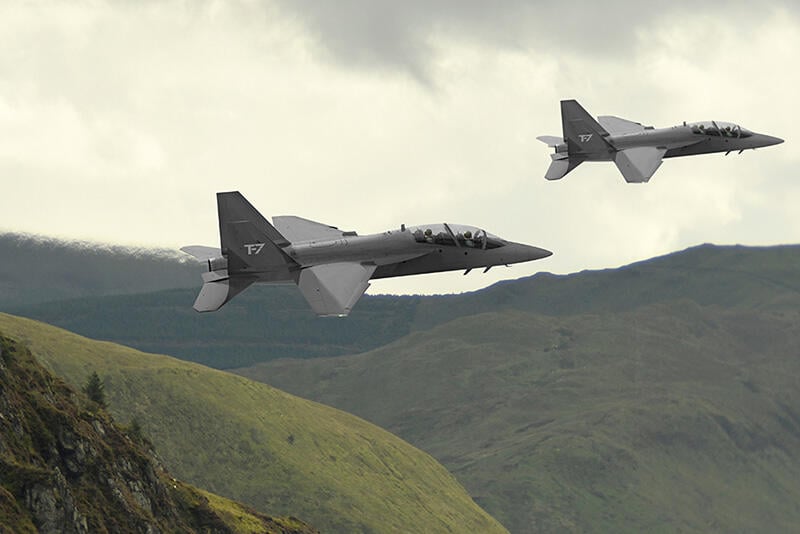
WARTON, England—BAE Systems is committed to performing final assembly and development work on the T-7 Redhawk in the UK if the Boeing-Saab platform is selected as the Royal Air Force’s (RAF) Hawk jet trainer replacement.
Although the UK’s Strategic Defense Review highlighted a Hawk replacement as a priority, the UK Defense Ministry is yet to formally launch a program as it awaits the outcome of the government’s Defense Investment Plan. The plan could call for a single fleet of aircraft to replace the Hawk T2s used for advanced training and the Hawk T1s used by the Red Arrows, the RAF’s aerobatic team.
BAE is currently in a “preparatory phase” for its response to any contest, Chris Hunter, the company’s T-7 campaign director, told journalists during a briefing at its facility in Warton, England, on June 18. At the heart of its proposal, BAE is offering final assembly and check out of the aircraft, some local development work—depending on national requirements—and what Hunter called “clear line of sight” to manufacturing work to feed into the T-7 supply chain.
Hunter said the company had evaluated a range of jet trainers ahead of its decision to opt for the T-7. The company's analysis concluded that the T-7 training system was “most suited for the fourth, fifth and sixth [generation training] continuum.” The platform can be adapted from being a Phase 4 trainer to something more closely integrated with front-line fleets, including potentially as a surrogate platform for more expensive aircraft such as the F-35 Joint Strike Fighter or the aircraft that emerges from the Global Combat Air Program, he said.
BAE’s view is that the RAF would also want to align with the U.S. Air Force on its training systems and its path toward sixth-generation platforms. Hunter said T-7 represented the “best solution” for the UK and said he was confident the selection would bring “real value” when measured against the National Value Framework, a UK government process for assessing the performance of procurement decisions.
Questions have been raised, however, about the suitability of the T-7 for the UK role and its maturity against other competitors, notably Leonardo’s M-346 which has been recently selected by Canada.
Industry observers have argued that the T-7 will be expensive even before additional UK development is added. Notably it lacks a UK ejection seat, instead using the Collins Aerospace ACES 5, and there are questions about the platform’s endurance and whether it would have the fuel to divert in the event of poor weather, which is a more common problem in the UK than in the sunny climes of the the southern U.S.
Hunter said the T-7 represented a “different way” to train and that training syllabi would be adapted for the introduction of new technology and platforms.
Training could be performed inbound and outbound to the training area with air and ground targets inserted into the ingress and egress, he said. The training system he said allowed synthetic aircraft to train against live flying aircraft.
“We would hope the requirements would reflect there's different ways of doing things,” Hunter said.
More details about BAE’s offer are expected to emerge during the Farnborough Airshow.
BAE’s proposal is just one of two expressions of interest in the Hawk replacement from industry so far. Italy’s Leonardo is proposing its M-346 Block 20 and had hoped to cooperate with BAE on their offer. The Korea Aerospace Industries T-50 and Turkish Aerospace Hurjet are also expected to be proposed, but it is unclear whether they will be put forward by the manufacturers or with more local partners.
The RAF wants to accelerate the withdrawal of the Hawk T2, before its out-of-service date of 2040, after a series of technical problems with the aircraft’s engine impacted availability and forced the service to send students overseas. The Strategic Defense Review—published in June 2025—recommended that both marques of Hawk “be replaced with a cost-effective fast jet trainer,” and that training arrangements be “urgently revised to optimize capacity,” and “build in maximum use of contractors and provision for training overseas students.”