This article is published in Aviation Week & Space Technology and is free to read until Sep 27, 2026. If you want to read more articles from this publication, please click the link to subscribe.
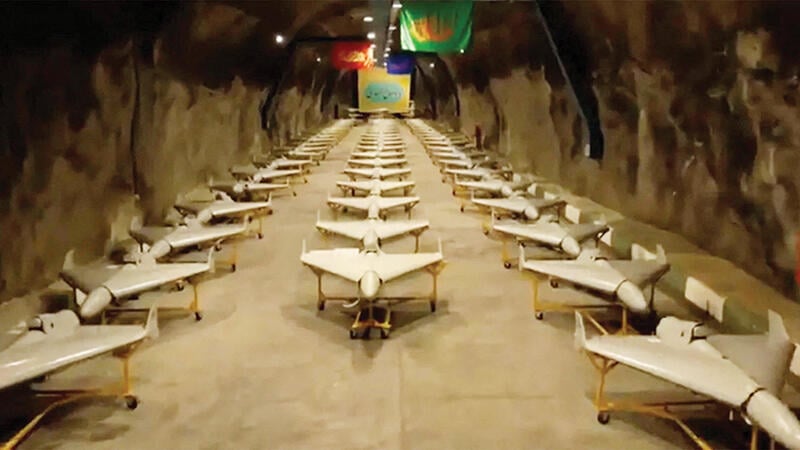
Iran’s one-way attack Shahed drones and other missiles have created a “Hellscape” in the Strait of Hormuz.
During the Vietnam War, between 1965 and 1972, the U.S. military flew 871 combat sorties and lost 11 aircraft to destroy a single bridge vital to North Vietnamese Army supply lines. The Thanh Hoa Bridge, nicknamed the Dragon’s Jaw, was the cause of great frustration and, it was put out of action only with the use of laser- and television-guided bombs—the first generation of precision-guided munitions.
By the 1991 Gulf War, the U.S. had honed smart-munition-based warfare. Laser-guided bombs and terrain-contour-matching cruise missiles, paired with a target list mapped from reconnaissance satellites and other intelligence sources, hit critical systems across Iraq’s air defense, command-and-control and communications networks.
- Tehran’s disruption of the Strait of Hormuz offers lessons for Taipei
- Precision strike is no longer the exclusive domain of the U.S. or other advanced nations
With its brain-nerve-muscle connections snipped, the military of Iraqi President Saddam Hussein collapsed in the face of U.S.-led coalition forces. The dictator’s attempts to split the coalition with Scud ballistic missile strikes on Israel and Saudi Arabia failed. The Soviet-built munition’s crude gyroscopes caused it to miss targets by wide margins.
Roughly 35 years later, however, the precision strike capabilities that were once the exclusive domain of the U.S. and its close allies are accessible not only to rival powers, such as China and Russia, but also small countries defending against more powerful aggressors.
The Iran-Israel-U.S. war offers a case study in the technological shift and potential lessons for other small nations, such as Taiwan, that want to defend themselves against larger aggressors.
If Tehran’s resilience in the face of superior U.S. forces shows anything, it is that commercial products with dual uses can be rapidly retrofitted into precise weapons that can frustrate even the most advanced adversary. GPS receivers, accelerometers, satellite communications and imagery, and chips—ironically, hardware often developed decades ago in Silicon Valley with Defense Department funding—have eroded U.S. technological advantages.
Many of those technologies have been combined in Iran’s Shahed one-way drones to attack and scare off commercial shipping in the Strait of Hormuz, hurting Gulf state economies and raising gas prices for Americans. Fixed and slow-moving targets are more vulnerable than ever.
Tehran has also shown particular sophistication using one-way attack drones and ballistic missiles—some guided with commercial accelerometers and gyroscopes—to target infrastructure critical to U.S. military operations. Precision strikes on radar systems, communication nodes and missile warning architecture is no longer solely for advanced militaries, according to a U.S. Space Command report published this year.
Countries do not necessarily need to launch their own global navigation satellite systems or reconnaissance satellites to orchestrate a precision strike campaign, the report states. “Through commercial partnerships, foreign-enabled capabilities and automated analysis, competitors can pool resources to impose disproportionate operational risk at significantly lower cost and investment,” Space Command says.
Taipei is paying attention. In a March special report to the Legislative Yuan, Taiwan’s Defense Ministry said the U.S.-Iran conflict showed the difficulty of defending against simultaneous missile and drone attacks and called for low-cost interceptors and stronger uncrewed aircraft system defenses.
On the other hand, Iran is demonstrating that low-cost drones and missiles are a nasty counterpunch to an aggressor. “I think we should learn from Iran, because what Iran is doing in the [Strait of] Hormuz is actualizing the Hellscape [strategy],” Cathy Fang, a policy analyst with the Research Institute for Democracy, Society, and Emerging Technology (DSET) in Taiwan, tells Aviation Week.
The Hellscape concept predates the Iran war. The term first surfaced publicly in 2023, when then-U.S. Indo-Pacific Command head Adm. John Aquilino described a concept for hitting an incoming Chinese invasion force with a flood of uncrewed systems, thus turning the Taiwan Strait into a “Hellscape.” The idea reflected years of U.S. experimentation and observations from the Ukrainian battlefield, Aquilino said.
Taiwan has not formally adopted the Hellscape strategy but is increasingly taking on aspects of the concept, including plans to buy tens of thousands of drones alongside more conventional weapons such as anti-ship cruise missiles. The National Chung-Shan Institute of Science and Technology is developing Shahed-like attack drones such as the Mighty Hornet II.
“Iran’s asymmetric blockade tactics in the narrow, shallow chokepoint of the Strait of Hormuz offer a template for exploiting geographical vulnerabilities to paralyze global maritime commerce,” says Republic of China Navy Rear Adm. (ret.) Chauluen Lin, who is an adjunct associate research fellow with Taiwan’s Institute for National Defense and Security Research.
Even if low-cost, one-way attack drones, exemplified by the Shahed, cannot destroy warships, they can tie up a navy that is attempting to protect commercial shipping.
“Escorting just 5-6 slow-moving tankers through a 12-hr. transit requires upward of 10 destroyers, littoral combat ships and continuous air cover,” Lin says. “Furthermore, defending against cheap one-way attack drones and coastal cruise missiles forces escort navies to expend high-cost interceptors against low-cost targets, creating an unsustainable cost-exchange ratio.”
About 33% of China’s imports and 16% of its exports pass through the Taiwan Strait, according to the Center for Strategic and International Studies (CSIS) in Washington. Whether Taiwan would be willing to attack China’s commercial shipping is not known, but if it were pushed into an extreme situation, that could be conceivable, says Melanie Sisson, senior fellow for foreign policy at the Brookings Institution.
“China probably would think so also and would take anticipatory measures to make that [commercial shipping] less available to Taiwan in the event,” Sisson says.
For all the success Iran has had in creating havoc in the Strait of Hormuz, it has been unable to break the U.S. Navy’s distant blockade, which is crippling Iran’s economy. The roughly 81-mi. distance across the narrowest point of the Taiwan Strait is about four times wider than the Strait of Hormuz. People’s Liberation Army Navy ships enforcing a distant blockade would likely be even farther away. To break a blockade, Taiwan would need a mix of long-range weapons, Lin says.
“Taiwan can significantly weaken a Chinese blockade by threatening China’s extensive commercial shipping and energy supply lines using land-based mobile anti-ship missiles, [such as the] Hsiung Feng II/III, uncrewed surface vessels (USV), and anti-ship drone swarms,” he notes.
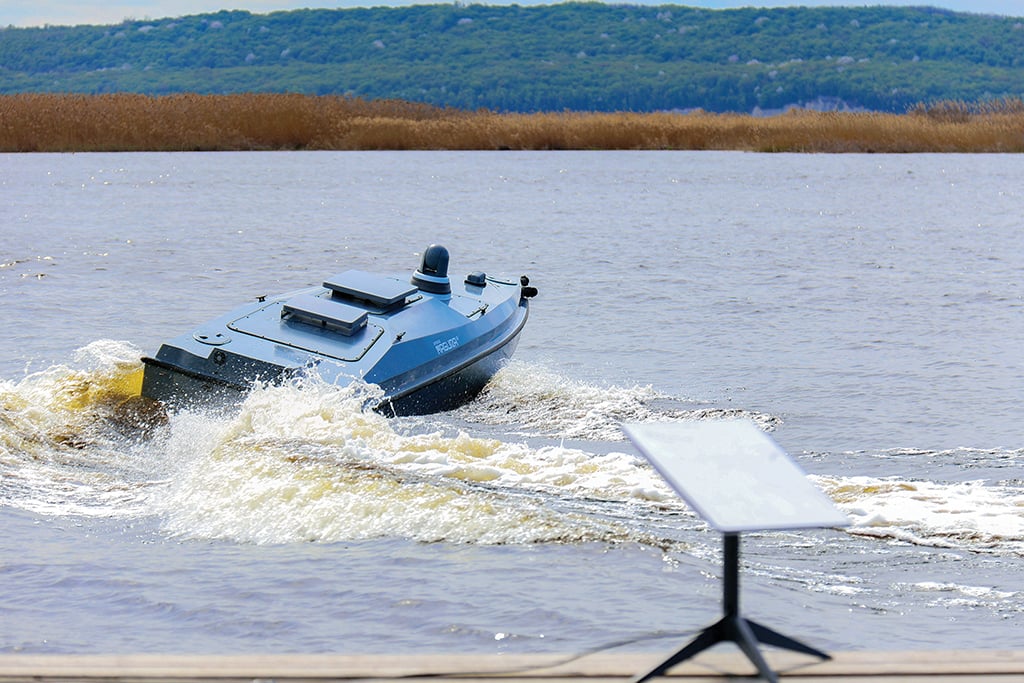
Here, the Russia-Ukraine war might be more instructive. Ukrainian USVs, anti-ship missiles and one-way attack aerial drones have pushed backed the Russian Black Sea Fleet hundreds of miles to Novorossiysk. Kyiv has been able to command USVs over great distances by relying on SpaceX’s Starlink low-Earth-orbit (LEO) communications constellation.
USVs could be useful for Taiwan as one-way attack boats, mine-laying vessels, platforms for anti-aircraft missiles or as launchpads for pallets of small drones, say Fang and Samara Duerr, another policy analyst at DSET.
However, the concept is nascent because Taipei has not approved a budget to buy USVs in large enough numbers, Duerr says. “They’re still trying to get the numbers to test, develop and deploy them and see what use cases would be most feasible in the Taiwan Strait compared to what we see in the Black Sea,” she says.
“Further, despite excitement about how USVs have revolutionized naval warfare, most Russian naval losses have been to long-range precision missiles against stationary ships in port, not surface drones,” Mark Cancian, a senior advisor with the CSIS, wrote in a 2025 report. “USV use in warfare is just beginning.”
And then there is the other problem: “We have no Starlink,” Fang says.
SpaceX has not said it plans to deploy Starlink to Taiwan, although it is activated in the nearby Philippines, Malaysia, Indonesia and Singapore as well as more than 160 markets in total. CEO Elon Musk has extensive business in China through Tesla and has made sympathetic statements that parallel Beijing’s position on Taiwan.
Taiwan also has restrictions on foreign-owned telecommunications companies, and SpaceX has been unwilling to change its corporate structure. However, in July, the country’s legislature authorized case-by-case exemptions, potentially clearing a path for foreign satellite operators such as SpaceX.
Taipei also has agreements for Eutelsat’s OneWeb LEO and SES’ O3b mPOWER medium-Earth-orbit constellations to support emergency government communications, should China cut undersea cables or other telecommunications infrastructure. But Fang says OneWeb’s bandwidth is insufficient and its latency too high.
Ultimately, Taipei can only guess what China will do and how best to prepare and what weapons to buy, which is perhaps the point.
“There’s this huge range of contingencies that the Taiwan government has to try to attend to,” Sisson says. “It’s just literally impossible to attend to them all.”

Related Content