This article is published in Aviation Week & Space Technology and is free to read until Jul 14, 2026. If you want to read more articles from this publication, please click the link to subscribe.

Germany Is Undergoing A Historic Defense Industrial Makeover

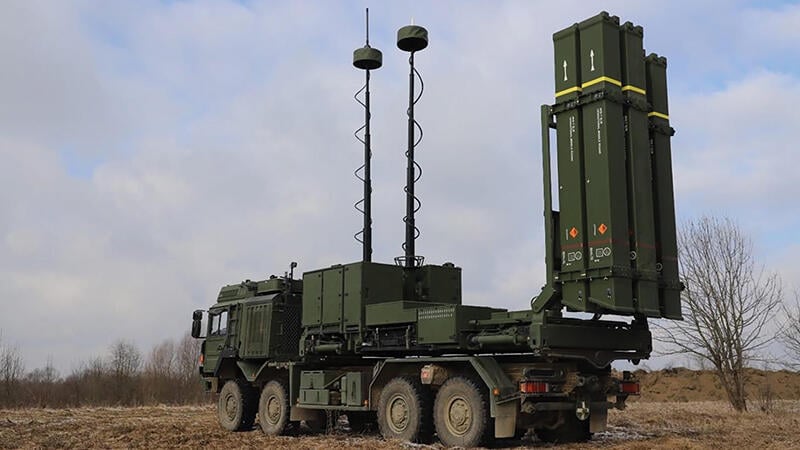
IRIS-T missile defense system

Ukraine has been using ground-launched IRIS-T missiles to down Russian cruise missiles.

Credit: Ukraine Defense Ministry

Germany is racing against time to become war-ready. The starting gun fired four years ago when then-Chancellor Olaf Scholz declared a turning point—a Zeitenwende—in the country’s defense posture after Russia’s full-scale invasion of Ukraine. Now the government and defense industry are trying to turn a somewhat moribund military into one ready to deter and, if necessary, fight Russia by 2029.

That drive has unleashed record defense spending levels and a pledge by ministers to junk old ways of doing business. Germany adopted its first-ever post-unification military strategy in April—a largely secret document, given security concerns—setting out to become Europe’s largest conventional combat force by 2039.

  • Diehl ramps up IRIS-T interceptor production
  • Germany buys loitering munitions through multiple vendors
  • Rheinmetall plans to produce long-range missiles

While the verdict is out on how combat-capable the Bundeswehr will be if Moscow attempts further attacks on neighbors, what is clear is that Germany’s defense industrial landscape is undergoing a fundamental makeover.

Companies that did not exist or barely existed when Russia sent troops toward Kyiv have become suppliers to the German military as well as to Ukraine. Orderbooks are bulging, causing companies to add staff, production facilities and suppliers to scale up.

“We are really on the right path so that in 2029, we are ready,” Diehl Defense CEO Helmut Rauch says. “I’m very optimistic that we will really achieve this, especially in missiles, especially in ammunition.” His company provides the infrared imaging system tail/thrust vector-controlled (IRIS-T) interceptors that Ukraine has used heavily to down Russian cruise missiles.

Although Moscow has released images of IRIS-T air defense equipment being destroyed, Rauch says this is not the case. The vehicles use automation to reload missiles as well as to relocate quickly after firing to make themselves harder to attack. All the Russian images released are of Ukrainian decoys set up to fool the adversary, he says.

Diehl has increased IRIS-T missile production 20-fold and is targeting another 50% jump in output next year, Rauch says. The privately held company is spending about €1.5 billion ($1.7 billion) on capacity expansion, largely around missiles and munitions.

FV-014
Rheinmetall has joined the field of vendors supplying loitering munitions to the German military. Credit: Rheinmetall

Timo Haas, CEO of Rheinmetall’s Digital Systems unit and a reservist, notes that it is not just hardware that matters. “I believe the German forces and the European forces are ready by ’27,” he says, asserting that troops have the needed fighting spirit that also was key to Ukraine’s defense, particularly in 2022. The time until 2029 will serve to build up spares and equip reserve forces properly to be able to sustain a campaign, he adds.

More effort is needed in technical training for personnel because equipment is becoming more sophisticated, Haas notes.

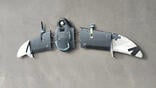
loitering munition
Helsing is one vendor supporting a German Armed Forces effort to field loitering munitions quickly. Credit: Helsing

A sense of urgency is driving lots of change, including in Germany’s historically slow-moving government, industry officials say. “What is relatively obvious is that there is a desire to move faster on all levels, and that also, when we talk about the importance of actually building systems at a timescale of relevance,” says Klaus Herrmann, director of product management at European defense startup Helsing.

Whereas the bureaucracy was once focused on managing money carefully, it is now trying to spend it. “A lot has moved—you can really feel it,” he adds.

For example, loitering munitions are demonstrating the desire to move with greater pace and take more risk. Rather than pursuing lengthy developments, the defense ministry has awarded contracts to relative newcomers Helsing and Stark Aerospace, as well as established player Rheinmetall, to deliver systems that could then evolve. “They actually moved relatively fast for German standards,” Herrmann says.

As Germany looks to learn from the war in Ukraine, it is embracing ideas such as multivendor purchases beyond loitering munitions. The Bundeswehr’s top officer, Army Gen. Carsten Breuer, suggested in April that the same model could be used to acquire deep-strike weapons. Industry officials also expect the government to pursue this procurement model for collaborative combat aircraft to move equipment quickly into the hands of the Luftwaffe.

The shifts in Germany’s industrial landscape have been driven less by Berlin and more by Kyiv, with its sense of urgency and willingness to embrace risk and newcomers. Helsing, established less than a year before Russia’s full-scale invasion of Ukraine in 2022, quickly became a supplier of loitering munitions to Kyiv. Drone equipment maker Donaustahl similarly was founded before the conflict erupted but changed its focus and gained traction in 2023 through Ukraine.

Startups are not the only companies altering Germany’s defense industrial landscape; established players also are adapting. Rheinmetall, largely known as a metal-working provider of armored vehicles, has bet heavily on digitalization and is expanding into the military satellite market. The company teamed with Iceye in 2024 to deliver satellite imagery to Ukraine and the year after that secured a German Defense Ministry contract for synthetic aperture radar (SAR) spacecraft, the first four of which are already in orbit. Through its joint venture with Iceye, Rheinmetall plans to start building spacecraft at a new facility in Neuss, Germany, to support the German SAR Space System for Persistent Operational Tracking Stage 1 program, or SPOCK 1.

The corporate pivot includes branching into shipbuilding, underscoring a sense that militaries are increasingly focused on working across operational domains and tying platforms and sensors together, Haas says.

Rheinmetall has ambitions to work in military satellite communications and is teaming with OHB on signals-intelligence spacecraft. The focus would be on connecting various users and platforms rather than developing hardware, Haas says. A similar approach underpins the company’s push into collaborative combat aircraft, he notes.

Ruta Blk. 3
The Ruta Blk. 3 is designed to have a range of 2,000 km and carry a 250-kg warhead. Credit: Destinus rendering

Rheinmetall also is moving into the business of precision-guided missiles, exploring partnerships with Lockheed Martin and Raytheon. And the company is setting up a joint venture with Dutch startup Destinus, which has embarked on developing and producing a range of deep-strike missiles. First deliveries by the joint venture are planned this year. Destinus is building the 300-km-range (186-mi.) Ruta Blk. 1 in the Netherlands, has begun flight trials of the roughly 700-km Blk. 2 and plans to start flight-testing the 2,000-km Blk. 3 with a 250-kg-class (551-lb.) warhead next year.

What is the biggest risk to Germany’s newfound commitment to security? Industry officials cite the endurance of political will. Even as Berlin pledges a decade of military increases, taking the defense budget to €161.3 billion in 2029 from €46.9 billion in 2021, some executives wonder how deep the commitment really is. If the war in Ukraine ends, at least one industry official fears that Germany will cut defense spending soon after.

Others note that despite efforts from the country’s defense procurement agency to move more quickly, many of the rules hindering it have not yet changed, hampering progress.

For now, though, companies are in a strong position. Diehl’s defense revenue was around €810 million before 2022. It now stands at €2.5 billion, Rauch says. Hensoldt, which had about €1.5 billion in sales and a backlog of €5.1 billion in 2021, grew those figures to €2.5 billion in revenue and €8.8 billion in backlog in 2025. Rheinmetall’s defense sales totaled €3.8 billion in 2021 and are forecast to exceed €14 billion this year.

The huge backlogs are driving a need to expand production capacity. Rauch notes that the increased demand prompting higher production volumes helps the business case for investment in greater manufacturing automation.

However, it also means competition for staff in an industry that has often struggled to attract labor. That, too, has become much easier with the war in Ukraine, industry officials note. Whereas working in the military industrial complex was broadly frowned upon in post-World War II Germany, the potential threat from Russia has changed the narrative. The country’s wider industrial problems, particularly in its crucially important automotive sector, also have opened a new labor pool.

OHB CEO Marco Fuchs says the satellite-maker is seeing people move midcareer into the industry, helping address its workforce needs.

At Diehl, Rauch says the change in attitude toward defense is helping. “To hire new employees is much easier than before the war in Ukraine, because now the employees are proud of their products, about their work,” he explains. His business added 1,000 staff in the last year, bringing the workforce to 6,000 employees.

Helsing’s Herrmann says he is an example of this shift. “For me, it was just not a thing I would even think about much,” he recalls. “But after Zeitenwende, with the Russian invasion of Ukraine, geopolitics changed. So motivations also change.”

While filling positions has become easier, bringing new personnel into the defense environment requires training, Haas notes. Information technology specialists, for instance, need to learn about practices such as air-gapping equipment to provide military-grade security and the idiosyncrasies of writing software for the military rather than consumer applications, he says.

Another challenge with which the industry is grappling is supply chain strains. Many of these defense companies are drawing on the same pool of lower-tier suppliers that lack the financial resources to ramp up quickly.

Price inflation has crept in, Rauch adds. To some extent, that is offset by companies buying items in greater quantities, generating volume discounts. Diehl Defense is playing another card: using sister companies to help with ramping up. Parent Diehl has metals and controls divisions that have not previously worked on defense. They now help make artillery shells and deliver defense electronics.

Helsing is turning to nontraditional suppliers, including in the automotive industry, that can deliver precision parts at lower cost than aerospace vendors, Herrmann says. “It’s a significant price difference.”

Even though volumes in the defense business still pale in comparison to the massive production runs in the auto industry, Herrmann notes that some suppliers are ready to bet on increasing volumes—and to embed themselves with customers showing growth promise.

Robert Wall

Robert Wall is Executive Editor for Defense and Space. Based in London, he directs a team of military and space journalists across the U.S., Europe and Asia-Pacific.